LM386 Questions

Thread Starter

Lerior

Joined Jan 18, 2018
28
Hello again,

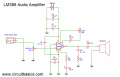
I'm trying to build a simple audio amplifier using LM386. I'm trying to understand few things so I came up with few questions. Referring to the circuit diagram below:

1- Why do we use 10Ω and 10kΩ? Why these values in particular?

2- What determines the value of the capacitors? For instance, why 0.1µF and 10µF? Is there a way to know how to select these values (equations?)

3- Would using 3Ω speaker work with the same values?

Also, would adding a preamplifier (Like a single stage BJT transistor amplifier) work to enhance the sound quality by increasing the voltage gain? (More than 200?).

I apologize if these questions seem very obvious, I'm new to electronics and want to learn the theory behind LM386 amplifier.

Thank you.

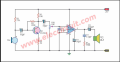
Edit: I attached another circuit with a BJT amplifier.
 

Attachments

Arjune

Joined Jan 6, 2018
354
10 ohms passes much more current than 10,000 ohms with the same voltage across them. Lower frequency voltages can go through 10uf than .1 microfarads. Check the formula for capacitive reactance (Xc). I don't think one transistor can have a gain as high as 200. Also, I'm not good with math because some type of extraneous disability is affecting my brain.
 

Arjune

Joined Jan 6, 2018
354
A 3 ohm speaker should be okay but that may load the lm386 too much compared to an 8 ohm one. A 10 uf capacitor across R4 (1k) should increase the gain of the transistor
 

Thread Starter

Lerior

Joined Jan 18, 2018
28
You have to be careful with a pre-amplifier. The result will be motor-boating and nothing else.
That seems to be the case, I built the circuit with both BJT amplifier and Lm386 and it was too noisy. I'm sticking with LM386 alone.
 

ebp

Joined Feb 8, 2018
2,332
I'm not clear what resistors and capacitors you mean.

By adding capacitance from pin 7 to ground some of the voltage variation that may be present on the power supply is filtered. This variation might be due to noise on the supply or might be due to loading of the supply by current going to the output. The latter can make an unwanted feedback path and is not unusual with battery operation, especially if the battery is nearing end of capacity. The filtering of pin 7 reduces the effect of these variations on the "sensitive" input stage of the amplifier. Typically you would use enough capacitance to be make the filter effective down to reasonably low in the audio frequency spectrum. Figure 2 of the datasheet shows "power supply rejection" of about 20 dB (a factor of 100) at 10 Hz, which is pretty good. Power supply rejection is a measure of how well power supply variations are kept out of the signal path. Ideally it should be very high for the entire frequency range of interest. The 10k resistor in series with the cap in the first schematic makes the capacitor almost completely useless.

Any load that is not purely resistive on the output of any amplifier will potentially cause the amplifier to behave poorly, in a manner that ranges from variation in gain at different frequencies to instability where oscillation occurs. A speaker has a good deal of inductive characteristic that changes with frequency. The 0.1 µF capacitor in series with the 10 ohm resistor helps to make the load that the amplifier output "sees" a bit more like a pure resistance over a wider range of frequencies. As frequency rises, the impedance of the capacitor falls. To keep the cap from looking like a full short circuit at high frequency the resistor is added. The combination used is a compromise that usually does a good job with the type of speaker that is likely to be used with that sort of amplifier. The "best" combination might be somewhat different.

The preamp circuit certainly isn't a low-noise design. It could be improved by putting a resistor of perhaps 500 ohms between the battery and the top end of R1 and R3 (i.e. instead of directly to the battery) and adding a 10 µF or larger capacitor from the R1-R3 end to ground. This serves the same purpose as the capacitor connected to pin 7 of the IC. That preamp is clearly intended for an electret microphone that requires power. Adding capacitors from 9V to ground, like C4 and C5 can help prevent problems when using battery power.

If you set the gain of the IC amp high enough, you won't need a preamp for some signals, but you will for others. If you want to use a microphone you will likely need the preamp. If you want to try an electret mic without the preamp, you would use R1 and C1, but C1 would go directly to the LM386 input. Using a volume control at the amp input with a mic but without a preamp isn't likely to be satisfactory.

TI datasheet for LM386
http://www.ti.com/lit/ds/symlink/lm386.pdf
The LM386 was designed several decades ago at National Semiconductor, which was acquired by TI.
 

Arjune

Joined Jan 6, 2018
354
That seems to be the case, I built the circuit with both BJT amplifier and Lm386 and it was too noisy. I'm sticking with LM386 alone.
I think that the hiss you may hear at high volumes may be the evidence of the spirit of the Earth. Hiss like from a cassette tape or 8 track tape player.
 
Top