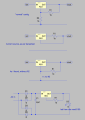
Since words don't cut it, here's a visual that should remove any possible doubts.
Before someone goes wild about the simulation, don't bother. I know this won't work as is, I just wanted to use it to draw up schematics and drive the point home once and for all.
The 1st piece is the "normal" config as per datasheet. R1 & R2 divider, as we've been discussing.
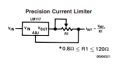
Second one is how they say to make a current source.
Third is this config in question, without R2, as I've been describing. Nothing fancy, just the "normal" minus the R2.
And the last one shows how it's being used. A 12V or so, AC is put in, rectified by a bridge of 4004s, filtered, as I mentioned, by that small 2u2 cap, before going into the 317L, and only R1 is there, but not as the current source described in the datasheet, as the output isn't taken on the "inner" side of R1 from the Adj pin, but indeed directly from the output pin.
So this can't be a proper current source.
This is why I'm puzzled. It's not following any of the recommended configs, and I don't see how this can work.
I surely will be testing those 317/337 models shortly. I just used them for now just to put together those quick schematics.
I'll be testing that dual 317/337 supply with tracking shortly, since I have models now. I hope they work well enough...
Yes it is. And it's not how it's used. As I mentioned, it's the "normal" minus R2, with R1 still in its normal position with the output still coming as normal, not moved to the adj pin to make the current source.
As I mentioned many times, starting at post #1, that R1 is 1k, just like I showed again on those last schematics.
It's not just from some obscure schematic. This is in a real circuit, a commercially sold product, from Bryston.
I still don't get how this works. I suspect it might just be something of the nature as mentioned in post #14 ;-) Something is afoot!
But if it does have some actual "raison d'être", I'm really curious to figure out what this circuit is all about.
In that application, it takes AC ~12V as some remote controlling voltage, to trigger a power up, which is actuated by that optocoupler with its led lit by whatever comes out from that 317L...
Intriguing and puzzling... I'm thinking that thing might just work the same if that 317 was just a simple resistor.
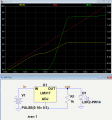
Here's my simulation of the circuit.
All the LM317 does is initially drop some voltage and then limit the current at its inherent internal limit of around 1.6A.
So its sole purpose is apparently to limit the LED current to the internal limit of the LM317.
The difference between using that and a resistor is the LM317 limit, and thus the LED current, is fairly insensitive to the input voltage once the limit is reached.
That's right, the 317L would limit the current lower, but still quite high for leds.
Seems the leds would be pushed too hard, even though a 317L is used. Assuming let's say that the 317L would limit at some ~200mA, it's 10 times the max that leds are supposed to handle. Let alone 300mA.
So there has to be something more to it. I don't think Bryston would leave something like this in their design where optocouplers could blow at any time...
no compatibility / accordance with the actual chip guaranteed , it's an experimental "Component level model" (use / trust the simulation results at your own risk) you can create the .asy for this file from MENU > Hierarchy > Open this Sheet's Symbol . . . "Create new" = Yes . . .
I have to conclude that the way that LM317LZ was shown to be used in that schematic must've been wrong.
It just doesn't make any sense and that IC isn't made to be used that way, not predictably at least.
I think what may have happened is that whoever made the schematic made a booboo and put the resistor wrong, because it should've been inserted at the output pin 2 and the output from the circuit taken after that resistor, with the return going to the adj pin 1, as described in the datasheet for the current source limiter usage.
Now if this was accidental or intentional is an other story...
But assuming their schematic is wrong, and correcting it with R1 in the proper position, at 1k, that would but the current limit at a bit more than 1.25mA, if we taken the adj current at some 100uA, then possibly ~1.35mA.
This would be reliable and fully functional, with the optocoupler datasheet stating "Current Transfer Ratio Guaranteed to be > 50% at 1 mA LED Drive Level", then the phototransistor should conduct over 500uA, more than enough to drive a micro-controller input.
I think there should be no more doubt after post #23. The current is controlled by the value of the resistor,not whether the low power version or the larger version is used. Check the formula.
Not sure what that means.
The majority of the output current is still generated by the OUT terminal.
Iadj is just the small bias current (100μA max) of the LM317.
The LM317 maintains 1.25V across R1 to generate the constant current.
@crutschow , The load of the LM317 current source is connected at the Adj pin.
As you say, the OUT delivers the current and is regulated by the Adj pin, measuring the voltage accross R1.
That's true, but if the load takes its output straight from the 317's output, the current drawn isn't going through the R1 resistor, so there can't be any good sensing of that current.
That's why it makes no sense to have it done that way and so that's why I have to conclude that it's wrong on that schematic. It can't work properly if the output current is taken straight from the output pin instead of on the adj pin side of R1, since the output current isn't passing through R1 to be sensed by the adj pin.
Hehe, that's what I just said
So there can be no doubt that commercial schematic has to be wrong. And it's not entirely impossible that it was made wrong intentionally, to mess with people's minds...
That's why it makes no sense to have it done that way and so that's why I have to conclude that it's wrong on that schematic. It can't work properly if the output current is taken straight from the output pin instead of on the adj pin side of R1, since the output current isn't passing through R1 to be sensed by the adj pin.
The schematic is the datasheet is correct. The current from the adjust terminal was designed to not vary significantly when the load on the regulator changes. That's why the datasheet mentions a minimum load current of 10mA. That makes the 100uA maximum current from Iadj insignificant.
Nothing is "sensed" by the Adj pin. The regulator attempts to maintain 1.25V between the output and adjust terminals. In the original schematic you posted, the current through R1 plus the adjust current will flow through R2. That's what sets the output voltage.

 Facebook
 Google
 GitHub
 Linkedin