LM317L without R2

Thread Starter

spookydd

Joined Aug 12, 2013
45
Hi all,
I'd like to know how a simple circuit using the LM317L without having an R2 resistor, only the R1 (1k) in its "normal" position, is supposed to behave.
Having the R1 in the normal position, meaning, not in the output line to make it a constant current source, and without the R2 there, would make the voltage across R1 to stay fixed at the 1.25V reference, I assume. But that won't regulate the output voltage, nor will it regulate the current either, as the output current isn't passing through that R1.
So how does this work then?
thx
 

jpanhalt

Joined Jan 18, 2008
11,087
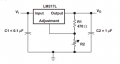
Your description is vague. What is "normal?" R1 and R2 make a divider. R2 is connected to ground, usually. I am assuming you are connecting R1 to the adjust terminal and that is connected to ground (as shown). If R1 is connected to gruond and the adjustment terminal is left open, there is no regulation. That is, output follows input minus approximately 1 volt.

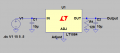
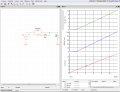
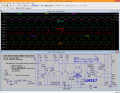
Here is how is simulates with R1=128 ohm and no other load using the similar LT1084:
upload_2019-9-4_6-23-5.png

Input voltage is being sweeped from 15V to 5V.

Circuit:
upload_2019-9-4_6-35-16.png
 

danadak

Joined Mar 10, 2018
4,057
upload_2019-9-4_6-47-43.png

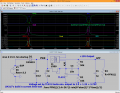
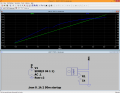
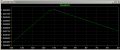
No R2 the regulator does this -

upload_2019-9-4_6-59-41.png

It just acts as a saturated element. Shown sweeping input 0 to 12.
The hiccup at start is due to min load (10 mA) requirement for the
regulator to function.


Regards, Dana.
 

ci139

Joined Jul 11, 2016
1,989
the R1 in the normal position, meaning, not in the output line
LM317-TEST-2-detailed.png there seems to be not so constant 1.47V from I to O voltage drop basically no current (?5pA) through the reg.-pin . . . other words it pretty much acts as a diode ? . . . LM317-TEST-2-diode.png . . . with it's current and voltage swapped . . . . . . another question is - will it survive that ?
 
Last edited:

Thread Starter

spookydd

Joined Aug 12, 2013
45
Your description is vague. What is "normal?" R1 and R2 make a divider. R2 is connected to ground, usually.
"Normal" is how the datasheets says to do it, with the R1/R2 divider. Simple.

I am assuming you are connecting R1 to the adjust terminal and that is connected to ground (as shown). If R1 is connected to gruond and the adjustment terminal is left open, there is no regulation. That is, output follows input minus approximately 1 volt.
No. I said "without R2", not a short instead of it. Just remove R2 and don't connect anything else any other way than the "normal" way.

Here is how is simulates with R1=128 ohm and no other load using the similar LT1084:
Input voltage is being sweeped from 15V to 5V.
That's not the configuration I mentioned. The adjust pin doesn't go to ground, only to R1 as "normal", and R2 is REMOVED, not shorted.

Of course, ignore the caps or whatever...
 

Thread Starter

spookydd

Joined Aug 12, 2013
45
No R2 the regulator does this -

It just acts as a saturated element. Shown sweeping input 0 to 12.
The hiccup at start is due to min load (10 mA) requirement for the
regulator to function.
I don't have a proper model for that chip, so I couldn't try that out.

But that's exactly what I was referring to, without R2.

So then it doesn't behave as a regulator at all, not even a current regulator. I'm wondering what's the point of using it that way then. I'm not just making something up to see what happens, I saw this in a real circuit, commercially used in a product, and that's how they used it.

I would like to understand why they did this and how it works.
 

Thread Starter

spookydd

Joined Aug 12, 2013
45
there seems to be not so constant 1.47V from I to O voltage drop basically no current (?5pA) through the reg.-pin . . . other words it pretty much acts as a diode ? . . . View attachment 185444 . . . with it's current and voltage swapped . . . . . . another question is - will it survive that ?
No, you apparently replaced R2 with a short, which isn't what I was referring to. When I said "without R2", I meant exactly that, just nuke it, and don't replace it with a short.

The "normal" usage, is with the R1/R2 divider, and without R2 is the same, without R2, not replacing it with a short.

So I assume it would behave differently if done that way.
 

Thread Starter

spookydd

Joined Aug 12, 2013
45
As shown in post #3 is exactly right. Just R2 removed, not replaced by a short.

In that commercially used circuit where I saw that, they put R1 at 1k.

I assume that would put ~1.25V across R1, but what would it do then?
 

ericgibbs

Joined Jan 29, 2010
21,439
hi sp,
Do you have the circuit the output is connected too.
As its L version it will current Limit at 200mA to 300mA, if the load tries call for more than that limit.
E
 

Thread Starter

spookydd

Joined Aug 12, 2013
45
Do you have the circuit the output is connected too.
As its L version it will current Limit at 200mA to 300mA, if the load tries call for more than that limit.
I thought it would be limited to something more like ~100mA...

But for the load, it's quite easy, the only thing on its output is the diode from an optocoupler MOC8100.

A simple LED in such a coupler wouldn't want much more than some 20mA, likely less would suffice, so more than 100mA in any case would be too much for it.

But what if, 12Vrms was rectified (4 x 4004) and a small 2u2 smoothing cap is used before that LM317L, and nothing else besides that 1k R1 and the optocoupler diode as the sole load?

Once the 12Vrms is rectified and somewhat filtered, there would be some 17V to feed that 317L, and how much of that would be left to the diode load, with how much current going through it?

I'm just not understanding how this use of the 317 is done. What does it really do? What's the influence of the R1 at 1k? What is the aim when calculating that R1?

Weird way to use the 317...
 

dl324

Joined Mar 30, 2015
18,326
But they don't list anything with such a config without any R2 at all.
It's implied. The regulator develops a nominal 1.25V between the adjust and output terminals. If you connect adjust to ground, that would make the output voltage 1.25V and R1 should be sized to provide a current of at least 10mA. That requirement is also in the datasheet.
 

Thread Starter

spookydd

Joined Aug 12, 2013
45
Well, in this case there is no connection to ground, so that 1.25V doesn't apply as is. I'm just wondering how it behaves this way, what voltage ends up on that diode load, what current is actually going through.

I doubt it would let it rip and go all the way to that 300mA max limit. There has to be something else that happens that doesn't let that much current go through, or that product wouldn't last long, with optocouplers dying all the time..

I'd like to get a good working spice model for that 317, and the 337 as well. I recently designed something that uses both and I couldn't simulate that part of the circuit. I made the supply a tracking one, with an additional opamp (a simple 741), to make the 337 track the 317's output voltage, to match, and I'd love to simulate this and see how it actually works. And if the model is good enough, maybe the ripple on the output could also say something about performance.
 

dl324

Joined Mar 30, 2015
18,326
Well, in this case there is no connection to ground, so that 1.25V doesn't apply as is. I'm just wondering how it behaves this way, what voltage ends up on that diode load, what current is actually going through.
A schematic would have clarified what you meant.

The datasheet should describe operation as a current source.
 

AnalogKid

Joined Aug 1, 2013
12,128
All of this chatter about R1 and R2 is useless without an image *from the TS* showing which resistor is in which location. The LM317 is produced by at least a dozen manufacturers spread out around the world, and not all of the datasheets are identical.

Please post an image of the circuit you are discussing.

ak
 
Top