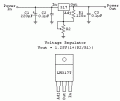
LM317 only outputs 1.0V

SgtWookie

Joined Jul 17, 2007
22,230
so the reference 1.25V is not the same 1.25V that drops from output to adj?
Yes, that is the reference voltage; Vout with respect to ADJ.

But in order to measure Vref, you need to apply >=3v to the Vin terminal, with Iout >=10mA.

If you really want to get technical about it, the National Semiconductor datasheet is in error, as if Iout is 1.5A and the regulator is near -50°C or 150°C, then National's own specifications are not correct, as they do not agree with the dropout chart. In that case, Vin must be >= 1.3v(max Vref)+2.5v(max dropout) = 3.8v.

However, if 10mA<=Iout<=500mA, and 50°C <= regulator temp <=150°C, then 3v<=Vin<=40v would be OK - as long as the power dissipation was handled.
 

Thread Starter

a10t2

Joined Apr 23, 2010
10
Well, I figured out the original problem. I had a frayed wire on the breadboard that was intermittently grounding the V- terminal.

Even with that fixed, though, the output is 10.3 V no matter what value I use for R2. Even 0 or infinite, the output is still 10.3 V.

If you grounded the ADJ terminal, and connected a 120 Ohm resistor between VOUT and GND (thus also the ADJ terminal) you should measure 1.2v to 1.3v inclusive, nominally 1.25v, at the VOUT terminal. Under these conditions, Vout will be equal to Vref.
I tried it with both regulators, and both still measure 10.3 V at Vout.
 

SgtWookie

Joined Jul 17, 2007
22,230
You may have damaged your breadboard by jamming wires that were too large in the sockets, and now some sockets aren't making reliable connections.

This circuit really isn't that complicated. Your ADJ terminal does not have a path to ground, or R1 is not connected between the VOUT and ADJ terminals.
 

Thread Starter

a10t2

Joined Apr 23, 2010
10
This circuit really isn't that complicated. Your ADJ terminal does not have a path to ground, or R1 is not connected between the VOUT and ADJ terminals.
Right, that's what has me banging my head - there just isn't much that could go wrong.

I guess at this point I don't have anything to lose by putting it together on a board and seeing what happens.
 

SgtWookie

Joined Jul 17, 2007
22,230
About the only other thing that might cause the low output is your output cap being installed with the wrong polarity (if it's electrolytic) or being shorted. Check it with your meter to make sure it's not shorted - but make sure it's discharged (short the leads using a 1k Ohm resistor for at least 10 seconds or more) before you check it on the Ohms scale, or you can blow your meter.
 

Thread Starter

a10t2

Joined Apr 23, 2010
10
Turns out the output cap was shorting. The circuit is now behaving as expected. I *know* I checked both caps at least once - oh well, at least it's working.

Thanks, everyone, for the help.
 

SgtWookie

Joined Jul 17, 2007
22,230
If it was an electrolytic cap and you had previously connected it backwards, that would have destroyed the dielectric.

Electrolytic caps that have been sitting around unused for a long time will lose their dielectric properties. The dielectric can often be restored by a process called "re-forming"; where the cap is slowly charged to it's operating voltage via a high impedance source over a period of time.

I'll use a 10k resistor and a variable output DC power supply to re-form old caps. You connect the resistor and cap in series across the supply voltage, and measure the cap leakage current by measuring the voltage across the resistor. With a 10k resistor, 1mA leakage = 1v across the resistor.
 

hgmjr

Joined Jan 28, 2005
9,027
Turns out the output cap was shorting. The circuit is now behaving as expected. I *know* I checked both caps at least once - oh well, at least it's working.

Thanks, everyone, for the help.
It is always the last place you look. Putting an electrolytic cap in backwards is an error that is not that uncommon. I have done it in the past and that is why I recommended checking it out earlier in the thread.

hgmjr
 
Top