lm 2917 question

Thread Starter

Bob123456

Joined Aug 14, 2013
23
I am trying to use an lm 2917 (8 pin) as a basic freq to voltage converter.

http://www.ti.com/lit/ds/symlink/lm2907-n.pdf

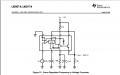
I set up the circuit in the datasheet (page 10 1st diagram), using 12V for Vcc and a 250mV (peak to peak) 600Hz square wave offset so that the minimum amplitude of the wave was at 0V as the frequency input.

This setup worked but when I increased the amplitude of the square wave to 1.5V (with corresponding change in offset) it broke the chip. The datasheet says the input voltage can be a max of +-28V, so I'm a bit confused at why it broke. Is there a way I can get it to work with a larger amplitude wave?
 

ericgibbs

Joined Jan 29, 2010
21,442
hi Bob,
Fig #21 of page #10, should handle a 0v to +1.5V square wave input OK.
If required a simple resistive divider could get the Vinp down to 250mVppk , if required,
When you say 'broke' the IC , whats the problem.?
What is the : (with corresponding change in offset)
E
 

Thread Starter

Bob123456

Joined Aug 14, 2013
23
hi Bob,
Fig #21 of page #10, should handle a 0v to +1.5V square wave input OK.
If required a simple resistive divider could get the Vinp down to 250mVppk , if required,
When you say 'broke' the IC , whats the problem.?
What is the : (with corresponding change in offset)
E
With the offset I just meant that when I increased the amplitude I adjusted the offset so that the minimum amplitude of the wave was still at 0V.

When I readjusted the square wave back to 250mV pk-pk there was no increase in voltage like there was before from the ic so I assumed I broke something (It didn't heat up or anything though).

edit: meant voltage not frequency
 
Last edited:

eetech00

Joined Jun 8, 2013
4,705
With the offset I just meant that when I increased the amplitude I adjusted the offset so that the minimum amplitude of the wave was still at 0V.

When I readjusted the square wave back to 250mV pk-pk there was no increase in frequency like there was before from the ic so I assumed I broke something (It didn't heat up or anything though).
Hi

Can you post a schematic of your circuit?
It sounds like you are expecting a change in the frequency detected by changing input amplitude(?)o_O

eT
 

Thread Starter

Bob123456

Joined Aug 14, 2013
23
hi Bob,
'eetech' could be correct, lets see your circuit.
E
My circuit is figure 21 of the datasheet (zener controlled frequency to voltage converter).
http://www.ti.com/lit/ds/symlink/lm2907-n.pdf
I use the described square wave for fin. I did try using the circuit in figure 19 on my first chip but it heated up massively as soon as I supplied vcc (I'm guessing the lack of a resistor to restrict current from vcc fried it).

Hi

Can you post a schematic of your circuit?
It sounds like you are expecting a change in the frequency detected by changing input amplitude(?)o_O

eT
I was planning on keeping the amplitude constant and just have the input frequency change the output voltage, I tested with a small amplitude frequency signal first and then scaled the amplitude up a bit to see if it would keep working, the output voltage did increase to start with but then as I increased further it dropped back to zero.

upload_2014-10-8_0-48-37.png
 

eetech00

Joined Jun 8, 2013
4,705
I was planning on keeping the amplitude constant and just have the input frequency change the output voltage, I tested with a small amplitude frequency signal first and then scaled the amplitude up a bit to see if it would keep working, the output voltage did increase to start with but then as I increased further it dropped back to zero.
Ok...here is where this statement is confusing. The device is a F to V converter, so why expect the output to change if only changing input amplitude? The output voltage shouldn't change. The output voltage should change only if the input frequency changes. Or maybe I'm just misunderstanding....

Vout = Vcc*Fin*C1*R1*(gain=1.0)

Vout = 12v*600Hz*0.02uf*100k*1.0

For the R1,C1 values shown, and 600 Hz input, the output would be about 14.4 vdc...yikes!

eT
 

Thread Starter

Bob123456

Joined Aug 14, 2013
23
Ok...here is where this statement is confusing. The device is a F to V converter, so why expect the output to change if only changing input amplitude? The output voltage shouldn't change. The output voltage should change only if the input frequency changes. Or maybe I'm just misunderstanding....

Vout = Vcc*Fin*C1*R1*(gain=1.0)

Vout = 12v*600Hz*0.02uf*100k*1.0

For the R1,C1 values shown, and 600 Hz input, the output would be about 14.4 vdc...yikes!

eT
It's all good now, I misread the datasheet formula. thanks
 
Top