Facebook
 Google
 GitHub
 Linkedin

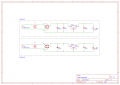
If you're using a transformer which outputs 16 volts RMS when the transformer is under a full 2 ampere load, then its output voltage will be higher than that when it's loaded with only one ampere. Small transformers usually exhibit something like 30% regulation from no-load to full load, so just for the sake of argument let's say that with a 1 ampere load the transformer's output is up 15% from 16 volts, which will put it at about 18.4 volts, RMS, which is about 26 volts peak.Hi, I have build an Linear Power Supply similar like that on the attached picture.
I use and 230:6x2 transformer that is insulated in epoxy.
Line (socket) that is connected is about 235V-245, 50Hz (EU).
Instead the C1 470u of the pic use 2200u, and instead C3 100n block, I use 100u electrolytic.
The load that is connected is an led strip, that makes less than 200mA.
The transformer is rated for 1A output like the LM7812 and the Diode Bridge.
My problem is that the Transformer and the Volt Regulator (LM7812) get very hot (60-80Celsius).
Transformers in normal condition get warm. But mines get very hot.
My question is: Why the transformer and 7812 get very hot even the load is less then 200mA, and transformer and 7812 are rated for 1A.
Thanks in Forward.
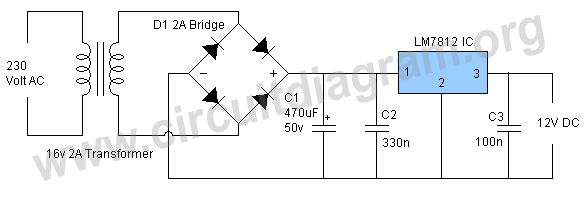
After that you'll get about a 1.6 volt drop across the bridge, so the reservoir cap will charge up to 24.4 volts on each rectified half-cycle and present that voltage to the input of the 7812, and if the 7812 is holding its output steady at 12 volts, there'll be 12.4 volts across the 7812 during those peaks.
If your load current is 1 ampere and the regulator is dropping 12.4 volts, then it'll be dissipating 12.4 watts while its input is at 24 volts.
That won't be true all the time of course, because the rectified input to the cap will vary, but the larger you make the reservoir cap the closer it'll stay to 24 volts while the load is discharging the cap through the regulator and the hotter the regulator will get. It's no picnic for the transformer either, since it has to power the load AND charge the cap on its peaks, so it'll get hot too.
If you have to use a linear supply, you should use a transformer sized to run the load and charge the cap so that the cap's voltage never falls below the regulator's dropout voltage, and get a cap which will hold enough charge from cycle-to-cycle so that its ripple valleys never allow the regulator's input voltage to fall below the regulator's threshold voltage, but get close.
Last edited: