Linear Regulated Power Supply -- Peer review

Thread Starter

JT60451

Joined Feb 3, 2025
24
Hi -- adapting a known design for a +/- 15VDC regulated power supply. To be used in an audio preamp so no ripple or noise is critical. I came up with this, based on commonly-seen schematics:
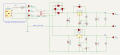
1743700296252.png

Wondering if...

Do I need to remove the connection between mains earth and 0V? Need to figure this out before we do the PCB.
Sanity check on topology and values? FYI Trim pots are 4-turn.
Using a toroidal 120VAC - > 24-0-24 50VA transformer -- Does that sound sufficient?

I also need +/- 12VDC and +/- 5VDC in preamp. Planning to regulate those voltages on the preamp chassis.

Thanks!
 

Jon Chandler

Joined Jun 12, 2008
1,560
Do note that the pinout is different for positive and negative regulators. Negative regulators become very unhappy and hot enough to burn off your fingerprint when checking them if wired wrong.
 

Thread Starter

JT60451

Joined Feb 3, 2025
24
Do note that the pinout is different for positive and negative regulators. Negative regulators become very unhappy and hot enough to burn off your fingerprint when checking them if wired wrong.
So that is what they did to Will Smith in Men in Black. :p

I will triple check the KiCad footprint with the datasheet. I don't like magic smoke. :) Thanks!
 

Irving

Joined Jan 30, 2016
4,995
Minor Note on naming of power rails: VCC and VDD identify, by convention, positive voltages. VEE identifies, by convention, a negative voltage. VSS is often the same as GND, but can also be a negative voltage.

If you are concerned about noise then consider including an EMI filter before the transformer.

I would leave the GND to PE connection out, or make it an optional link. Its common for grounds to be star wired to a common point and to PE from there to avoid Ground Loops.
 

Thread Starter

JT60451

Joined Feb 3, 2025
24
Minor Note on naming of power rails: VCC and VDD identify, by convention, positive voltages. VEE identifies, by convention, a negative voltage. VSS is often the same as GND, but can also be a negative voltage.

If you are concerned about noise then consider including an EMI filter before the transformer.

I would leave the GND to PE connection out, or make it an optional link. Its common for grounds to be star wired to a common point and to PE from there to avoid Ground Loops.
Thanks for the detailed advice. You are a steely eyed missile man sir!
 

LowQCab

Joined Nov 6, 2012
5,101
Replace the 1uF Output-Caps with some ~330uF-Electrolytic-Caps,
and, add an additional 100nF-Ceramic in parallel with them as well.
.
.
.
 

Thread Starter

JT60451

Joined Feb 3, 2025
24
Replace the 1uF Output-Caps with some ~330uF-Electrolytic-Caps,
and, add an additional 100nF-Ceramic in parallel with them as well.
Thanks! Not meaning to challenge, just to learn. Might I ask the benefit of the 100n ceramic in parallel with the 330u electrolytic? I had planned a tantalum in the 1uf and going to a less expensive cap sounds like a great thing.
 

Ian0

Joined Aug 7, 2020
13,097
Don't use a tantalum! They explode and smell bad.
The electrolytics don't work as well as the ceramics at high frequencies.
The electrolytics are good a low frequencies, and their higher ESR makes them look like a snubber network.

Two schools of thought on transformers: Toroids are often recommended because they don't radiate stray magnetic field, but they couple everything perfectly from primary to secondary.
If you use an E-I transformer with an earthed inter-winding screen, or a split bobbin transformer, the split-bobbin has no coupling beyond 1kHz, and its high leakage inductance reduces pulse currents in the capacitors, BUT it does produce stray field, so keep it away from sensitive circuitry.
 
I've designed and built a few power supplies like this. My suggestions:
-Add reverse diodes across the outputs of the Vregs. This prevents latchup or a rail going reverse-polarity with some loads on startup, or if the loads short in a wierd way.
-10A rectifier diodes is overkill. I find fast recovery types have less switching hash, or an RC snubber across the transformer secondary to lower EMI from that. NOt sure whart
- I find a 25VCT transformer too low in voltage, regulators will drop out if there is a mains sag or low line. 28VCT works great. I also depends on the VA rating of the power transformer, you can expect 20% regulation for some cheap ones.

Most important is to use a star grounding scheme. I had one design with 10-15mV output ripple too much for a recording console and poking around with a scope I found it was due to the PCB traces and wiring. The Vreg GND was seeing ripple due to the filter cap's ripple currents. Got it down to 5mV ripple at 1A load and was happy (but 10,000uF filter caps).
Your filter caps at 1,000uF is too small for 1A and low ripple.

Very good website with designs and discussion about similar PSU:
Elliot Sound Products
Power Supply for Preamplifiers - Elliott Sound uses 7815/7915
Power Supply for Preamplifiers Rev. D - Elliott Sound uses LM317/LM337
 

Thread Starter

JT60451

Joined Feb 3, 2025
24
I've designed and built a few power supplies like this. My suggestions:
-Add reverse diodes across the outputs of the Vregs. This prevents latchup or a rail going reverse-polarity with some loads on startup, or if the loads short in a weird way.
Do D5 and D6 accomplish this goal? That is why I added them... :)

-10A rectifier diodes is overkill. I find fast recovery types have less switching hash, or an RC snubber across the transformer secondary to lower EMI from that. Not sure what
- I find a 25VCT transformer too low in voltage, regulators will drop out if there is a mains sag or low line. 28VCT works great. I also depends on the VA rating of the power transformer, you can expect 20% regulation for some cheap ones.
The transformer is 50VA.

Will look into a snubber.

Most important is to use a star grounding scheme. I had one design with 10-15mV output ripple too much for a recording console and poking around with a scope I found it was due to the PCB traces and wiring. The Vreg GND was seeing ripple due to the filter cap's ripple currents. Got it down to 5mV ripple at 1A load and was happy (but 10,000uF filter caps).
Your filter caps at 1,000uF is too small for 1A and low ripple.
Upping C1 and Cr to 10000u. I literally am looking at 4 new 10000u 63V cans on my desk! :)

Went to read this link; it is broken. :(

Thinking that I should prototype this before building the final PCB. Deciding if I should create a PCB for the prototype or not. To PCBWay or not to PCBWay... That is the question... :)
 

ElectricSpidey

Joined Dec 2, 2017
3,312
I would consider placing bleeder resistors on those 10,000 uf filter caps.

Not only for safety, but also for better regulation...I know it's a little old school and many will just laugh at the suggestion.
 

Thread Starter

JT60451

Joined Feb 3, 2025
24
I would consider placing bleeder resistors on those 10,000 uf filter caps.

Not only for safety, but also for better regulation...I know it's a little old school and many will just laugh at the suggestion.
Hi - thanks, do R2 and R4 accomplish that purpose? That is sort of why I put them there.... :)
 

ElectricSpidey

Joined Dec 2, 2017
3,312
I suppose they could, but the discharge rate will depend on the output voltage, and the load they place on the transformer will vary as well, so I can't really say the effect on regulation will be the same.
 

MrChips

Joined Oct 2, 2009
34,626
Thanks! Not meaning to challenge, just to learn. Might I ask the benefit of the 100n ceramic in parallel with the 330u electrolytic? I had planned a tantalum in the 1uf and going to a less expensive cap sounds like a great thing.
0.1 μF capacitor in parallel with 330 μF does not make 330.1 μF. Besides, the tolerance of the 330 μF capacitor is likely ±10 or 20%.
The two capacitors have different properties and purposes.
Large value capacitors are reservoir capacitors, used to hold charge. Small ceramic capacitors are used to stop the regulator from oscillating.

Put a 0.1 μF ceramic capacitor right at the input pin (to GND) of the LM317.
Put a 0.1 to 1 μF ceramic capacitor right at the output pin (to GND).
 

MisterBill2

Joined Jan 23, 2018
27,159
The 0.1 MFD capacitors are for keeping the linear regulator ICs from oscillating. They are not intentionally for anything else. And with just a very small bit of excess impedance in the connections the regulators can oscillate in the megahertz range. Been there and done that long ago.
As for connecting DC common to the green wire, avoid doing it. That green wire is to prevent shocks from the mains voltage. It can contribute a volt or two of hum and noise to the supply voltage sometimes. Some places have noisy grounds.
 

Thread Starter

JT60451

Joined Feb 3, 2025
24
Thanks for all of the suggestions... I am now looking at this schematic...

1743723923162.png

Still unsure if R2 and R4 are going to be sufficient bleed resistors for the big caps. I'll spec them big (100W - just kidding - 2W).

When I design the PCB, I am debating star ground vs. ground plane. The mains earth will go to the chassis, and the ground on the PCB will be separated completely from it, based on the excellent advice you all have given me. For which I am eternally grateful. When this is done, I will likely put up the schematic and PCB KiCAD files after I test it and get a happy scope with a clean, consistent noise-free power supply.

I of course will be super grateful to anyone who can give me any additional comments.

Thanks!

EDIT: I missed a 100n cap on the positive side going to ground that is also on the negative side. Just saw this. :(
 
Last edited:

crutschow

Joined Mar 14, 2008
38,314
Some audio power supplies I've seen have small (e.g. 100nF) ceramic caps across each bridge rectifier to suppress the switching spike that can occur when the rectifier suddenly stops conducting each half cycle.
That would cause a double-line-frequency buzz if it sneaks into the audio.
Don't know if you need it, but it couldn't hurt to add them.
 

Thread Starter

JT60451

Joined Feb 3, 2025
24
Some audio power supplies I've seen have small (e.g. 100nF) ceramic caps across each bridge rectifier to suppress the switching spike that can occur when the rectifier suddenly stops conducting each half cycle.
That would cause a double-line-frequency buzz if it sneaks into the audio.
Don't know if you need it, but it couldn't hurt to add them.
Sounds like a good idea and I am trying to picture where to put the caps. Across each of the four diodes?
 
Top