Linear Regulated Power Supply -- Peer review

Ian0

Joined Aug 7, 2020
13,158
Some audio power supplies I've seen have small (e.g. 100nF) ceramic caps across each bridge rectifier to suppress the switching spike that can occur when the rectifier suddenly stops conducting each half cycle.
I've often wondered if that idea started out as an RC snubber and someone took out the resistors to save money.

There is a fallacy that a massive transformer and massive capacitors make a better pre-amp power supply, but all you get is massive pulse currents in the diodes which radiate magnetic field.
 

MisterBill2

Joined Jan 23, 2018
27,652
I came across an interesting related issue many years ago when I simply replaced a rectifier tube with new silicon power diodes, and no other changes.
Suddenly there was a very weak 120 cycle buzz in the audio output. Not a sine-wave HUM, but a faint buzz.
An investigation with an oscilloscope (AC coupled & line synch) revealed small pulses on the B+ line at 2x the mains frequency.
These were apparent at DC the filter input.
The solution was to add a 0.047/400 volt capacitor in parallel with the input electrolytic cap.

The explanation was that the silicon diodes do not switch off quite instantly at zero volts, and so there was a very small reverse current pulse as the transformer voltage reversed for the other half cycle. That made sense, and the fix was simple enough. So it was not transients on the mains power, but diode caused noise.
 

Thread Starter

JT60451

Joined Feb 3, 2025
24
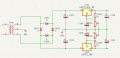
OK, I have taken advice to get to the following final design:
1743773914543.png

I am also thinking that I will put the power supply in a separate enclosure from the audio circuits.

Thanks for all of the help; please let me know final thoughts or if I missed something.
 

Irving

Joined Jan 30, 2016
5,140
In your revised schematic D8 on the -ve rail is reversed - as drawn it shorts -v to ground.

R2 & R4 aren't bleeding the big caps, though they will drain them off eventually. They should really be directly on the caps themselves. Since your peak AC in is only 34v bleed resistors aren't really necessary. In the absence of any other load they'll discharge the caps to around 10v in 30sec approx. Putting R2 & R4 on the output to improve regulation is only necessary to meet minimum output current requirements. Assuming your amp is permanently attached and no other switchgear in-line then they do nothing useful. BTW 1/4W resistors are fine 3k @ 15v W = V^2/R = 225/3000 = 75mW!

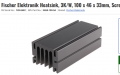
Is your preamp seriously going to take 1A on both rails? If so your LM3x7s better be on decent heatsinks. 34v DC in, 15v DC out at 1A = 19W dissipation. A TO220 cased-device LM317KCS will need a heatsink better than 3degC/W to stay safe - that's a big heatsink (see example pic below).

If 1A is really needed you'd be better off with a 36v CT transformer, a 48v CT transformer is too big. But you also need to spec the VA rating and regulation % of the transformer. Did you have a specific one in mind?

1743768621685.png
 

Thread Starter

JT60451

Joined Feb 3, 2025
24
In your revised schematic D8 on the -ve rail is reversed - as drawn it shorts -v to ground.

R2 & R4 aren't bleeding the big caps, though they will drain them off eventually. They should really be directly on the caps themselves. Since your peak AC in is only 34v bleed resistors aren't really necessary. In the absence of any other load they'll discharge the caps to around 10v in 30sec approx. Putting R2 & R4 on the output to improve regulation is only necessary to meet minimum output current requirements. Assuming your amp is permanently attached and no other switchgear in-line then they do nothing useful. BTW 1/4W resistors are fine 3k @ 15v W = V^2/R = 225/3000 = 75mW!

Is your preamp seriously going to take 1A on both rails? If so your LM3x7s better be on decent heatsinks. 34v DC in, 15v DC out at 1A = 19W dissipation. A TO220 cased-device LM317KCS will need a heatsink better than 3degC/W to stay safe - that's a big heatsink (see example pic below).

If 1A is really needed you'd be better off with a 36v CT transformer, a 48v CT transformer is too big. But you also need to spec the VA rating and regulation % of the transformer. Did you have a specific one in mind?

View attachment 346111
Thanks for all of this valuable advice, and for catching the copypasta error on D8. I had intended big honking heat sinks of both regulators. I will attempt to calculate the max current draw in the preamp and adjust the transformer. I'll also add direct bleed resistors on the 10ku caps.
 

Irving

Joined Jan 30, 2016
5,140
Thanks for all of this valuable advice, and for catching the copypasta error on D8. I had intended big honking heat sinks of both regulators. I will attempt to calculate the max current draw in the preamp and adjust the transformer. I'll also add direct bleed resistors on the 10ku caps.
Do you understand how to run the numbers on the transformer? If you have a specific one selected we can run them with it....
 

MisterBill2

Joined Jan 23, 2018
27,652
OK, I have taken advice to get to the following final design:
View attachment 346117

I am also thinking that I will put the power supply in a separate enclosure from the audio circuits.

Thanks for all of the help; please let me know final thoughts or if I missed something.
There is a direct shorted circuit at the input of the negative supply, several lines where they should not be. The secondary center tap is tied to both the negative regulation and to the negative common side. And also the actual diode bridge is wrong as well.
 

Ian0

Joined Aug 7, 2020
13,158
I'll just add: use a time-delay fuse on the mains input. if you use a fast-blow, it will blow on the inrush current of the transformer.
 

Irving

Joined Jan 30, 2016
5,140
There is a direct shorted circuit at the input of the negative supply, several lines where they should not be. The secondary center tap is tied to both the negative regulation and to the negative common side. And also the actual diode bridge is wrong as well.
Good catch.

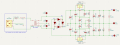
@JT60451 Try to avoid connecting everything together, it produces confusion. A better layout, that reduces the crossing wires and makes it clearer that the lower section is a -ve mirror image of the top +ve section. When you come to lay the PCB out this will help structure that more cleanly.

1743854463393.png
 
Last edited:

Thread Starter

JT60451

Joined Feb 3, 2025
24
Good catch.

@JT60451 Try to avoid connecting everything together, it produces confusion. A better layout, that reduces the crossing wires and makes it clearer that the lower section is a -ve mirror image of the top +ve section. When you come to lay the PCB out this will help structure that more cleanly.

View attachment 346200
Thanks!!! This is indeed much cleaner!

Here is my final cleanup...

1743875744632.png
 

Irving

Joined Jan 30, 2016
5,140
Much better, but you should move D5 and D6 outside of the regulators as you had previously. The regs are the most important component here so they should be in the main 'flow', plus having a wire crossing another component is generally a bad idea. You should be able to look at a schematic and get a feel for how the current 'flows'. Similarly, why do C7 and C9 join together and then to ground (as do C10 & C11)? Again, its a crossing wire that has no real purpose and makes it look cluttered. You don't have to squeeze it all into a tiny space, you can spread it out!
 

Thread Starter

JT60451

Joined Feb 3, 2025
24
Much better, but you should move D5 and D6 outside of the regulators as you had previously. The regs are the most important component here so they should be in the main 'flow', plus having a wire crossing another component is generally a bad idea. You should be able to look at a schematic and get a feel for how the current 'flows'. Similarly, why do C7 and C9 join together and then to ground (as do C10 & C11)? Again, its a crossing wire that has no real purpose and makes it look cluttered. You don't have to squeeze it all into a tiny space, you can spread it out!
Thanks so much for all of the thoughtful advice. You are the kind of person who will bring more people to this as a hobby and even a profession. Now if I could only solder SMD 0402 components! :)

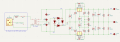
Here we go again...I can see how the PCB layout will be MUCH easier with this schematic. Only three crossing points in the whole thing!

1743880566524.png

The only remaining thing I am going back and forth about is re-adding 100n caps across all four rectifiers since I have them on both sides of both regulators. It seemed confusing, but I can understand how they would benefit in noise reduction. It's super cheap, does not take up much real estate on the PCB. Thoughts?

One more thought... I am planning on using a filled ground plane on the back side of the board. Any reasons not to do so?

AC Power traces are 3.5mm, DC are 1.5 or 2.5mm depending on components.
 

MisterBill2

Joined Jan 23, 2018
27,652
When you are actually assembling this PCB, it is often good to not have the components flat against the circuit board if they are producing heat. I am thinking that you are only building one of these so the small bit of extra effort will not be a big issue like in an assembly line.
 

Thread Starter

JT60451

Joined Feb 3, 2025
24
When you are actually assembling this PCB, it is often good to not have the components flat against the circuit board if they are producing heat. I am thinking that you are only building one of these so the small bit of extra effort will not be a big issue like in an assembly line.
I agree. I intended to keep the rectifiers at least 2mm above the board. The regulators will be on substantial heat sinks that have pins into the board to connect. I think that they have a bit of space above the board in the center but will look at them when they come in from Digikey.
 

Thread Starter

JT60451

Joined Feb 3, 2025
24
Why do you need to use 0402 SMD?
I don't use 0402 or 0603. I generally stay with 0805 for my own PCB.
I am practicing on a practice board I got from AliExpress because I am doing my Magnavox console servicing and refit and adding a Bluetooth board from Mend it Mark and that has SMD on it. Mark’s board doesn’t have the 0402 on it but the practice board does. When the practice board arrived I had a small depends moment when I saw the 0402s in the tape. I almost bought a hot plate on the spot.
 

Irving

Joined Jan 30, 2016
5,140
I never go below 0805, and I use the 'hand-soldered' footprints in KiCAD. Unless you have a real need for super-miniaturization there no need and you're just making a rod for your own back. I'd avoid putting HV AC on the board, though the LV secondary input should be OK. Personally for this project I'd stick with through-hole parts, there not much space-saving needed, the regulators are leaded anyway as will be the 10k capacitors, and they're typically 30mm dia. You should have no difficulty fitting this on a PCB 80 x 60 with just THT parts. Heatsinks will be your limiting factor.

You definitely should use a ground plane. Convention puts it on the back but it doesn't have to be. You could have it on the front as well, as long as they are well stitched together. The layout for this will follow the schematic and there are relatively few tracks needed. I'd keep the tracks all the same width, there's no real need to go below 1.5mm, and that's good for at least 3A.

Did you chose a transformer yet? and heat-sinks? Also think about getting on and off the board - direct wire-to-board (not recommended), push-on connectors, screw terminals, etc?
 
Top