limit question

Zeeus

Joined Apr 17, 2019
616
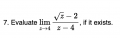
I'm doing some intro complex analysis and doing this limit, http://tutorial.math.lamar.edu/Solutions/CalcI/ComputingLimits/Prob7.aspx,
what happens to the negative root of 4, so 1/(-2+2)=1/0.

So even if this was just in R, not C, what rule says to ignore the pole at (-2,0). What am I forgetting.
Don't really understand your question but to solve the limit? an easy way to find the limit is to use...

L'Hopital : since expression is 0/0. Differentiate numerator and denominator : Google L'hopital
 

Thread Starter

DarthVolta

Joined Jan 27, 2015
521
when it's factored to 1/(sqrZ+2) and then you enter z=4 you get 1/(-2+2) and 1/(2+2)

so what is being done to say the answers is only 1/4, and that there is only 1 answer, not 2, limits are supposed to have 1 answer
 

ci139

Joined Jul 11, 2016
1,989
\( \displaystyle{\lim_{z→4}{\frac{\sqrt z-2}{z-4}}=\left[{\cases{\text{assuming}\ z \in C\\ y=\sqrt z-2\\ u=\sqrt z+2}}\right]=...=\frac14} \)
http://www.suitcaseofdreams.net/Reciprocals.htm , perhaps L'Hôpital's rule /// ←← both of which are not yet used here
...
\( w=\frac{\sqrt z-2}{z-4}=\frac1{\sqrt z+2}\ → z=\left({\frac1w-2}\right)^2=\left[{x=\frac1w}\right]=x^2-4·x+4 \)
\( \left[{z→4}\right]\ →\ 4=x^2-4·x+4\ →\ 4=x=\frac1w \) ←← all this to show where the limit is "srewed" →→ \( z=\left({\frac1w-2}\right)^2 \)
 
Last edited:

bogosort

Joined Sep 24, 2011
696
when we take the square root of 4, it's -2 and 2, so why is the -2 being left out
The symbol \( \sqrt{z} \) stands for the principal square root of z, which is -- by definition -- a single, positive number. In other words, though \( z^2 = a \) has two solutions, \( \pm \sqrt{a} \), the expression in your limit is using only one of them, the positive root.

The general rule is that whenever you see a radical symbol, it represents a single number. However, when you apply the square root operation (as when solving an equation with a squared variable), you need to consider both the positive and negative roots.
 

MrAl

Joined Jun 17, 2014
13,702
If you take:
(sqrt(x)-2)/(x-4)


If you take sqrt(4) you get 2, but if you allow negative results you get -2.

If you take sqrt(-1) you get a complex result regardless.

So sometimes you get a choice sometimes you dont.

Math is an extension of reality, it is not reality itself. What this means is that sometimes results depend on the application not on some formula that can be applied in every situation without examining the context.

I also did this:
(sqrt(a*a*)-2)/(a*a-2)

and got as simplification:
(abs(a)-2)/(a^2-4)

But if i use this:
(a-2)/(a^2-4)

and allow 'a' to go to 2 i get:
1/4

but if i allow 'a' to go to -2 i get:
infinity

So in the case of '2' we get a limit, in the case of '-2' we dont get a limit.
This must mean that 2 is the only valid result.
 
Last edited:

djsfantasi

Joined Apr 11, 2010
9,237
If you take:
(sqrt(x)-2)/(x-4)


If you take sqrt(4) you get 2, but if you allow negative results you get -2.

If you take sqrt(-1) you get a complex result regardless.

So sometimes you get a choice sometimes you dont.

Math is an extension of reality, it is not reality itself. What this means is that sometimes results depend on the application not on some formula that can be applied in every situation without examining the context.
In that equation, regardless of the value of sqrt(4), the function is not valid at that point. you’ll never take the square root of 4. The function does not have a valid result at that point, since it divides by (x-4) and that’s division by 0, when x=4...
 
Last edited:

MrAl

Joined Jun 17, 2014
13,702
In that equation, you’ll never take the square root of 4. The function does not have a valid result at that point, since it divides by (x-4) and that’s division by 0, when x=4...
Yes i expanded my reply you quoted before i was done posting really.
Sometimes i read it over and correct it or add information to the post.

But you may want to reword your reply "you'll never take the square root of 4"
because i can easily take the square root of 4 and get 2 or -2, it's just that when the complete function is evaluated we may get an infinity which means that result is not valid. But we still can take the square root of 4.
The whole point of the question was what happens when we take the square root of 4 and allow -2 as result. So we have to be able to examine that result first, then look at the whole problem. I understand what you were getting at though, thanks.
 

ci139

Joined Jul 11, 2016
1,989
If you take:
(sqrt(x)-2)/(x-4)
the fast inline math without entering dummy menus ::
you write ∖( LaTeX/AjAx ∖) - no space in between backslash and opening/closing closes -- but the space before after your MATH code
so the ∖( \frac{\sqrt x-2}{x-4} ∖) renders as \( \frac{\sqrt x-2}{x-4} \) or ∖( \displaystyle{\frac{\sqrt x-2}{x-4}} ∖) renders as \( \displaystyle{\frac{\sqrt x-2}{x-4}} \)
and the ∖( \frac{\left|{a}\right|-2}{a^2-4} ∖) renders as \( \frac{\left|{a}\right|-2}{a^2-4} \) --or--
the ∖[ \frac{\left|{a}\right|-2}{a^2-4} ∖] renders as (centered below) \[ \frac{\left|{a}\right|-2}{a^2-4} \]
https://en.wikipedia.org/wiki/List_of_mathematical_symbols_by_subject
https://oeis.org/wiki/List_of_LaTeX_mathematical_symbols
∖( \overline{boolean} \qquad \overrightarrow {vector} ∖) → \( \overline{boolean} \qquad \overrightarrow{vector} \)
 
Last edited:

Thread Starter

DarthVolta

Joined Jan 27, 2015
521
I've been studying a lot lately, in my OP I was also mis-using L'HR. I've started on chapter 2 of my calculus book, I should fly through most of it.
 
Top