Lights dimming all over house

MisterBill2

Joined Jan 23, 2018
27,652
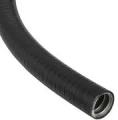
If it was really "BX" and not Greenfield, be very careful moving the wires when you work on the box. My experience with BX is that the steel sheath cut with whatever they used had a very sharp edge that cut thru the insulation and cause the breaker to trip. And there were none of those red collar pieces to protect the wire insulation.
The wires in "Greenfield" can move and be pulled out, while the wires in "BX" are not removable. And usually BX conductors have clothe covered rubber insulation.
 

MaxHeadRoom

Joined Jul 18, 2013
30,688
Coming from the UK where nothing like BX I ever recall existed, I hated the stuff, for my own use, if I needed armored cable of any kind, I sprang for the cost of metallic flexible conduit with appropriate fittings and wired it as needed.
The perks & benefits of working with industrial machinery! :cool:

1702409363227.png
 

Ya’akov

Joined Jan 27, 2019
10,258
If it was really "BX" and not Greenfield, be very careful moving the wires when you work on the box. My experience with BX is that the steel sheath cut with whatever they used had a very sharp edge that cut thru the insulation and cause the breaker to trip. And there were none of those red collar pieces to protect the wire insulation.
The wires in "Greenfield" can move and be pulled out, while the wires in "BX" are not removable. And usually BX conductors have clothe covered rubber insulation.
It’s BX, cut with a proper purpose made saw, and equipped with “no shorts“ anti short bushings. The electricians that wired this house did everything by the book. It’s a high end house built in 1941—perhaps the pinnacle of real trades construction with the most modern materials and craftsmen before the war made both unobtainable.

After the war, housing construction changed dramatically. For example, there is gypsum board (drywall) in this house, but it isn’t the walls, it‘s the lath for the top quality plaster walls. It was an innovation that, after the war, became the walls themselves. No one would have thought that something you can put your fist through was a proper wall before that.
 

ElectricSpidey

Joined Dec 2, 2017
3,336
I don't have any ground fault outlets in my house, but I do have 2 GF breakers in my panel.

They both trip the handles to the center position like any other breaker.

I don't know if I would be comfortable with a GF device without any status indication.
 
Last edited:

Ya’akov

Joined Jan 27, 2019
10,258
I don't have any ground fault outlets in my house, but I do have 2 GF breakers in my panel.

They both trip the handles to the center position like any other breaker.

I don't know if I would be comfortable with a GF device without any status indication.
GFCI outlets have test and reset buttons. The reset is usually large and red and pops out when tripped.
 

MisterBill2

Joined Jan 23, 2018
27,652
On the GFI devices in the home I visited today to solve the problem, there was no difference visible with either button, between tripped and non-tripped. At least, not visible from 12 inches away wearing good reading glasses. Clearly the designs have become better over the years.
The issue with a GFCI breaker is that one fault switches off power for a number of locations. In another house job, the refrigerator was on the same circuit as the outlet near the kitchen sink. So one wipe on the wall shut off refrigerator power. THAT was an issue that had to be corrected.
And the heat-tape used to prevent pipes freezing plugged into a GFCI that tripped every time it rained. Some times it makes a lot of sense to defeat safety devices.
 

MisterBill2

Joined Jan 23, 2018
27,652
Now a thought comes to mind that a simple action could be to cycle the main breaker a few times, just in case it is a contact issue. And also take a close look at the incoming power cable terminations.I once solved a 3-phase motor problem by tightening the tree connections in the lugs. Did not even need to switch off the power. I DID use an insulated tool and I DID stand on an insulating neoprene mat kept for that purpose.
 

t_glover

Joined Mar 16, 2021
56
I had an issue with flickering lights in an older home I owned. It was intermittent and of course when the electric company sent someone to check it wasn't acting up. I was on the roof replacing the shingles and I noticed one of the three big crimp connectors that connect the mast to the line from the pole the insulation was melting. I called the electric company and the lineman they sent cut the three connectors out and replaced them. Resolved the problem.
 

MisterBill2

Joined Jan 23, 2018
27,652
problems certainly can be caused by outside connections. I spotted one outside a townhouse quad. But the intermittent was between the one line and the neutral when there was rain. The corrosion/copper migration was visible. Covering it with new tape would not have solved the problem at that stage, so the power company was notified and they replaced the damaged materials and the problem was solved.
For the situation discussed here, it might indeed be a single failing joint in a splice, shaken by the wind, not completely failed yet.
 

ThePanMan

Joined Mar 13, 2020
929
Now a thought comes to mind that a simple action could be to cycle the main breaker a few times, just in case it is a contact issue. And also take a close look at the incoming power cable terminations.
Even an easier solution - hire a competent electrician. If a breaker has bad contacts then it's time to replace it. But replacing it simply because you suspect it's bad is a bad idea in itself.
 

MisterBill2

Joined Jan 23, 2018
27,652
Even an easier solution - hire a competent electrician. If a breaker has bad contacts then it's time to replace it. But replacing it simply because you suspect it's bad is a bad idea in itself.
In some areas it is rather difficult to even find an electrician who is both competent and honest. In addition in many areas they are horribly expensive.
And as for a failed breaker, I have come across one that failed on it's own, and one that was worn out by using it as an ON/OFF switch for a coffee maker for 25 years, and one destroyed by being tripped off many times by a dead shorted plug, by punks who thought it was funny.
 

Thread Starter

Ecbessa

Joined Dec 5, 2023
11
Thank you everyone for your responses.

I should admit that I have absolutely no knowledge or experience when it comes to electrical repairs. As in, I do not even feel confident enough to change my own outlets. I am a bit embarrassed to say that here on this forum, but it is the truth.

Although I am not able to do any of the troubleshooting you have suggested myself, I have taken many notes and come up with many questions that I will ask the next electrician I hire.

Since I first posted the power company came back and checked the transformer again. This time, they did find a loose connection. They were confident this would fix the problem, but it did not. They came back a second time and completely replaced the transformer with a bigger and more powerful one. Their reasoning was the distance my house is from the transformer and how far the voltage had to travel down the wires, the fact that the old transformer was the smallest available, and the fact that new houses have been going up in the area. I live in a rural area and my house is the only one serviced by this transformer. I was hopeful, but this did not work either.

The electrician came back and checked all the wires behind all of the light switches, outlets, fans, and light fixtures. I know it was stated on a post here that a competent electrician would not suggest that and he was just trying to run up the service charge. However, I agreed to it because the outlets, switches, and fixtures in the house were very old and I had been wanting to get them replaced anyways. So I asked him to replace them all as he was checking for loose wires. He did in fact find one loose neutral behind a switch and one loose hot wire behind an outlet, but still the dimming lights persist.

The dimming is intermittent and unpredictable. As I mentioned earlier it can be several quick dims back to back to back or it can be dims that last a few seconds, or a combination of the two. Usually there are several single dims throughout the day and a few periods of 15 minutes or so when there are dozens at a time. Lights, the refrigerator, fans, etc. will all experience a drop in voltage. I have never noticed any brightening or indications of a rise in voltage. 9-11 PM seems to be when the most activity occurs, although it happens at other times as well.

Something that I have only noticed over the past few days, and I think is very important, is that one circuit seems unaffected. There are two lights, a hall light and an office light, on the same circuit, which do NOT dim when all the other lights in the house do. These lights are rarely used. I wish I had noticed this earlier and reported it here on my initial post.

What could cause all BUT one circuit to experience intermittent drops in voltage? Apologies if clues to the answer to this question are present in the previous posts. My lack of electrical knowledge means that things that are clear to you all may go right over my head. I am trying to learn and understand, but still...

Again, thank you all very much for taking the time to respond and try to help me!
 

BobTPH

Joined Jun 5, 2013
11,555
There are two lights, a hall light and an office light, on the same circuit, which do NOT dim when all the other lights in the house do
If these are LED lights it is possible their circuitry can deal with a reduction in voltage without dimming.

An explanation where the voltage is not dipping for those two lights is hard to imagine.

Edit to add: My theory is easy to test. Swap one of those bulbs with one known to dim, and note which of them dims after the swap.
 
Last edited:

ThePanMan

Joined Mar 13, 2020
929
What are the odds that the contacts in all breakers would go bad at the same time?
My comment was directed at another person who was suggesting there might be a bad breaker. I know the likelihood of ALL breakers being bad at the same time is highly unlikely.
 

MisterBill2

Joined Jan 23, 2018
27,652
Interesting indeed. The power company found and corrected a "loose connection", although we don't know where it was. And new information is that you are the only house on that transformer, and that other homes have been added in the area. Finding one loose connection tells me that there could be another "loose connection" farther upstream, on the primary feed side of the transformer.
For those two lights that do not dim, a check to see it that circuit is on the same side of the breaker panel as all the others could be revealing. OR they could be LED lights that do not dim with small changes in the mains voltage.
A very useful tool at this stage would be a plug-in line voltage meter, the kind that takes no technical expertise to use. That would allow knowing the amount of voltage drop when the dimming happens.
At this point, one reasonable guess is that the drop is happening in the primary feed line upstream from both your transformer and other transformers, and could be due to a larger load switching on and off, such as a pump motor or an electric heating system at a more distant location.
 

Tonyr1084

Joined Sep 24, 2015
9,744
Finding one loose connection tells me that there could be another "loose connection" farther upstream, on the primary feed side of the transformer.
On the primary side, there would be other homes being affected as well. And since the power company previously said they could find no problem with their equipment either during their testing they did not experience one of those brown-outs. Fixing a loose connection can be the fix or it can reveal yet another loose connection somewhere upstream or downstream.

My home primary feed is 7KVAC. The transformer (or "Tub" as they call it locally) happens to hang right in my back yard. A few years ago one leg burned out. Not the tub, but rather a leader wire. All the homes connected to that tub experienced loss of half their circuitry. Upon looking at the wires coming from the tub you could clearly see how one wire completely burned through. I don't know how that didn't start a fire but I'm glad it didn't.

The mystery has deepened. What is needed is a power logging system that keeps a record of the power available. If the voltage drops the recorder records the drop. It can be installed after the breakers but it will need to either be connected to a 220 circuit (double breaker) or two of them, one to each line. OR it can be connected to the feeder line. IF the problem appears on the feeder line then we can all stop talking about circuit breakers. IF it occurs ONLY through the breaker panel then that's where the problem lies. Having said that I'm wondering if maybe the bus bar inside the breaker panel might be loose. That's a connection that is probably never checked. I DON'T KNOW THAT FOR A FACT, but I've pulled an old panel apart and the way it was connected there could be corrosion or oxidation causing a poor contact. That's why it's important to log the voltage from the down-feed line from the pole and then another log from the breaker panel. To be sure - there's something going on that nobody has found yet.
 

MisterBill2

Joined Jan 23, 2018
27,652
Certainly corrosion or a poor connection in a breaker panel can cause a voltage drop, but not an intermittent one as described. Corroded connections get worse and worse, they seldom heal themselves and then act up again later. And a rather simple check for a breaker panel would be to bang on it with a rubber mallet a few times. That approach is admittedly crude, but also quite effective. Likewise, wiggling the cables at the meter box will stimulate many bad connection symptoms.
Breaker failures are very seldom on and off, especially not rapid cycling.
One question: Does the TS have a backup generator system with a change-over switch in the system? Just thought of that.
 

MaxHeadRoom

Joined Jul 18, 2013
30,688
Any consumer here that experiences these problems can have a chart recorder placed at supply entry in order to monitor whether the cause is on the supply line.
But I see apparently this was done!?
 

Tonyr1084

Joined Sep 24, 2015
9,744
Any consumer here that experiences these problems can have a chart recorder placed at supply entry in order to monitor whether the cause is on the supply line.
But I see apparently this was done!? {Italics and Bold mine (tonyr1084)}
Twice. The first time revealed no issues whatsoever. The second time revealed problems as yet to be located. And if it IS with the power company feed then it's upon them to fix it. If ALL circuits are going out then it could be a HV Feed problem. They DID change the transformer, so they're thinking something is on their side.
 
Top