Lights dimming

Thread Starter

ApacheKid

Joined Jan 12, 2015
1,762
Some posted recently about lights dimming and I also have a question about this.

When my AC starts up the lights diem for a fraction of a second, not much but noticeably.

My question is why? the power grid is surely able to prove huge currents without a sizeable drop in voltage surely?

Also why don't my lights dim when a neighbors AC kicks in? we are all close together fed from the same supply so why should the fact that an AC is on my property make any difference?
 

ElectricSpidey

Joined Dec 2, 2017
3,314
The grid can handle the surge, but your local wiring cannot.

Your neighbor's AC doesn't pull your lights because you are not connected to their local wiring.
 

Thread Starter

ApacheKid

Joined Jan 12, 2015
1,762
The grid can handle the surge, but your local wiring cannot.

Your neighbor's AC doesn't pull your lights because you are not connected to their local wiring.
But we are connected, I don't see how calling one homes wiring "local" has much meaning here. The houses are all "fed" from the same source, a local pole mounted transformer, my understanding is that several homes are all galvanically connected to the secondary winding of these pole transformers.
 

Thread Starter

ApacheKid

Joined Jan 12, 2015
1,762
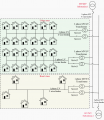
See here, multiple homes are connected to the distribution transformer secondary:

1702759731404.png

If I were to short circuit the feed coming into my circuit breaker panel, the feed from the street, a fuse somewhere in the street would blow and several houses would lose power, it wouldn't just be my house. So this implies that an AC coming on in any of those house would cause a brief voltage drop and all those same homes would see their lights dim - can you see my point?

My experience is that every time I notice this brief dimming, my AC comes on, I've never seen it dim yet not have my AC come on.
 

SamR

Joined Mar 19, 2019
5,473
Not only that, but most feeds are from separate transformers. Most newer homes also have a 200A panel and older ones had 100A at most and that is @ 120VAC so cut it in half for 240VAC.
So if your AC pulls 20A @ 240VAC on an old 100A panel that only leaves 60A for the rest of the circuits and that is not counting the inrush current which is why your lights dim. More modern (and pricey) AC units use soft start for this reason.
 

SamR

Joined Mar 19, 2019
5,473
12 homes @ 200A is a 288kVA xfmr. Most pole mounted xfrms are less the 15kVA! And that is for a 200A panel which if was pulling its full load is 24kVA. I think my single source xfmr is 12kVA for my 200A panel and my lights don't dim on AC start. So maybe a 122kVA for 12 houses and that is still a HUGE xfmr.
 

geekoftheweek

Joined Oct 6, 2013
1,429
Maybe things have changed in the 20 years since I was a regular in the construction world, but I have never saw 3 phase wiring in houses, apartments, or any residential structure.

In rural areas the voltage drop along the secondary will limit how far apart houses can be from the transformer. My family lived in a row of houses of 1/2 acre lots and at most there were two houses to a transformer.

Edit:

My current house now is 250' from the road and while I have multiple houses in front of me I am the only one on the transformer situated just outside my house.
 

geekoftheweek

Joined Oct 6, 2013
1,429
More or less your A/C on startup is drawing more power than your wiring and wiring to the transformer can handle. The transformer is probably more than capable of handling several such events at the same time, but since everyone else is on a separate feed from the transformer the drop is limited to only the feed the event is happening on.
 

Thread Starter

ApacheKid

Joined Jan 12, 2015
1,762
More or less your A/C on startup is drawing more power than your wiring and wiring to the transformer can handle. The transformer is probably more than capable of handling several such events at the same time, but since everyone else is on a separate feed from the transformer the drop is limited to only the feed the event is happening on.
This is my point, several homes actually share a single secondary of that distribution transformer, so far as that secondary is concerned it has no idea if there's one house or five, all it "sees" it just a load of appliances - as if the appliances were all in one house.
 

MaxHeadRoom

Joined Jul 18, 2013
30,585
Maybe things have changed in the 20 years since I was a regular in the construction world, but I have never saw 3 phase wiring in houses, apartments, or any residential structure.
My current house now is 250' from the road and while I have multiple houses in front of me I am the only one on the transformer situated just outside my house.
In N.A. residential area, 3 to 6 homes are fed from each centre-tapped secondary phases of a 3 phase transformer
 

Tonyr1084

Joined Sep 24, 2015
9,744
My home is powered from a transformer right in my back yard. My southerly neighbor two doors down runs an auto shop. when he starts up some of his equipment my lights DO dim ever so briefly but noticeably.

Some years back a feed wire burned out and all 12 of the homes on that transformer lost half their power. The power company came out and fixed the burned wire. The technician also noted that the tub (transformer) was hot. Not hot from being in the sun - hot, no, it was hot from the amount of current running through it. The tech said that the power company needs to come out and replace that transformer with a larger one. One that can handle all the electrical demands the neighborhood is putting on it. Like I said, that was some years ago and nothing has changed.

But like others are saying, you shouldn't be seeing a dip in power when your neighbor's AC comes on. The lines should be heavy enough to conduct sufficient current to prevent that. However, in my neighborhood, built in the early 60's, people's homes were not expected to need services in excess of 60 amps. Today homes are constructed for 200 amps. Or at least 100 amps. But today's modern electronics are far more prolific than an electric stove, electric clothes dryer, electric water heater, a toaster, some lights and a TV. I have three TV's, entertainment centers, air conditioning, (back to) an electric stove, microwave and dishwasher. I also have a woodshop over my garage that runs a 5 HP table saw, a 2 HP bandsaw, 2 HP dust collection, a 15 amp plainer, some other power tools, split phase HVAC, computer, printer and a few other things. My lighting is LED that does not flicker. Fluorescent lighting can be dangerous in that a spinning blade can look like it's standing still. I'm dumb enough to grab a spinning blade if I think it's not spinning. Yes, yes, I know; I'd hear the whirr of the spinning blade. But DC lighting is now common in factories because of that very issue (spinning tools looking like they're standing still when AC lit).

As for what you can do about it ? ? ? Probably not much other than live with it. If you're still concerned, have an electrician inspect your system. Or call your local power company and ask them to monitor the line voltages. See what the report says. The best we can do is guess.
 

Thread Starter

ApacheKid

Joined Jan 12, 2015
1,762
The voltage drop is in the line from your electric meter to the transformer, which is not shared with your neighbor.
I still don't follow. Firstly the presence of the meter is surely academic? we can simply regard it a piece of wire to all intents and purposes and secondly there is only ONE secondary winding, and multiple homes connect to that single winding. If the lights in my house dim that must mean the voltage across that shared secondary has dropped, in which case all the houses connected to that secondary would surely see the same dropped voltage?

I know this is not a DC circuit we're discussing, it's AC and so I accept that my "analysis" is simplistic but it does puzzle me, I mean if I wanted to simulate this on a bench with say a simple 12V transformer and connect three pretend "houses" to that secondary and inside each house have a light and an equivalent to an AC compressor, then would we expect when one of these "compressors" is switched on, there's a voltage drop, lights dimming only inside one of the "houses" and none of the others?
 
Last edited:

MisterBill2

Joined Jan 23, 2018
27,258
Consider that between your house and the distribution wires on the posts is between 50 and 200 feet of ALUMINUM connection wire. Next, consider the starting current draw of your AC compressor. That draw will be the Locked Rotor (LR) current listed on the specification tag. That current draw lasts for about half a second each time the compressor starts, and that current causes a voltage drop in your aluminum wire feed connection. That is the cause of the momentary light dimming. Your power feed drop wires are simply not heavy enough to reduce that drop to an un-noticeable amount.
 

ElectricSpidey

Joined Dec 2, 2017
3,314
The meter is academic and only used as a reference point.

Consider this...

You have a power hogging appliance on one of the branch circuits in your home, when that device is drawing current the other devices on that branch circuit see a voltage drop, but the rest of the house does not. (some small drop only)

Now imagine the distribution feeds as your branch circuits.
 

MisterBill2

Joined Jan 23, 2018
27,258
The meter is academic and only used as a reference point.

Consider this...

You have a power hogging appliance on one of the branch circuits in your home, when that device is drawing current the other devices on that branch circuit see a voltage drop, but the rest of the house does not. (some small drop only)

Now imagine the distribution feeds as your branch circuits.
Given that the "Locked Rotor" current of at least one 3 horsepower compressor that I examined is 80 amps, it qualifies as that "power hogging appliance" and would be the device responsible for the momentary voltage dip observed. But that is the price paid for using electric motors without the expensive soft starter in line. The good news is that the mechanical watthour meters are not fast enough to catch that very brief current draw. The bad news is that the modern all digital electronic watt-hour meter probably ARE FAST ENOUGH to catch it.
 
Top