Lights dimming all over house

Thread Starter

Ecbessa

Joined Dec 5, 2023
11
The lights throughout my house have all been dimming at the same time. It is not related to any large appliances starting up. It doesn't matter if many lights and many appliances are running or if just one light is on. Appliances that make noise like the refrigerator and fans and space heaters will get quieter for a second at the same time the lights dim. Some days it will only happen a few times, other days hundred of times. Sometimes it is a series of small quick dims, maybe three per second. Other times it is more obvious and longer lasting dims, each lasting two or three seconds. Sometimes it is a mixture of the two, back to back for a period of 15 minutes or so, then nothing for a few minutes, then it repeats. It happened a lot last month (beginning to mid November) then completely stopped for about three weeks and has now started happening again. Last month I had an electrician come out three times to try and diagnose the problem. He thinks it is a loose neutral. He checked the breaker boxes and tightened a few things. He checked a few light switches and light fixtures and ceiling fans. His next step is to check every outlet, light switch, and fixture in the house. Before he started that process I called the power company to check their side of things. They checked the transformer and the wires and read the info from my smart meter. Then they attached a voltage recorder to my meter for a weekend and had me record when the dimming happened so they could compare it to their recorder. They did not find any unusual readings despite my list of when I saw dimming (many, many times). They said it is not a problem with their equipment and they also do not think it is a loose neutral because they said I would also see the lights brightening. I would be grateful for any suggestions you all could give as to what the problem might be.
 

dl324

Joined Mar 30, 2015
18,261
Welcome to AAC!

Does the power company have recorders you can connect to outlets on your circuit breakers? If they don't, do you have the ability to do it? Monitor voltage with a Raspberry Pi, record the data, write a program to analyze the data. I'd measure the secondary of a step down transformer so you're not working with lethal voltages. But that will reduce the magnitude of the anomalies by the step down ratio.

Unfortunately, Rpi doesn't have an ADC, so you'd need to add that. Arduino has an ADC, but it has limited memory capacity and getting data off of them is a pain. You can add an SD card to Arduinos, but I haven't bothered. Plus you can login to an Rpi and check things while it's doing its thing. Can't do that with Arduino...

Are all lights and appliances affected? Or just on certain circuit breakers?

If you can isolate to circuit breakers, you might find a pattern.

I don't trust any electricians. Plumbers either...

Try using paragraphs to organize your thoughts.
 

Ramussons

Joined May 3, 2013
1,567
The lights throughout my house have all been dimming at the same time. It is not related to any large appliances starting up. It doesn't matter if many lights and many appliances are running or if just one light is on. Appliances that make noise like the refrigerator and fans and space heaters will get quieter for a second at the same time the lights dim. Some days it will only happen a few times, other days hundred of times. Sometimes it is a series of small quick dims, maybe three per second. Other times it is more obvious and longer lasting dims, each lasting two or three seconds. Sometimes it is a mixture of the two, back to back for a period of 15 minutes or so, then nothing for a few minutes, then it repeats. It happened a lot last month (beginning to mid November) then completely stopped for about three weeks and has now started happening again. Last month I had an electrician come out three times to try and diagnose the problem. He thinks it is a loose neutral. He checked the breaker boxes and tightened a few things. He checked a few light switches and light fixtures and ceiling fans. His next step is to check every outlet, light switch, and fixture in the house. Before he started that process I called the power company to check their side of things. They checked the transformer and the wires and read the info from my smart meter. Then they attached a voltage recorder to my meter for a weekend and had me record when the dimming happened so they could compare it to their recorder. They did not find any unusual readings despite my list of when I saw dimming (many, many times). They said it is not a problem with their equipment and they also do not think it is a loose neutral because they said I would also see the lights brightening. I would be grateful for any suggestions you all could give as to what the problem might be.
Which country are you in?
Are you on Single Phase or 3 Phase?
 

Thread Starter

Ecbessa

Joined Dec 5, 2023
11
dl324:

Thank you for your help. I will ask the power company about the recorder that they used and about connecting them to outlets.

It is on all circuit breakers. All lights throughout the house. As for appliances, the only ones I can tell are affected are those that have an audible motor sound that I can hear lose a bit of power for a second or two. Refrigerator, fans, space heaters, hair dryers, etc. These appliances can be in different rooms in different parts of the house and will quiet down all at the same time, right as the lights dim. There is never a complete loss of power so microwave, router, etc. never shut off. I have not noticed any issues with 240V appliances like stove, dryer, HVAC.

I should have used paragraphs. My apologies.
 

Ramussons

Joined May 3, 2013
1,567
Monitor your 240 Volts outlet, and the Two 120 Volts outlets at the same time. What is the observation?
If 240 Volt is steady and the 110 volt misbehave, the problem is the Neutral Return.
 

Ya’akov

Joined Jan 27, 2019
10,226
Welcome to AAC.

First, though a loose neutral is a nice prospect because it has an easy fix, the power company is correct insofar as there would be both under- and over-voltages. Some lights would dim and some would brighten. Appliances with motors like air conditioning and refrigerators would sometimes be noisier making a scary growling sound.

My first impulse would be to use a logging DMM to monitor voltage for a while first on one phase, then the other. This DMM is incredibly cheap but offers bluetooth access to the data with an app. I can’t vouch for it (yet, I ordered one given the price—I am very curious) but for ~20 bucks, it seems a reasonable gamble.

If there is a voltage drop of a couple of seconds, it will be very clearly recorded. It’s very hard to guess the source at this point given the power company report of stable voltage at their connection. It does imply the problem must be at or after the main panel. Do you have any sub-panels in the house? Is there any case where you have confirmed that every room is affected as the same time? (e.g.: more than one observer, cameras, etc.)
 

Tonyr1084

Joined Sep 24, 2015
9,744
Here's MY encounter with flickering lights: HALF my lights would go out. That meant it was on a single leg of the circuit. When I turned the electric stove on the lights would come back on at full brightness. Same thing when I turned on the electric baseboard heat. The problem could not be found in the breaker panel. Since it was just one side the problem had to be outside but not with the power company's side of things. The problem was a loose connection inside the meter box, the customer side. The electrician tightened that connection and reinstalled the meter and that was the end of the problem.

[edit] The reason why they'd come back on is because the 240VAC draw was strong enough to weld the connection back enough to restore the lights. But the winter cold would soon shrink the wire and the weld would break. That's why it was a routine of switching the heater or the electric stove on. [end edit]

So my guess is that it's either at the meter or the breaker panel feed line, which the electrician would have likely checked. But then again I've known some not so smart electricians in my days, many as they are.
 
Last edited:

j?e

Joined Dec 6, 2023
2
I had the same problem. The power company checked all the stuff they did for you. I rented a power quality meter and set it up for a week. I gave the results to the power company and a power quality tech talked to me. The power company was having problems with the auto tap changers at the power generating plant. The auto tap changes change the voltage of the generated power to compensate for extra load on the grid. They fixed the auto tap changers and the problem went away. I live in Canada and worked as a UPS emergency generator tech for 40 years.
 

MisterBill2

Joined Jan 23, 2018
27,281
It is certainly NOT a "neutral fault, as has been explained already. And with ALL of the lights dimming it is not likely a mains connection either, UNLESS all of the lights are on one side of the feed, which might have been done by an unknowing installer of the breaker panel.
Monitoring the incoming power before the main breaker will be able to show if it is in the house portion or not.
Meter box problems are rare but they do happen. Otherwise it could be a power company problem at a nearby transformer that supplies both sides of the 240 volt feed. If your power lines are underground, the problem may be much more difficult to locate, if it is not in a local transformer box nearby.
There was never any reason to check all of the outlets and switches, except to run up a large service charge. A competent electrician would have known that.
 

dl324

Joined Mar 30, 2015
18,261
It is on all circuit breakers.
It might be an imbalance on the two legs. Power in the US is split phase and I always struggle to describe it...
You don't need to worry about 240AC appliances because they're across both legs.

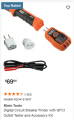
Troubleshooting that will be tedious, but you want to do it yourself instead of paying an electrician to do it. I'd start by labeling all of the circuits that have high current appliances on them. For 120VAC receptacles, you can get a circuit breaker tracer. It has a signaler that you plug into an outlet and use the tracer at the breaker panel to identify the circuit.

If you have circuits that only have overhead lights on them, there's an adapter that you can screw into the bulb socket and then plug in the signaler.

From Home Depot:
1701877716864.png
I should have used paragraphs. My apologies.
You see the issue, so it's okay. Some members post that way most/all of the time. I doubt that they ever try to re-read any of their posts or they would have seen the problem with not organizing their thoughts. Maybe that's the way they think...
 

schmitt trigger

Joined Jul 12, 2010
2,053
This DMM is incredibly cheap but offers bluetooth access to the data with an app. I can’t vouch for it (yet, I ordered one given the price—I am very curious) but for ~20 bucks, it seems a reasonable gamble
Please Y, when you receive it and operate it for a while, post your impressions here. A mini-review.
There are many reviews on the web which range the gamut from a single to five stars. But the reviews don’t appear very competent, though.
I would be interested mostly for its data logging characteristics, precisely for the reasons outlined by the TS.
 

j?e

Joined Dec 6, 2023
2
I was called by the football team. They were having problems with their tv monitor and time clock. The local power company said there was no problems with the incoming power. I used a power quality meter on the incoming service. It should harmonics on the power service. The power company changed the transformer to a K rated transformer. The power quality meter will tell you if the problem is in your house or coming from out side the house.
 

Ya’akov

Joined Jan 27, 2019
10,226
Please Y, when you receive it and operate it for a while, post your impressions here. A mini-review.
There are many reviews on the web which range the gamut from a single to five stars. But the reviews don’t appear very competent, though.
I would be interested mostly for its data logging characteristics, precisely for the reasons outlined by the TS.
I’ll do that. If it is even moderately competent the price is excellent and it would be very useful.
 

BobTPH

Joined Jun 5, 2013
11,482
might be an imbalance on the two legs
Are you implying that the two sides of the feed into the house must always have the same current?

What do you think would happen if you turn off all the 220 breakers and all of breakers on one of the phases? Would all the 110 outlets that are still on not work properly?
 

MisterBill2

Joined Jan 23, 2018
27,281
How likely is it that all of the lights are on the same side of the 240?If it were a weak neutral some would brighten and some would dim.
What is missing is what is spotted measuring the line with a VON, not a DMM, which will not be fast enough to catch a momentary dip. And that would show on either side or on the 240.
I did once long ago (1956) visit a "camp" in the boonies and the lights would dip a couple times an hour. The line feed, 110/220 came from a transformer at the highway, about 1/4 mile to the yard-pole. When the well pump kicked on the lights dimmed momentarily.That was accepted as the way things were at the time. the main electronic device was a tube-type AM radio. So no TV to have problems.
 

geekoftheweek

Joined Oct 6, 2013
1,429
Having been through a loose neutral before that took talking to the right person at 3 a.m. after a lineman just left and things went south again to get to the bottom of things I'll vote for the problem being something else. It's extremely unlikely that all affected loads would be on the same leg so there should be some items showing signs of over voltage. I have a few ceilings fans that have not been the same since, but the still work so they're still here. I also have a PC that lost it's life and one of the two hard drives that were in it also went.

Most 240 volt appliances can handle a pretty decent power drift so it's pretty unlikely you'll notice a change there. Usually the only part that is 240 volt is heating elements anyways. It would take something like an air compressor motor or air conditioning compressor to notice an issue with 240 volt.
 

MisterBill2

Joined Jan 23, 2018
27,281
So it must be something else, not a loose neutral connection. Maybe a failed meter? Probably not Possibly a large load across the 240 feed? Might be, except the TS says it sometimes is longer. A failing appliance does not do that. It could be a large load on the same 240 nearby. OR it might be a pole-mounted transformer with a primary feed problem, such as a loose wire. or a bad ground for the primary return.
OR is the distribution underground?? A different set of causes then.
 
Top