LF356 Op Amp Output Voltage Issue

Thread Starter

Melvo

Joined Feb 19, 2018
19
Hello All,

I am currently working on a circuit that I want to input a small square waveform to.

The input signal characteristics are:
Square wave
f = 10kHz
Vpp = 2V
Voffset = 1V
Duty Cycle: 10%

I am using the non-inverting configuration with an op-amp. I have performed calculations to get a gain of 2V/V.

The circuit shown below is the topology that I am using. The Op-Amp in the diagram shows an AD op amp but I am using the LF356 op amp, this is just for illustration.
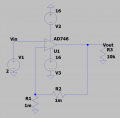
upload_2018-9-23_14-24-33.png

When connecting this circuit I get the following waveform
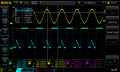
NewFile1.png


It looks like the output is saturating approximately at my +16V supply. I do not understand why this is happening nor do I understand how to fix this in a practical manner. I thought the op-amp would saturate at +/-8V input if I have a 2V/V gain and 16V supply.

I have found a fix for this but it involves adding some offset to the input voltage waveform which for some reason allows me to have more expected behavior at the output.

Any help on this issue would be appreciated.

Thanks
 

Thread Starter

Melvo

Joined Feb 19, 2018
19
Also, in the scope capture you see a sine waveform when I said I originally input a square waveform. I did this to hopefully gain some sort of insight on what is going on.
 

Thread Starter

Melvo

Joined Feb 19, 2018
19
Bertus,

Ah yes, you are right. I did not run the simulation, but when I physically built the circuit I used 1MegOhm.

Thanks
 

ebp

Joined Feb 8, 2018
2,332
It looks to me like the negative supply is not connected. If you built this on a breadboard you might have missed by one hole. I've also seen pins of DIPs get bent up under the body instead of going in a hole.
I'm not totally convinced that is what is wrong since the amp appears to be behaving as a comparator, which suggests the feedback resistor is not properly connected. Note that the positive supply pin is 7, not 8 as might be expected.

I always recommend scoping each pin, right on the pin itself when possible, just to check for things like missed connections.

The circuit should be fine with 1 meg resistors. The amp is a FET type so the input bias current is very low. 1M resistors will add a bit more noise than lower values.
 

Thread Starter

Melvo

Joined Feb 19, 2018
19
ebp,

I took the entire circuit apart and rebuilt with the same results. It is possible that my circuit connection to my power supply is messed up. I will take a picture of my setup. This is such a simple circuit it's frustrating that it is not working lol. I've worked with other op-amps with no issue. I am using this one because of the slew rate.
It looks to me like the negative supply is not connected. If you built this on a breadboard you might have missed by one hole. I've also seen pins of DIPs get bent up under the body instead of going in a hole.
I'm not totally convinced that is what is wrong since the amp appears to be behaving as a comparator, which suggests the feedback resistor is not properly connected. Note that the positive supply pin is 7, not 8 as might be expected.

I always recommend scoping each pin, right on the pin itself when possible, just to check for things like missed connections.

The circuit should be fine with 1 meg resistors. The amp is a FET type so the input bias current is very low. 1M resistors will add a bit more noise than lower values.
 

ebp

Joined Feb 8, 2018
2,332
Something is still wrong. Adding a resistor has simply masked whatever that is.

Phase reversal does not happen unless the input exceeds the allowable common mode voltage range. If you have ±16 V supplies, the common mode voltage range for the LF356 is at least ±11 V. You are nowhere near this, and with a gain of, even if the 2 Vp-p signal is swinging +2 V with respect to ground or -2 V with respect to ground, the output should be clean with no sign of clipping. With a light load, the output should be able to swing within about 3 volts of the supply rails.
 

danadak

Joined Mar 10, 2018
4,057
Totally agree with ebp, CM limits are -

upload_2018-9-23_19-44-30.png

Its acting like - supply pin is at ground or >> -16, eg. much closer to ground.

Regards, Dana.
 

ebp

Joined Feb 8, 2018
2,332
If the power supplies really are ±16 V and not +16 V and 0 V, then I really suspect some sort of connection problem. Even on a single supply, I can't rationalize how the output has become rectangular from a sinusoid at the input, plus the output swings closer to zero than I would expect with single supply. The amp has offset adjust pins, and I have no idea, without spending more time than I care to, what would happen if those pins were misconnected, especially to a power supply.

Phase reversal can be rather nasty in error amplifiers in closed loop systems, especially when it results in the big electrical club swinging at you when it should be swinging away.
 

BobaMosfet

Joined Jul 1, 2009
2,211
@ebp-

I think the OP is not seeing/connecting/or-checking something right- I suspect input voltage. The only reason you see an output square-wave is because the OpAmp is attempting to amplify beyond the rail-to-rail voltage, and it's being clamped. the anomoly in the wave-form is a failure in the OpAmp to hold it at the rail because of how the OpAmp is designed internally.

Speaking to a single-ended non-inverting input, that is. Just going by original drawing.
 

BobaMosfet

Joined Jul 1, 2009
2,211
Can the OP confirm the schematic as stated (with the exception of the OpAmp itself) is truly representative of the circuit? I mean, simulated, the circuit works as expected with values shown. 1M/1M+1 = gain of 2, and this behaves. Should not see rail-to-rail unless non-inverting input gain wired wrong, or input voltage causing OpAmp to go to rails.
 

ebp

Joined Feb 8, 2018
2,332
I agree the flat top is due to the limit of the swing of the amp, but the slew rate is far too great for a gain of 2 with a sinusoidal input and the output should get nowhere near the positive rail with that gain and the input signal as it appears on the 'scope. And the amp is inverting! It looks to me like it is running open loop - behaving as a comparator. I'm becoming more and more supicious that the input or ??? is connected to one of the offset adjust pins.
 

BobaMosfet

Joined Jul 1, 2009
2,211
I agree the flat top is due to the limit of the swing of the amp, but the slew rate is far too great for a gain of 2 with a sinusoidal input and the output should get nowhere near the positive rail with that gain and the input signal as it appears on the 'scope. And the amp is inverting! It looks to me like it is running open loop - behaving as a comparator. I'm becoming more and more supicious that the input or ??? is connected to one of the offset adjust pins.
Yes, agreed. A gain of 2 should not produce this (and does not in simulation, as expected). And yes, you noticed the output was inverted as well. At this point I'm skeptical that the breadboard is wired to match the schematic given. Easy mistake.
 
Top