Because you would have to bias the single output transistor in the linear region and it will run very hot.@MrChips , yes 8ohm speaker. Why is this not suitable as an audio amp?
That's not a problem, after all it is only ~0.5A of current. The problem is rather how to bias the ~3V output so there is no DC offset. The only idea I have in mind is to add a push pull stage now?Because you would have to bias the single output transistor in the linear region and it will run very hot.


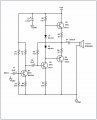
C6 I have added for a feedback purposes. I have changed the feedback path to R12 - R1 but it destroyed the output completely.1. What on earth is C6?
2. Feedback comes from the output.
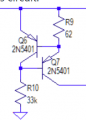
3. Bias diodes go in series with R9.
4.You can’t put capacitive coupling inside the feedback loop.
5. a 5V supply is rather limiting when you will lose 1.3V in each Darlington .


2. Feedback comes from the output.How can I fix it?
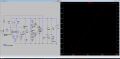
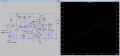
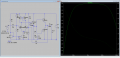
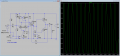
@Ian0, I have connected feedback from output to input. There are no diodes on my current schematic but I believe you meant to say "voltage multiplier" formed by Q10 so I removed it for now as I want to focus on stable gain first. Lastly capacitive coupling was removed - results are even worse:2. Feedback comes from the output.
3. Bias diodes go in series with R9.
4.You can’t put capacitive coupling inside the feedback loop.
You can never have too much open-loop gain.


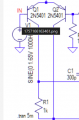
Not quite, I had collector resistors of 1k on differential pair - yes, but I had it on both of them. @Danko 's version has resistive load on one of them, which automatically introduces current imbalance?R1 is the load for the long-tailed pair. Isn't it the same as you had? (as in post #8) A current mirror does a better job.


That's the one. Remembered who told me, but not how it worked!
Yes, it fixed oscillation. Thank you. However how does it help here? Does it create a pole at low frequencies so that the gain doesn't exceed 1?Put 220pF between base and collector of Q5, that should sort it out.
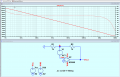
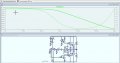
Yes, makes sense to maintain negative feedback. @ericgibbs , can you help to establish the open loop gain for below circuit?You need to make sure that the open circuit gain reduces to less than unity, before the phase shift reaches 180°.

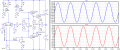
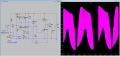
Not sure I get your point here. First, this proposal introduces a DC offset at the output + distorts it:2. You need a boostrap circuit. You have probably realised that the base current delivered to Q7 by R9 gets very small as the output voltage approaches the negative supply. To improve that, split R9 into two 50Ω resistors in series, then connect a capacitor (say 100uF) between the junction of the two parts of R9, and output. That will provide extra drive for Q7 at low output voltages.