Level shifting - transistor type selection

Thread Starter

mondo90

Joined May 16, 2025
125
Underbiassed refers to the fact that there is no standing current through the output stage, so the Base voltage of the output transistors has to jump to +0.6V before any positive current can flow in the load, and the jump to -0.6V before any negative current flows. There is a dead band in the middle when no current flows.
I see what you mean, yes, I was even surprised the output I got doesn't expose any crossover distortion. I believe the negative feedback came as a cure here - whenever the output wants to show some distortion the feedback loop enhances the gain as to oppose this change. Am I right? Do you think I still should add those biasing diodes or voltage multiplier as I had them in earlier posts?

I am doing some study on the output impedance & pole compensation, will likely come back with some more questions soon :)

Thanks!
 

Ian0

Joined Aug 7, 2020
13,132
I see what you mean, yes, I was even surprised the output I got doesn't expose any crossover distortion. I believe the negative feedback came as a cure here - whenever the output wants to show some distortion the feedback loop enhances the gain as to oppose this change. Am I right? Do you think I still should add those biasing diodes or voltage multiplier as I had them in earlier posts?

I am doing some study on the output impedance & pole compensation, will likely come back with some more questions soon :)

Thanks!
Have a look at the waveform on the bases of the output transistors. You will see how much of a jump it requires to get over the dead zone in the middle.
The feedback can make a better job of reducing the crossover distortion if the compensation capacitor is connected to the output rather than the collector of the Voltage amplifier transistor.
If you do the "two diode" bias, you need some emitter resistors to set the current, because if you overdo the bias things get warm very quickly.
Or you can use a single diode, which gives the feedback a bit of help, but never allows the output stage into conduction.
 

Thread Starter

mondo90

Joined May 16, 2025
125
Or you can use a single diode, which gives the feedback a bit of help, but never allows the output stage into conduction.
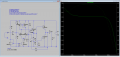
But I observe no gain when a single diode is added + waveform is clipped, so really no benefit:
1757620506509.png
As for the compensation capacitor, I was trying to obtain the frequency at which the phase is 180 and magnitude 0 db (following the tutorial from @ericgibbs
) but I have some problems:
1. I've shorted the input source and labeled output by "Gain" and feedback input by "Feed", however on the tracing view I can not do Feed/Gain as it says "Unknown voltage Feed", same for the gain, why is that?
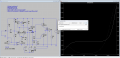
2. I continued by using the default nodes n005 (gain) and n007(feed) to get the frequency where the phase shifts by 180 degree while gain is 1 (0db) but as you can see below, there is no such place:
1757620130674.png

The phase gets close to 180 degrees starting from 1Khz but the gain never reaches 0db so therefore the system should be stable in this frequency window, what is wrong then?

PS: The video tutorial is not fully clear to me, they break the feedback and replace it with 0V DC source and then it looks like that put AC 1V source on top of that - when I do it in LTspicie the system correctly throws an error "over-defined source".

Thanks.
 

Attachments

Top