Level shifting - transistor type selection

Thread Starter

mondo90

Joined May 16, 2025
125
Because you would have to bias the single output transistor in the linear region and it will run very hot.
That's not a problem, after all it is only ~0.5A of current. The problem is rather how to bias the ~3V output so there is no DC offset. The only idea I have in mind is to add a push pull stage now?
 

Ian0

Joined Aug 7, 2020
13,132
Precisely, you need to add a complementary emitter follower.
You don't need to bother about the 3V offset, as you just capacitively couple to the speaker.
 

Thread Starter

mondo90

Joined May 16, 2025
125
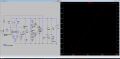
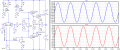
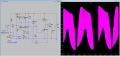
I have added push pull stage, but still something is off:
1757057328956.png

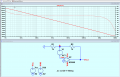
Bode plot shows in the audio band I have nothing but loss of signal gain, however there actually is a gain in transient analysis at 1kHz:
1757057570152.png
This should be ~1.7 db, so what's wrong with the bodle plot which always shows negative gain?

Also, 1.7 db is not impressive either. What can I improve?
 

Ian0

Joined Aug 7, 2020
13,132
1. What on earth is C6?
2. Feedback comes from the output.
3. Bias diodes go in series with R9.
4.You can’t put capacitive coupling inside the feedback loop.
5. a 5V supply is rather limiting when you will lose 1.3V in each Darlington .
 

MrChips

Joined Oct 2, 2009
34,824
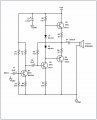
Here is an example of a push-pull output stage.
Notice the higher supply voltage and power transistors at the driver and output.

Edit: The polarity of C2 should be reversed.

1757058636214.jpeg
 

Thread Starter

mondo90

Joined May 16, 2025
125
1. What on earth is C6?
2. Feedback comes from the output.
3. Bias diodes go in series with R9.
4.You can’t put capacitive coupling inside the feedback loop.
5. a 5V supply is rather limiting when you will lose 1.3V in each Darlington .
C6 I have added for a feedback purposes. I have changed the feedback path to R12 - R1 but it destroyed the output completely.
How should I form this feedback loop then? As for the diodes, I can't really place them in series with R9 as this alters the first stage gain. I am attaching ltspicie file if you can correct that, I would appreciate.
 

Attachments

Thread Starter

mondo90

Joined May 16, 2025
125
I have made some further progress in terms of obtaining expected gain, but my waveform as well as frequency response is far from perfect:
1757142925415.png
In green is input, blue is output.
Frequency response?
1757143029761.png

I think my negative feedback is still not working properly. In fact currently I have two feedback paths, the main one is between emitter of Q5 and base of Q2 - I had to add it otherwise the gain out of Q5 is too high. How can I fix it?

Thank you.
 

Thread Starter

mondo90

Joined May 16, 2025
125
2. Feedback comes from the output.
3. Bias diodes go in series with R9.
4.You can’t put capacitive coupling inside the feedback loop.

You can never have too much open-loop gain.
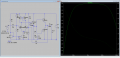
@Ian0, I have connected feedback from output to input. There are no diodes on my current schematic but I believe you meant to say "voltage multiplier" formed by Q10 so I removed it for now as I want to focus on stable gain first. Lastly capacitive coupling was removed - results are even worse:
1757187837270.png

@Danko , thanks for your example. I like this amplifier, I like how simple it is to control the gain (just adjust R3), however it utlizes double supply which I don't have ;/
Nevertheless I have a few questions to it:
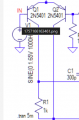
What is this:
1757188915593.png

I already saw it on somebody's else diagram, it looks like a weird current mirror? How is it different/better?

Next, why did you add 1k resistor to only Q1's collector?
1757188959768.png

@Ian0 keeps repeating feedback should go from output to input but in your case, just as I saw in many others, the feedback signal actually goes to the non signal transistor of differential pair,why?

Thanks!
 

Ian0

Joined Aug 7, 2020
13,132
Your circuit has a differential amplifier aka long-tailed pair, which has two inputs. One is the inverting input and one is the non-inverting input. Feedback goes to the inverting input.
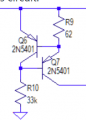
@Danko 's circuit with the two transistors and a 62Ω resistor is a constant current source. You used a current mirror.
R1 is the load for the long-tailed pair. Isn't it the same as you had? (as in post #8) A current mirror does a better job.
 

Thread Starter

mondo90

Joined May 16, 2025
125
R1 is the load for the long-tailed pair. Isn't it the same as you had? (as in post #8) A current mirror does a better job.
Not quite, I had collector resistors of 1k on differential pair - yes, but I had it on both of them. @Danko 's version has resistive load on one of them, which automatically introduces current imbalance?

Thanks for your inverting/non-inverting hint, I got it, I corrected my version further:
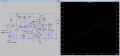
1757192290487.png
It looks much better now, however the bode plot below shows very little gain <2db while the amplitude plot above suggests
~17 db of gain, where is this inconsistency coming from?
1757192238005.png
 

Ian0

Joined Aug 7, 2020
13,132
From your first plot you seem to have half a Volt in and 3.5V out, which is a gain of 7, or 17dB.
From an AC signal point of view, R2 and R13 are in parallel, so your gain should be 1+(R1/(R2||R13), whch is 1+3000/500 which is 7.
The Bode plot does indeed show a gain of 1.5dB, which looks a bit weird. First make it plot In and Out separately, to see which one doesn't match the settings. Then I would suggest giving a part number to all the transistors and trying again, because SPICE's generic models don't work too well. It often needs "real" transistors.
The next things you need to know:
1. Your output capacitor is too small, unless you really don't like the sound of bass, as it cuts off at 200Hz.
2. You need a boostrap circuit. You have probably realised that the base current delivered to Q7 by R9 gets very small as the output voltage approaches the negative supply. To improve that, split R9 into two 50Ω resistors in series, then connect a capacitor (say 100uF) between the junction of the two parts of R9, and output. That will provide extra drive for Q7 at low output voltages.
 

Thread Starter

mondo90

Joined May 16, 2025
125
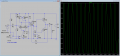
@Ian0 , a lot of good suggestions I will address all of them but first, I got stopped by horrendous output once I replaced generic transistors with "real" models:
1757265310880.png
It looks like the entire circuit entered oscillation? How is that possible a generic model worked quite well, and here we have such a big difference? Is that caused by transistors internal capacitance that changes frequency response so much?
 

Ian0

Joined Aug 7, 2020
13,132
That's the danger of using the generic models.
Put 220pF between base and collector of Q5, that should sort it out.
You need to make sure that the open circuit gain reduces to less than unity, before the phase shift reaches 180°.
There's a neat trick in SPICE to measure the open-loop gain, with a voltage source in the inverting input. @ericgibbs told me about it, but I've forgotten the exact details.
 

Thread Starter

mondo90

Joined May 16, 2025
125
Put 220pF between base and collector of Q5, that should sort it out.
Yes, it fixed oscillation. Thank you. However how does it help here? Does it create a pole at low frequencies so that the gain doesn't exceed 1?
You need to make sure that the open circuit gain reduces to less than unity, before the phase shift reaches 180°.
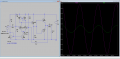
Yes, makes sense to maintain negative feedback. @ericgibbs , can you help to establish the open loop gain for below circuit?
1757267793328.png

@Ian0 , the gain in db has improved after I replaced generic parts with real ones but is still below what the transient analysis shows (7db vs 5db).

2. You need a boostrap circuit. You have probably realised that the base current delivered to Q7 by R9 gets very small as the output voltage approaches the negative supply. To improve that, split R9 into two 50Ω resistors in series, then connect a capacitor (say 100uF) between the junction of the two parts of R9, and output. That will provide extra drive for Q7 at low output voltages.
Not sure I get your point here. First, this proposal introduces a DC offset at the output + distorts it:
1757268364444.png

Second, the impedance seen by Q7 base should be the same as Q6 base right? When the input goes below C5, then the impedance it sees is R4 on the other hand when input goes above C5 the impedance seen is that of Q5, so I think the goal is to make Q5 resistance = R4?

Thanks.
 
Top