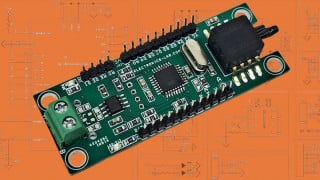
Judging from your question you have a long road ahead. What you are showing is merely a "display". How to make it light up is going to take some form of microcontroller, small computer, PI, or something along those lines and some programming. To make it playable is going to take actually programming the game itself.
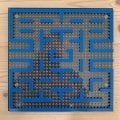
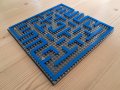
To make this Lego Pac-Man LED hybrid "playable" in the sense of having a visual display of Pac-Man and ghosts moving through the maze, and ideally interacting with the physical Lego maze, you would need several components and a significant amount of programming.
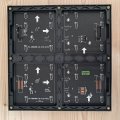
LED Controller Card: To drive the LED display, a compatible controller card is needed. This card connects to your computer or microcontroller and sends the image data to the LED modules. Common types include NovaStar, Colorlight, or Linsn. The specific model will depend on your LED module.
Power Supply: LED displays require a significant amount of power. You'll need a suitable DC power supply (e.g., 5V) with enough amperage to power all the LED modules you plan to use.
Cables:
Data Cables: Flat ribbon cables to connect the LED modules to each other and to the controller card (as seen on the back of the module, labeled "INPUT" and "OUTPUT").
Power Cables: To distribute power from the power supply to each LED module.
Integrating the Lego Maze and LED Display:
Physical Mounting/Enclosure: You'll need a way to securely mount the LED display module(s) behind or beneath your Lego maze. The clear baseplate of the Lego maze is crucial here, as it allows the light from the LEDs to shine through. You'll need to ensure proper alignment so the LED pixels correspond to the "grid" of your Lego maze.
The "Playable" Aspect (Software & Interaction):
Microcontroller or Computer:
For simpler animation/interaction: An Arduino, Raspberry Pi, or similar microcontroller could be used to control the LED display. This would involve programming the microcontroller to send pixel data to the LED controller card.
For more complex gameplay: A Raspberry Pi or a full-fledged computer would be better suited, especially if you want to implement actual Pac-Man game logic, including user input and AI for ghosts.
Input Method:
Physical Controls: If you want a truly playable game, you'll need joysticks or buttons for the player to control Pac-Man. These would be connected to your microcontroller/computer.
Graphics Rendering: You'll need to translate your game state (position of Pac-Man, ghosts, dots) into pixel data that can be sent to the LED display. This involves mapping your game's grid to the LED module's pixel array.
Functional LED Display: Get the front of the display, a compatible controller card, and a power supply all working together.
Physical Integration: Securely mount the LED display under your Lego maze.
Control System: A microcontroller (like Raspberry Pi) or computer to run the game logic and drive the LED display.
Software Development: Program the Pac-Man game logic and the display control.
Input Mechanism: Joysticks or buttons for player control.

 Facebook
 Google
 GitHub
 Linkedin
 1.9 MB Views: 11
 3.1 MB Views: 12
 1.8 MB Views: 12