LED - VF, IF vs Reality education

Thread Starter

staples

Joined Nov 10, 2019
7
I have been playing with electronics a while, and LED's a while, but for the most part have stayed away from any real calculation and true "Power" stuff. With a new project, I realized I wanted to learn a bit more.

Project. Room LED light, Shines dim, until I call for full light. (though the project is irrelevant to the problem)

Situation:
I want to create a bright enough light to work with when on full brightness. I purchased some 3W LED beads (VF = 2.0-2.4; IF = 400-700). Figured I would need about 10 or 15 to create the right amount of light. For reference I used LEDCalculator to calculate the limiting resistor .

I know/believe the LED's will take whatever power they take and over running the voltage will create a runaway with current and short life for the LED. I also know the ranges are defined on paper but the LED behave as they behave.

However I was interested in understanding what I am seeing. Using the LED calculator 5 LED's with 2.1Vf and 400mA, I would expect a total power consumed of 4.2W (10.5v * 400mA = 4200mW)

Putting the LED's on a bench with a 10.5V supply, I get 2400mW consumed power. the LED's stayed cool, so don't feel they are over-worked. this would say consumed amperage is 240mA (about 1/3 of total possible)

If I increase the voltage to 12v I get about the 4200mW expected. But this would be the top end of the Vf and the bottom end of IF.

Please note, for education, I removed the current limiting resistor, to better understand the actual power consumed from the bench supply.

Not inclined to run the voltage up until I get to the 700mA IF limit and see what VF would be.

Just looking to get a better understanding how you would actually use these values, if you were to design a circuit, how actually would you determine the "optimal" IF and/or VF?

Thanks in advance
 

dl324

Joined Mar 30, 2015
18,326
Welcome to AAC!
Please note, for education, I removed the current limiting resistor, to better understand the actual power consumed from the bench supply.
It's not a good idea to do this. To calculate power dissipation in the LEDs, you just need to know the voltage they're dropping and the current through them.
Just looking to get a better understanding how you would actually use these values, if you were to design a circuit, how actually would you determine the "optimal" IF and/or VF?
Optimal is ambiguous. LEDs have a maximum continuous current rating and should have a peak current specified for multiplexed operation. Operating LEDs at their maximum continuous current rating will likely reduce their lifetime. Since you're using "high power" LEDs, cooling is important for longevity.

If you don't use a current source, connecting as many in series (with a current limiting resistor) will waste the least amount of power. If you use multiple series strings, each string requires its own current limiting resistor.

If you use a current source, how many you can put in series depends on the source.
 

WBahn

Joined Mar 31, 2012
32,823
I want to create a bright enough light to work with when on full brightness. I purchased some 3W LED beads (VF = 2.0-2.4; IF = 400-700). Figured I would need about 10 or 15 to create the right amount of light.
Just how bright do you need it to be to work with? A typical LED replacement bulb for a 60 W incandescent consumes about 9 W. So if you ran your LEDs at their rated 3 W and had fifteen of them, that would be about comparable to five 60 W bulbs. Do you really need that much light for what you are doing?

Be that as it may.

I know/believe the LED's will take whatever power they take and over running the voltage will create a runaway with current and short life for the LED. I also know the ranges are defined on paper but the LED behave as they behave.

However I was interested in understanding what I am seeing. Using the LED calculator 5 LED's with 2.1Vf and 400mA, I would expect a total power consumed of 4.2W (10.5v * 400mA = 4200mW)
Not completely sure what it is that you are seeing that you are trying to understand, but let's see if this helps.

It appears that you are interpreting the data sheet as saying that the LEDs will consume 400 mA at 2.0 V and 700 mA at 2.4 V.

That's not at all what they are saying. You will need to look at the data sheet more closely, but you should find a note of some kind telling you the test conditions. For the Vf, it will be a test conducted at a specific current. They likely held the device temperature constant at 25°C, probably by using a pulsed measurement technique. What they are saying is that if you pick one of these LEDs at random and put that current through it, that the voltage you will fall fall within that range of voltages. They usually don't give a range of currents, but they might supply a typical graph of voltage versus current that says that if you average the results over lots and lots of devices, this is what you see on average. Any given device can be different by quite a bit.

Putting the LED's on a bench with a 10.5V supply, I get 2400mW consumed power. the LED's stayed cool, so don't feel they are over-worked. this would say consumed amperage is 240mA (about 1/3 of total possible)
How were you getting the consumed power figure? What you wrote reads like you got the power number and calculated the current from that. Usually it would be the other way around -- the supply will tell you the current it is delivering and you calculate the power from that and the voltage.

If I increase the voltage to 12v I get about the 4200mW expected. But this would be the top end of the Vf and the bottom end of IF.
It just says that, at 350 mA that the average Vf of those five LEDs is 2.4 V. Pick another five from a different batch and you might be at that current at a total voltage of about 10 V.1

Please note, for education, I removed the current limiting resistor, to better understand the actual power consumed from the bench supply.
Not really a good idea, unless you are willing to risk letting the magic smoke out of things and possibly starting a fire. But, with care, doing so can be educational.

Not inclined to run the voltage up until I get to the 700mA IF limit and see what VF would be.
Probably a good idea, as you are very likely to induce thermal runway if you push the max current.

Just looking to get a better understanding how you would actually use these values, if you were to design a circuit, how actually would you determine the "optimal" IF and/or VF?
Normally what you would do is determine how much current you need to get the illumination you need and then design a constant current circuit (or by a chip or power supply module that does that) to drive the LEDs.
 

Thread Starter

staples

Joined Nov 10, 2019
7
It's not a good idea to do this. To calculate power dissipation in the LEDs, you just need to know the voltage they're dropping and the current through them.
I figured this was not appropriate for actual design, thus the reason I called it out. But in my model, I could calculate the the LED are dissipating about 2.1V ( 10.5v/5LED's), not sure how I could calculate that with the current limiting resistor?

If you don't use a current source, connecting as many in series (with a current limiting resistor) will waste the least amount of power. If you use multiple series strings, each string requires its own current limiting resistor.
But here is my lack of knowledge. If I wanted to use a current source (Assuming you mean what I would know as a Constant current Driver?) how would I actually know what current to use? I cannot understand what it should be from the info (400 to 700 mA). where my example consumed 240mA.
 

Thread Starter

staples

Joined Nov 10, 2019
7
How were you getting the consumed power figure? What you wrote reads like you got the power number and calculated the current from that. Usually it would be the other way around -- the supply will tell you the current it is delivering and you calculate the power from that and the voltage.
I got the power number from my bench supply, I turned it to 10.5V and it read 2400mW.

This is the question, how should you "design this" from the data. I typically just need indicator lights, so a small LED and a larger resistor give an indicator. I have never had to push one to the limits.

Just how bright do you need it to be to work with? A typical LED replacement bulb for a 60 W incandescent consumes about 9 W. So if you ran your LEDs at their rated 3 W and had fifteen of them, that would be about comparable to five 60 W bulbs.
This is where I am trying to get too, as I run this up on the bench to understand I don't know if I am wildly overloading these LED's, way underloading them or what. Trying to understand how this would best be designed. Right now with the units I have if I have 5 on a 10.5v power supply, they take about 2400mW. which seems low(not 3W/LED) but if I move it to 12.1V they draw about 4200mW (still less than 3W/LED) but now I am above the "range" of the sheet (2.0-2.4 VF)


It just says that, at 350 mA that the average Vf of those five LEDs is 2.4 V. Pick another five from a different batch and you might be at that current at a total voltage of about 10 V.1
[...]
Normally what you would do is determine how much current you need to get the illumination you need and then design a constant current circuit (or by a chip or power supply module that does that) to drive the LEDs.
So if I read you correctly, (heat dissipation and longevity at the moment ignored) it does not really matter the VF, as long as I get it up to the desired (required) IF of 400-700, so raising the VF to 2.4, 2.5, etc is still OK as long as it is under the IF (say 700 mA).

So if I am ok with LED's running at only 350 mA, I don't need to worry about getting to 400-700, even if it is over VF (2.0-2.4)? And the situation is if I have Supply of 12v and need more than 2.5V, I likely would need to re-design to 4 in series, since the VF is actually higher (2.5v*5 >12V)?

Not really a good idea, unless you are willing to risk letting the magic smoke out of things and possibly starting a fire. But, with care, doing so can be educational.
I am willing to let out the magic smoke to learn, but hoping that will improve what I do when installed.
 

BobTPH

Joined Jun 5, 2013
11,514
3W LED beads (VF = 2.0-2.4; IF = 400-700)
These cannot be correct. 2.4V at 700mA is only 1.7W. Are these specs from an AliExpress seller or a legitimate datasheet?

What color are they? White 3W LEDs will have a forward voltage of > 3, and a legitimate 3W one will have a max current of closer to 1A. 2.4V is typical for a red 3W LED.
 

WBahn

Joined Mar 31, 2012
32,823
What color are these LEDs? The 2 V range is typically for red/orange LEDs. Illumination LEDs are more typically white and in the 3 V to 3.6 V range. Is this, perhaps, for a dark room?

A commonly used rule of thumb is that whatever the data sheet says the maximum continuous forward current in the LED is, don't exceed half of that. I haven't done much with high-power LEDs, so I don't know if people that work with them adhere to that rule of thumb or use something more appropriate, but it's going to be along those lines. This is a widely-used rule of thumb for how much power to ask any device to deal with -- no more than half its rating. If you do that, then most electronic components will never fail due to heat stress and will have extremely long lifetimes. Of course, that does mean that you are also heatsinking it properly, if needed.

As for how you will know the voltage if you use a current limiting resistor, it is called a DMM (digital multimeter). If you don't have one, get one. They are the work horse of the electronics world. The good news is that you can get them dirt cheap (sometimes even free from places like Harbor Freight) and the cheap ones are usually more than good enough for the beginner.
 

Thread Starter

staples

Joined Nov 10, 2019
7
These cannot be correct. 2.4V at 700mA is only 1.7W. Are these specs from an AliExpress seller or a legitimate datasheet?

What color are they? White 3W LEDs will have a forward voltage of > 3, and a legitimate 3W one will have a max current of closer to 1A. 2.4V is typical for a red 3W LED.
Red LED's
Amazon. So no, not a legitimate datasheet.
 

Thread Starter

staples

Joined Nov 10, 2019
7
As for how you will know the voltage if you use a current limiting resistor, it is called a DMM (digital multimeter). If you don't have one, get one. They are the work horse of the electronics world. The good news is that you can get them dirt cheap (sometimes even free from places like Harbor Freight) and the cheap ones are usually more than good enough for the beginner.
Have one. I guess I will have to learn more about measuring components in a circuit. Guess that will be one to add to my education plan. Thanks for the guidance.
 

dl324

Joined Mar 30, 2015
18,326
how would I actually know what current to use? I cannot understand what it should be from the info (400 to 700 mA). where my example consumed 240mA.
You can determine experimentally what current gives you the brightness you want. If the maximum continuous current doesn't give sufficient brightness, you need to buy ones that have more brightness.
 

LowQCab

Joined Nov 6, 2012
5,101
Lets put this in a more simplified form ...........

FORGET ABOUT THE VOLTAGE

The Voltage figures/graphs are just to help you in calculating the minimum Voltage of your Power-Supply.

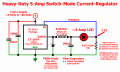
Build or purchase a "Current-Regulator" Circuit / Board / Module.

For initial Bench tinkering ............
Pay zero attention to the Voltage read-out of your Bench-Supply.
Set the Voltage of your Bench-Supply to it's maximum.
Set the Current of your Bench Supply to its minimum,

then connect a string of LEDs,
then slowly increase the Current and observe the Light-Output You get at a particular amount of Current.

Do not exceed the maximum-rated-Current,
and regularly check for overheating with fingers, and/or, a Digital-Infa-Red-Temperature-Gun.

If you expect to have a long life expectancy, ( ~5-years or more ),
do not exceed ~50% of the maximum-Rated-Current,
and insure adequate Heat-Sinking.

The only reason Voltages are provided in the Spec-Sheet is so that you can calculate
the minimum Power-Supply-Voltage that will be required to run your LEDs at a chosen Current.
And, of course, if You have a string of multiple LEDs, You must multiply
the "required", "minimum", Power-Supply-Voltage by the number of LEDs in a string.

Never adjust the LED-brightness by varying the "Voltage", the Voltage will fluctuate all over the place.
As long as the Voltage is "adequate", ignore the Voltage completely.

Always adjust the LED-brightness by varying the "Current",
only the Current determines the brightness.

Now You know how LEDs work.
.
5A 60V Current Source .png
 

MisterBill2

Joined Jan 23, 2018
27,504
ALWAYS, LEDs are very non-linear in the voltage/current relationship. And that varies a bit between batches, usually.
Mostly, voltage regulators are easier than current regulators, and almost always, voltage is easier to measure than current. With LEDs the current is certainly what must be controlled, and so it must be measured.
The challenge being that usually voltage is easier to control than current. So the common scheme is to assemble the desired length of string of LEDs and then, under control, with a bit of series resistance, adjust the voltage to have the intended current. At that point it becomes simple to add some series resistance and set a voltage regulator to the voltage that provides the intended current.
Complecated to describe, fairly simple to do.
 

Thread Starter

staples

Joined Nov 10, 2019
7
The challenge being that usually voltage is easier to control than current. So the common scheme is to assemble the desired length of string of LEDs and then, under control, with a bit of series resistance, adjust the voltage to have the intended current. At that point it becomes simple to add some series resistance and set a voltage regulator to the voltage that provides the intended current.
Complecated to describe, fairly simple to do.
This is likely the most interesting learning of my education on this subject. My 1st Grade electronics education is about formulas, feeling rigid controlled math like calculations. It is interesting to find that it is much more estimate, then verify and adjust. That LED's can vary that much is interesting.

I learned a lot from this. There is a lot more learning to do.

Thanks again for your help
 

LowQCab

Joined Nov 6, 2012
5,101
Just wait 'till You start trying to figure-out Inductors, you'll pull-out all your hair.

If You ever try to construct an Inductor from scratch,
You will find that Inductors have formulas that will only give You a
supposed "close-estimate" as to how they will actually perform in the real-world.

Even "store-bought" Inductors, from a reputable manufacturer, have rather "loose" specifications.
.
.
.
 

BobTPH

Joined Jun 5, 2013
11,514
Just to add another layer for you to contemplate, consider the simple circuit of an LED and a series resistor.

Quite simple, right? The LED drops a certain voltage at a certain current. Say 20mA at 3V. You power with a higher voltage, say 5V and the calculate the resistor needed to drop the extra 2V and everything works out. A few calculations will show you that nothing really bad happens is the LED has a slightly lower or or higher forward voltage.

But it is actually more subtle than that.

The forward voltage of an LED drops when it gets hotter. So that means more current flows, making it hotter still. If there was no resistor, this can run out of control until the LED gets too hot and is destroyed. This will happen if you try to drive high power LEDs with a constant voltage.

But with a resistor, something else happens. When the current increases, the resistor drops more voltage, leaving less for the LED. This is called negative feedback. Negative feedback stabilizes an unstable situation by countering a change with another change that pushing in the opposite direction. This is an extremely important concept in electronics. It is how a temperature controller can keep the temperature constant and an audio amplifier can make the output track the input with minimal distortion.
 

MisterBill2

Joined Jan 23, 2018
27,504
Just to add another layer for you to contemplate, consider the simple circuit of an LED and a series resistor.

Quite simple, right? The LED drops a certain voltage at a certain current. Say 20mA at 3V. You power with a higher voltage, say 5V and the calculate the resistor needed to drop the extra 2V and everything works out. A few calculations will show you that nothing really bad happens is the LED has a slightly lower or or higher forward voltage.

But it is actually more subtle than that.

The forward voltage of an LED drops when it gets hotter. So that means more current flows, making it hotter still. If there was no resistor, this can run out of control until the LED gets too hot and is destroyed. This will happen if you try to drive high power LEDs with a constant voltage.

But with a resistor, something else happens. When the current increases, the resistor drops more voltage, leaving less for the LED. This is called negative feedback. Negative feedback stabilizes an unstable situation by countering a change with another change that pushing in the opposite direction. This is an extremely important concept in electronics. It is how a temperature controller can keep the temperature constant and an audio amplifier can make the output track the input with minimal distortion.
Indeed "feedback" makes the whole thing a lot more complex, and with an LED being one case of a diode, even a bit more complex than would be expected. So the basic equation is simple UNTIL you add in the different things that affect the results, temperature being the most obvious one. another one is the effect of incident light: Some LEDs will produce an output voltage that is easily measured when light falls on the active surface. Others do not produce an easily measured voltage. It is a very simple experiment, connect a digital voltmeter (a multimeter set to read low voltage) across an LED and shine light into the LED. The voltage will range from a few millivolts to over a volt, depending on the color and the brand of LED. Even similar colors by different brands will produce different voltages.
This was the basis for an LED transceiver project in Popular Electronics Magazine back around 1970. And the concept was actually patented, according to the author. So the effect has been present in some LEDs for a long time.
 
Top