Facebook
 Google
 GitHub
 Linkedin
I have been playing with electronics a while, and LED's a while, but for the most part have stayed away from any real calculation and true "Power" stuff. With a new project, I realized I wanted to learn a bit more.
Project. Room LED light, Shines dim, until I call for full light. (though the project is irrelevant to the problem)
Situation:
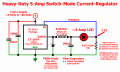
I want to create a bright enough light to work with when on full brightness. I purchased some 3W LED beads (VF = 2.0-2.4; IF = 400-700). Figured I would need about 10 or 15 to create the right amount of light. For reference I used LEDCalculator to calculate the limiting resistor .
I know/believe the LED's will take whatever power they take and over running the voltage will create a runaway with current and short life for the LED. I also know the ranges are defined on paper but the LED behave as they behave.
However I was interested in understanding what I am seeing. Using the LED calculator 5 LED's with 2.1Vf and 400mA, I would expect a total power consumed of 4.2W (10.5v * 400mA = 4200mW)
Putting the LED's on a bench with a 10.5V supply, I get 2400mW consumed power. the LED's stayed cool, so don't feel they are over-worked. this would say consumed amperage is 240mA (about 1/3 of total possible)
If I increase the voltage to 12v I get about the 4200mW expected. But this would be the top end of the Vf and the bottom end of IF.
Please note, for education, I removed the current limiting resistor, to better understand the actual power consumed from the bench supply.
Not inclined to run the voltage up until I get to the 700mA IF limit and see what VF would be.
Just looking to get a better understanding how you would actually use these values, if you were to design a circuit, how actually would you determine the "optimal" IF and/or VF?
Thanks in advance
Project. Room LED light, Shines dim, until I call for full light. (though the project is irrelevant to the problem)
Situation:
I want to create a bright enough light to work with when on full brightness. I purchased some 3W LED beads (VF = 2.0-2.4; IF = 400-700). Figured I would need about 10 or 15 to create the right amount of light. For reference I used LEDCalculator to calculate the limiting resistor .
I know/believe the LED's will take whatever power they take and over running the voltage will create a runaway with current and short life for the LED. I also know the ranges are defined on paper but the LED behave as they behave.
However I was interested in understanding what I am seeing. Using the LED calculator 5 LED's with 2.1Vf and 400mA, I would expect a total power consumed of 4.2W (10.5v * 400mA = 4200mW)
Putting the LED's on a bench with a 10.5V supply, I get 2400mW consumed power. the LED's stayed cool, so don't feel they are over-worked. this would say consumed amperage is 240mA (about 1/3 of total possible)
If I increase the voltage to 12v I get about the 4200mW expected. But this would be the top end of the Vf and the bottom end of IF.
Please note, for education, I removed the current limiting resistor, to better understand the actual power consumed from the bench supply.
Not inclined to run the voltage up until I get to the 700mA IF limit and see what VF would be.
Just looking to get a better understanding how you would actually use these values, if you were to design a circuit, how actually would you determine the "optimal" IF and/or VF?
Thanks in advance