LED sequence project

djsfantasi

Joined Apr 11, 2010
9,237
I didn't miss the resistor; it's right there in the "R-C" part of the sentence. If you reverse the R and C in your drawing, you can eliminate the gate, its diode, and the 10K pulldown resistor. You still need the diode coming from the "4" output.

I don't think you need an additional chip. The 4017 clock input has hysteresis, so you can hang the R, C, and switch on it directly. I'll try to whip out a schematic tomorrow.

ak
Ok. It'll be easier if we have your schematic as well. I have my interpretation of what you said, but the universal language of electronics will show me where I went wrong.
 

AnalogKid

Joined Aug 1, 2013
12,132
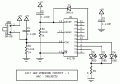
First pass at a schematic. R1/C1 debounce the switch. R2/C2 are the power-on reset. R2 is greater than R1 so the chip is held in reset while the debounce cap charges and the clock input goes low. D1 resets the 4017 when output 4 goes high, snapping it to output 0, the off state. A 4017 output is rated for 4 mA; R3 sets this value approximately. C3 is the decoupling cap for the 4017 power; it should be placed as close as possible to pin 16, with a short lead to pin 8.

ak
4017-LEDs-1-c.gif
 

Attachments

djsfantasi

Joined Apr 11, 2010
9,237
@Zaydonandrew , AnalogKid's schematic is much simpler and easy to follow.

@AnalogKid , I used the debounce circuit I drew because I've found it very reliable. Not saying yours won't work for this purpose, at all!

I only needed one Schmitt trigger inverter for the debounce, but with an extra NAND gate, I could use it in the gated power on reset circuit.

Hence, I needed a full diode OR gate, because the reset from the counter pin could backfeed into the Schmitt trigger. That's where my comment re: a missing resistor was coming from.

Thanks for the dialog!

ZaydoAndrew, hope we haven't scared you off. AnalogKid's solution is very doable!
 
Top