LED Lights - Power Supply / Battery

BobTPH

Joined Jun 5, 2013
11,538
Just to clarify the terminology, when you say two LEDs are in parallel, you are saying that the two anodes are connected together and the two cathodes are connected together. When they have separate resistors, that is not the case. In that case, the combinations of LEDs and resistors are in parallel.
 

Thread Starter

THRobinson

Joined Jun 7, 2018
82
Well the batteries I am looking at are these, they say 1.2v which is what I'm assuming they are.

LED lights, are these ones here. Has a chart but can zoom in on the image of the bags to get the Ohms.

Hopefully links work, on my phone now otherwise LED's were linked to earlier in the thread.
 

Thread Starter

THRobinson

Joined Jun 7, 2018
82
Just to clarify the terminology, when you say two LEDs are in parallel, you are saying that the two anodes are connected together and the two cathodes are connected together. When they have separate resistors, that is not the case. In that case, the combinations of LEDs and resistors are in parallel.
Fair enough, but I did list 4 LED's and 4 resistors and that the red LED needed a different resistor so, terminology may not have been clear but with 4 resistors listed, obviously either each LED was getting its own resistor, or I was (I guess) wiring the resistors together?

Regardless, there's a picture now.
 

Thread Starter

THRobinson

Joined Jun 7, 2018
82
So... no comment on the whether or not the diagram will working, apart from POST #40 saying fully charged batteries will blow the LEDs.

Is that true? and why is this more difficult than it should be? o_O

Seriously though... is this a concern? I thought 3x1.2v batteries was the agreed upon idea, but now told it won't work?
 

Audioguru again

Joined Oct 21, 2019
6,826
My Name Brand 5mm LEDs have a maximum allowed current of 30mA. Your cheap Chinese LEDs from Amazon are only 3mm so might have a lower max current rating but they do not have any current rating.

Charge the Ni-MH batteries to 1.5V each then three make 4.5V.
Most of the LEDs have a voltage rating of 3.0V so 4.5V-3V= 1.5V. 1.5V across the 20 ohms resistor makes a current of 75mA!

Charge to only 1.4V for each cell then the total is 4.2V. The resistor will have 1.2V and the current will be 1.2V/20 ohms= 60mA!
Charge to only 1.3V for each cell then the total is 3.9V. The resistor will have 0.9V and the current will be 0.9V/20 ohms= 45mA!
At such high currents then you should kiss the LEDs good-bye.
 

Thread Starter

THRobinson

Joined Jun 7, 2018
82
My Name Brand 5mm LEDs have a maximum allowed current of 30mA. Your cheap Chinese LEDs from Amazon are only 3mm so might have a lower max current rating but they do not have any current rating.
I think you missed something somewhere... The 3mm were AliExpress, someone said they're not going to be bright enough so bought 5mm LED's from Amazon which list a current rating of 20mAh.

Not sure if cheap Chinese or not, but decent packaging, 2500+ reviews, 4.5 star average. Can't be too bad.
 

Jon Chandler

Joined Jun 12, 2008
1,598
To be safe, calculate the resistor values using the maximum possible battery voltage, so you're calculating the greatest possible current.

Also, consider using a current of only 10 or 15mA instead of 20. The brightness won't decrease much, and you'll have some margin of safety.
 

Thread Starter

THRobinson

Joined Jun 7, 2018
82
Again with the "cheap Chinese" comment. Probably come from the same factory as the "good" ones. :D

Well... I dunno. People said no for 3mm and poo-poo'd the USB charging Lithium battery. I posted the 5mm link and no one commented any issues, so bought those. Was suggested to use 3xAA batteries because 2xAA wasn't enough, but needed AAA for space. So that's what I got.

I hope that's enough otherwise this simple project's getting kicked to the curb because too busy for all the back and forth and ordering parts.

When the holder and batteries arrives I'll fully charge them, get the multimeter out and see what it says. I'll use that calculator from many posts back and use that voltage and instead of 20mAh I'll use 15mAh.

Last year bought some parts for making guitar pedals with. Needed resistors and bought a 1400 pack online of various values. Should have a match for what I need. :D
 

Thread Starter

THRobinson

Joined Jun 7, 2018
82
Sigh, I had a response but kinda boiled down to who gives a s**t. It's four 8" lightsabers that light up and hang on the wall. 54 posts and we're disputing the quality of LED's for a wall ornament. :confused:
 

Tonyr1084

Joined Sep 24, 2015
9,744
Haha, I gotta say... Way more work and effort than I imagined to light up 4 LED lights. :D
I have to disagree with you. Lighting an LED is a very simple and straight forward matter. The ONLY consideration limit is the lowest voltage needed to light the LED. LED's are not voltage operated, they're current based. That's been discussed sufficiently and I'm certain you understand that point. So why am I talking about voltage? Because first, you need enough to light the LED Second, (in theory) there's no limit to how high a voltage you can use. But for the sake of argument let's not discuss thousands of volts as a source but limit the upper end to be 24 volts. Partly because if powered from AC then there's a reverse voltage that can not be ignored. But we're not going there. We're talking batteries. So just for the sake of foolish thinking let's assume you're lighting this with two car batteries in series. And let's assume you want to use 15mA as a target current.
V(battery) minus Vf (LED) is first calculated. Then we consider the target current. This example we're going for 15mA. Here's the math on that scenario:
(V - Vf) ÷ I = R
(24V - 2Vf) ÷ 15mA = 1.47KΩ (also expressed as 1K47)
Regardless (within reason) of the source voltage, the resistor is there to limit the amount of current going through the LED. So it's a pretty straight forward matter. There's no reason to get discouraged. It may just be a lot of information that seems confusing at times. Brush away the confusion and stick with the basics: You want to use three AAA batteries. That's fine. You want 15mA through each LED. That's fine. You need the proper resistor for each LED based on its forward voltage. As you can see from the math - that's simple. And that's also fine. It's not a difficult thing to do. It's rather basic. And if I can understand it then pretty much anyone can easily learn it.

With differing LED colors (using MY Vf test results) and a target 15mA and three AAA batteries:
Red: (4.5V - 1.95) ÷ 0.015A = 170Ω. I'd use a 180Ω resistor because 170Ω is not commercially available. Resulting current would be 14.2mA. The difference in brightness would be imperceptible.
Yellow: (4.5 - 2.01) ÷ 15mA = 166Ω. I'd use 180Ω, which would be 13.8mA
Green: (4.5 - 2.72) ÷ 15mA = 118Ω. 100Ω would be almost 18mA. Two series resistors (100Ω & 22Ω)=(14.6mA)
Blue: (4.5 - 2.82) ÷ 15mA = 112Ω. I'd use 100Ω, which would be 16.8mA. Two series resistors (100 & 10) = 15.3mA
White: (4.5 - 2.97) ÷ 15mA = 102Ω. I'd use 100Ω, which would be 15.3mA.

That would be MY approach using the LED's and resistors I have in stock (on hand). It's very simple when you understand how the math works out. No need to kick your project to the curb. Just stick with it until you get how they work. Hopefully my examples show you one approach. Probably the simplest approach. When I don't have a resistor close to the value I need I can combine two resistors in series to add their value up to what I'm looking for. Another method for combining resistors is parallel, but then you are reducing the resistance value. One quick example is two 100Ω resistors in parallel, their total resistance is 50Ω. Let us know if you need help calculating parallel resistors, that's also easy once you understand the math.
 

Thread Starter

THRobinson

Joined Jun 7, 2018
82
@Tonyr1084 ... Thanks!

Honestly thought be a straight forward "if using those LED's from Amazon, this is what you need" type deal but instead it kinda fell apart with arguments about what I meant by parallel and my cheap choice in LED's. Honestly, ended up clicking "ignore" for a couple of people.

@Jon Chandler PM'd me with some good straight forward info as well. Figured what I'll do is (when they arrive) fully charge the batteries and get an accurate reading of how many volts they are when at 100%. Use the Digikey calculator online from earlier in the thread, and use that voltage. All colours are rated at 20mA (different v though) but to be safe, I'll calculate at 15mA instead. All I have are 1/4w resistors so, hopefully that's enough.

So, for example... Blue is 3-3.3v 20mA. Using 15mA and 4.5v (3xAA)

Resistor Value = 86.667
Power = 0.0195

So I guess a 90Ohm 0.05% 1/4w resistor (white-black-black-grey). I'm assuming they don't make 87Ohm. Actually doing a search at Digikey, I guess they don't have 90 either so... 100Ohm 10% (brown-black-brown-silver) is the nearest I can find.
 

Tonyr1084

Joined Sep 24, 2015
9,744
So I guess a 90 Ohm 0.05% 1/4w resistor (white-black-black-grey). I'm assuming they don't make 87 Ohm. Actually doing a search at Digikey, I guess they don't have 90 either so… 100 Ohm 10% (brown-black-brown-silver) is the nearest I can find.
Two 47Ω resistors equal a value of 94Ω. Ignoring the tolerance on such a low resistance is not going to be a problem. And 94Ω versus 90Ω works out this way:

90Ω:
(4.5V - 3Vf) ÷ 90Ω = 16.7mA
94Ω:
(4.5V - 3Vf) ÷ 94Ω = 15.9mA
or
90Ω:
(4.5V - 3.3Vf) ÷ 90Ω = 13.3mA
94Ω:
(4.5V - 3.3Vf) ÷ 94Ω = 12.7mA

In the worst case, 4.5V x 16.7mA = 75mW. a 1/8 watt resistor is plenty for worst case scenario.
 

Thread Starter

THRobinson

Joined Jun 7, 2018
82
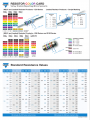
@Tonyr1084 found a standard value chart... Don't go up in nice even increments of 5 or 10... I'm sure there's a mathematical reason for it though.

I do see that they make 91Ohm though... well poop... don't have that one. I do have the 47, and 82 and 100 1/4w resistors though.

And I guess I need 153Ohm for the red one, so 160Ohm.

Wattage wise... I'm assuming resistors, so long as you have at least the minimum wattage required, you can go higher? so, if a 1/4w will work, it's more than safe to use higher like a 3w?

Like caps... if you need a 0.47uf 50v cap, you can use a 0.47uf 100v no problem, but you can't go down and use a 25v.
 
Last edited:

Thread Starter

THRobinson

Joined Jun 7, 2018
82
@bertus thanks... nicer chart than I found. Too bad that the Digikey calculator lets you create resistors that don't exist. They should add an extra field or two that display the nearest matches to what you picked. Like... a rounded up and rounded down value to the nearest existing resistor.

They do make 91Ohm and 160Ohm 3w +/-1% resistors, and I need to order a few guitar pots so if after I get an accurate reading on the 3xAAA batteries I might just order the correct values needed to my potentiometer order.
 
Top