LED Lights - Power Supply / Battery

Thread Starter

THRobinson

Joined Jun 7, 2018
82
in parallell. Two AA batteries at 3v total might have issue turning on an led with a forward voltage of 3.1v.
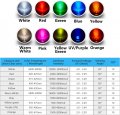
Haha, now I'm lost again. If the LED's say 3v-3.2v... why would they have issues turning on with 3v? Though noticed that the RED is much lower... may need a resistor for each LED (so parallel?) and use a bigger one for the RED one?

Sorry I'm so confused. Sounded like the 3mm 12v weren't bright enough and woulda needed more work. That's why switched to the 3v(ish) 5mm, and figured 2x1.5v batteries is 3v and done. Though I thought all AA batteries were 1.5v but @BobTPH just said the rechargeables are 1.2v and yup, totally correct, so... I guess 3xAA batteries in series for 3.6v total, at about 2000mAh.

So, calculator... I guess supply voltage 3.6v, forward voltage would be the LED's highest number, 3.2v? and the forward current would be the LED not battery, so 20mAh? Which says resistor value 20, power 0.008... guess that means 20ohm and is the 0.008 the wattage? red-black-black and I guess 1/4w or bigger? for each the blue and green LED's anyways. Red would be purple-black-black?

I gotta be close to figuring this out. :D

71CzBaZ8VdL._AC_SL1500_.jpg
 

jiggermole

Joined Jul 29, 2016
185
Using your numbers there I agree with the 20ohm resistor for the led with 3.2v forward voltage and 3.6v supply. And yes I meant the 4 leds in parallell. With each having the appropriate sized resistor for its forward voltage. Vader with the 2.1v(ish) red led and so on. The confusion I think comes from the forward voltage thing. An led with a forward voltage of 3.2v will not conduct electricity until supply voltage gets above that level. 3v it won't conduct, but 3.6v supply will overcome that threshold and the led will conduct.
 

BobTPH

Joined Jun 5, 2013
11,531
An led with a forward voltage of 3.2v will not conduct electricity until supply voltage gets above that level. 3v it won't conduct, but 3.6v supply will overcome that threshold and the led will conduct.
The voltage rating of an LED is the voltage at which it will draw a specific current, usually 20 mA for this type. It will conduct at reduced current at a lower voltage. A 3.2V rated LED will start conducting at something like 2.8V, lighting very dimly.
 

Tonyr1084

Joined Sep 24, 2015
9,744
The Vf (Forward Voltage) is the point where they begin to conduct current. It's the current that needs to be controlled. Whether you power them from 3v, 5v, 12v, 120v or whatever, it's the current that needs to be held to a maximum of what the LED is rated for. Many I've seen have a max of 30mA. And while you can run them at 30mA, they will have reduced lifespan. I never run mine above 20mA unless there's a specific reason to do so. Coin cells have a limited ability to deliver current. And as their voltage drops so does their current. It's not just a matter of taking a 3.2Vf LED and powering it with 3.2V. You can still blow them out.

Batteries have internal resistance. Bigger batteries can deliver more current than smaller batteries. The idea of using a coin cell for testing is valid. It's quick and you get an idea for how the light will act within your project. You've mentioned AA batteries as just barely fitting (not your exact words, my interpretation of them). AAA batteries are smaller still. But along with the smaller size comes diminished capacity. Still, it's wise to include a resistor to limit the current. And if 20mA is too bright, and I bet it would be, 15ma, 10mA, even 5mA might be enough to achieve the desired results.
 

Thread Starter

THRobinson

Joined Jun 7, 2018
82
That's where I get lost... I always though mAh wise for stuff, so long as the power supply has that amount or more, the item will only draw as may as needed. Like a cell phone charger. Some are 1A, 2A, 2.5A... but the phone only pulls what it's rated for.

V wise... I saw the 3-3.2v and just figured you need between 3-3.3v to make it work. Less will be dim or off, more will blow it up.

Makes me wish I were closer to a college or something, take an evening course. Though I guess these days, probably a few good free ones online. :)

Some AAA rechargeable look to be 1.2v 1100mAh. I had AA in my mind because Dollarstore has lots of them (rechargeable) and cheap devices I can rip a holder from. Maybe I'll just grab off eBay since I have time.
 

djsfantasi

Joined Apr 11, 2010
9,237
had AA in my mind because Dollarstore has lots of them (rechargeable) and cheap devices I can rip a holder from.
I tried those Dollarstore batteries. They’re really false economy. They will fail after only a few recharges. That’s why they are about 21⊄ apiece! (Or whatever)
 

Thread Starter

THRobinson

Joined Jun 7, 2018
82
I tried those Dollarstore batteries. They’re really false economy. They will fail after only a few recharges. That’s why they are about 21⊄ apiece! (Or whatever)
Really? I have a set of the Sunbeam ones and sometimes they get Panasonic (in Canada) and no issues with either, though, used in TV remotes nothing really heavy duty power hungry. Amazon ones though, ok for remotes but I have a head-lamp (flashlight on the head) and those things need charged after every use. EBL has a lot of 4-5 star reviews on Amazon, may grab those.

AAA battery holder from China for 3 batteries was less than $1.50CAD and free ship, ETA 2-8 weeks... hopefully closer to 2. Cheaper than anything at the dollarstore these days. :D
 

BobTPH

Joined Jun 5, 2013
11,531
V wise... I saw the 3-3.2v and just figured you need between 3-3.3v to make it work. Less will be dim or off, more will blow it up.
No, that is not what the voltage range means. The range means that they will conduct some specific current, often 20mA , at some voltage in that range.

If you get two of them , one might conduct 20mA at 3.0V and the other at 3.2V.

And the one that runs at 3.0V might conduct 40 mA at 3.2V and be damaged by overheating.

This is why we use a voltage higher than the operating voltage and a resistor in series. That simple circuit can make the current near the desired current no matter where in the voltage range the LED falls.

If you want the current to be less than the nominal current, say 10 mA, then the voltage across the LED will be lower than the range, maybe 2.7 or 2.8V.
 

djsfantasi

Joined Apr 11, 2010
9,237
@THRobinson

Bob said:
If you want the current to be less than the nominal current, say 10 mA, then the voltage across the LED will be lower than the range, maybe 2.7 or 2.8V.
To be clear, this doesn’t mean that you could run that LED with 2.7V without controlling the current.

LEDs are a different animal. They are a current controlled device; not a voltage controlled device. You’ve heard when you supply the proper voltage to a device, it only draws the current it needs. LEDs run at a given current and draw the voltage it needs. It’s all in the datasheet graphs.
 

Thread Starter

THRobinson

Joined Jun 7, 2018
82
Always learning something. :D

But, so we're all clear though... 4 x LED's (three 3-3.2v and one 2-2.3v) should run off 3xAAA 1.2v (3.6v) total with resistors.

Batteries in series. LED's in parallel.

Will need 3 x 20Ohm resistors (blue and green LEDs 3-3.2v) and 1 x 70Ohm (red 2-2.2v).

Not sure resistor strength... 1/4 watt? Using the calculator, the "power" says 0.028 for the red. 0.008 for the others... is that the wattage?
 

Tonyr1084

Joined Sep 24, 2015
9,744
LED's in parallel.
They must all be very close in Vf. Small differences makes a big difference. Here's a video I did on parallel LED's operated off of a single resistor. It's not the right way to do it - but I wanted to prove out whether it could be done or not.
Let me explain the reason for use of individual resistors, one for each LED: In the video you saw how one low Vf LED could stop all the other higher Vf LED's from getting any current. It's called "Current Hogging". (just made that up) Nevertheless, that's exactly what will happen if you try to run three LED's with a Vf of 3V and one LED with a Vf of 2V. The one LED will hog all the current. If you've calculated to have the current at a specific value with all four LED's in circuit, three of them will not light and the fourth will get all the current. Possibly too much current.

There's also a phenomena called "Cascading Failure". If you have as I had, multiple LED's on a single resistor and sufficient current for all of them to get as much as 30mA (just for an example) the one with the slightest lowest Vf will get more current than the others. If that LED fails then there will be more current available for the remainders. And suppose we have five LED's in parallel, sharing 150mA, 30mA each; if the one with the lowest Vf blows out then the remaining four LED's will share (or divide) 150mA among them. 150 ÷ 4 = 37.5mA. the next lowest LED will blow out rather quickly. Now you have three LED's in circuit, each trying to manage with 50mA. They will all fail in the same manor. And it will happen quicker than you can pull the plug. One by one they will cascade into failure.

So the video is not advice to run multiple LED's in parallel on a single resistor, it's just demonstration of how LED's of differing Vf will behave.

[edit]
The reason why 45mA doesn't blow the red LED is because I didn't do any calculations to take into account the Vf of each type of LED. The correct manor of calculation is this:
(V - Vf) ÷ R = final current.
(4.5V - 1.95Vf) ÷ 100Ω = 25.5mA
So no matter what the LED's do they're not going to ever get more than their potentially max current (typically 30mA).
[end edit]
 
Last edited:

Thread Starter

THRobinson

Joined Jun 7, 2018
82
Now I'm lost again.

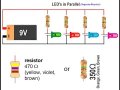
I thought parallel meant that each LED had it's own resistor, which is why I was asking if I needed 3x20Ohm and 1x70Ohm 1/4w resistors, one for each LED.

hqdefault.jpg
 

Tonyr1084

Joined Sep 24, 2015
9,744
If you noticed in the video, 5 LED's on a single resistor - all of the same Vf "Can" be done. But the diagram you post is correct. Each LED SHOULD have its own resistor, calculated in the same formula posted above. (V - Vf) ÷ I = R. That is to say if an LED has a 9V source and the LED's Vf is 3.2V(f) then (9V - 3.2Vf) ÷ 20mA = 290Ω. This means to achieve 20mA on an LED with a Vf of 3.2 you want a 290Ω (or very close) resistor. Do that with each different LED and you'll always find the right resistor. Should ANY or even ALL OTHER LED's fail, the one remaining will still only see 20mA (as per your chosen current limit). You won't see any cascading failure.
 

Tonyr1084

Joined Sep 24, 2015
9,744
If you have a CC (Constant Current) power supply set to deliver a CC of 20mA then the supply will give the LED you want to know it's Vf sufficient voltage to deliver 20mA. You then measure the voltage across the LED and you will have it's actual Vf. This is the method I used for all my LED's. It's how I calculated their max, min, and average Vf. Then using statistics I calculated the standard deviation - you don't need to do that - you know what to expect when you plug an LED into a circuit without blowing it up. In the case of the blue LED's their standard deviation was 0.01V deviation. That means their Vf will be very close and unlikely to be a problem. If I had a greater range of Vf then the deviation would be much higher.

Just to enlighten you all, these are the numbers I came up with in my testing:
Red: (avg.) 1.95Vf, (max) 1.95Vf, (min) 1.92Vf, (Std. Dev.) 10mVf per expected LED
Yellow: (avg.) 2.01Vf, (max) 2.07Vf, (min) 1.98Vf, (Std. Dev.) 3mVf per expected LED
Green: (avg.) 2.72Vf, (max) 3.03Vf, (min) 2.72Vf, (Std. Dev.) 110mVf per expected LED
Blue: (avg.) 2.82Vf, (max) 2.83Vf, (min) 2.80Vf, (Std. Dev.) 10mVf per expected LED
White: (avg.) 2.97Vf, (max) 3.04Vf, (min) 2.92Vf, (Std. Dev.) 30mVf per expected LED
(the reason for the Red average and the max is due to rounding off to the nearest 2 decimals)
 
Last edited:

Thread Starter

THRobinson

Joined Jun 7, 2018
82
Well, diagram is just one I found online... I'll be using 3xAAA 1.2v 1100mAh rechargeable batteries in series, so 3.6v 1100mAh.

Basically, exactly what I said in Post #30. Adding a post about parallel off a single resistor just added to the confusion. :D

So, ignoring what can but shouldn't be done... is Post #30 correct?
 

djsfantasi

Joined Apr 11, 2010
9,237
I thought parallel meant that each LED had it's own resistor,
That is the preferred way of wiring parallel LEDs. But your post wasn’t clear and people often wire LEDs in parallel with just one resistor. That’s what members are responding, too.

You are correct. Wire the LEDs each in parallel with its own resistor!
 

Tonyr1084

Joined Sep 24, 2015
9,744
Adding a post about parallel off a single resistor just added to the confusion.
Didn't mean to cause confusion. As demonstrated, it CAN be done. But isn't the right way to do it. I don't recall the exact reason why I made that video, I think there was an argument going on about using a single resistor for a bunch of parallel LED's. I had to prove it out to myself. Then I decided to join the argument with my video.

The correct approach is as you have stated, a resistor for each LED - that's the RIGHT way to do it. That way it doesn't matter what the Vf of each different LED is - they will all light and all be protected from cascading failure.
 

Tonyr1084

Joined Sep 24, 2015
9,744
You also question wattage: Wattage is simply the total voltage times the total current on that single LED under consideration. So if you're running 3.6V at 28mA, the wattage of the governing resistor should be not smaller than 3.6 x 0.028 = 101mW. A quarter watt resistor should be just fine. It's more than two times what's needed. Would I recommend an eighth watt? That's 125mW. Kind of close, and I wouldn't recommend it. But if that's all you have then it would be OK because it has a greater wattage capacity than needed.

And yes, you weren't clear enough about individual resistors for each LED.
 

Thread Starter

THRobinson

Joined Jun 7, 2018
82
Sorry if unclear, but, I did say parallel, I said resistors (plural) and I listed 3 x 20Ohm resistors and 1 x 70Ohm resistor (4 total). And mentioned that the Red would need a different value resistor than the Blue/Green ones. I'm not sure where the confusion came from but, I did list 4 resistors.

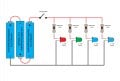
Ok... so... hopefully no confusion on this. I made a quick sketch of the setup using the actual values of the LEDs, Resistors and Batteries.

LED-Setup.jpg
 

Audioguru again

Joined Oct 21, 2019
6,826
Old green LEDs were 2.2V. New very bright green LEDs use newer blue and white LED chemicals and are the same higher voltage of 3.0V to 3.6V.
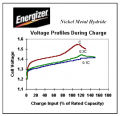
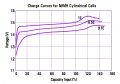
Battery University, battery maufacturers and I say that Ni-MH AA and AAA batteries are 1.4V to 1.5V when fully charged. They are 1.2V when half the charge is gone.
Your "quick sketch" will burn out your LEDs if your Ni-MH battery cells are fully charged.
 

Attachments

Last edited:
Top