LED circuit without a resistor.

dl324

Joined Mar 30, 2015
18,326
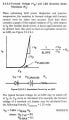
If the LED does have to drop 5V, you obviously can't calculate the current in the circuit just by looking at the above graph and seeing how many amps 5V equates to. I'm sure you will have to use the method dl324 explained.
If you extrapolated an LED IV curve, you'd find that the dynamic resistance would be low (couple ohms or less) at a current that would give a 5V forward voltage; though only blue or white LEDs would have much chance of surviving.

The picture below shows the equivalent circuit for an LED and how to calculate dynamic resistance:
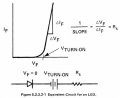
ledEquiv.jpg

Both pictures are from the 1977 HP Optoelectronics Application Manual.
 

Attachments

#12

Joined Nov 30, 2010
18,224
As I said in my original post, I know you're always supposed to use a resistor. It was just a theoretical question.
Theoretically, the LED will burn up in a few milliseconds. You are not likely to find an article about how to run an LED without a resistor because you can't do that and have the LED survive. Even the circuits with no physically separate resistor use the internal resistance of the source to avoid destroying the LED. So, theoretically, how do you run an LED on 5 volts with no resistor? You don't. That's the same as theoretically jumping out of an airplane with no parachute. You and the LED will be equally dead and you won't find a tutorial on how to jump out of an airplane with no parachute.
 

Thread Starter

Robert Smith_1437948150

Joined Jul 26, 2015
38
Thanks for the help everyone, much appreciated

I've now realised that the LED doesn't have to drop 5V, as there will also be a voltage drop over the wires and internal resistance.

I've been told that to calculate the current I would do: (source voltage - forwarding voltage of the LED) / internal resistance. For example if the 5V battery had an internal resistance of 25 ohms, the current would be around: (5-2)/25 = 120mA.

The problem with that is it's assuming the forwarding voltage of the LED is 2, which you don't necessarily know until you know what the current will be, which is what you are trying to figure out in the first place. So I'm not sure how correct this is....

Can someone do me a big favour, if you had a 5V battery with an internal resistance of 25 ohms and an infinite current source, a red LED with a forwarding voltage of 2V at 20mA, can anyone provide me a quick and dirty run through of the current and voltage drops in the circuit before the LED pops? (if there aren't enough details there I apologies, and feel free to fill them in with the most likely values).

Edit - by 'infinite current source', I mean there is no limit on the amount of current that battery can provide just to make it easier.

Regards,
Robert
 
Last edited:

kubeek

Joined Sep 20, 2005
5,796
Can someone do me a big favour, if you had a 5V battery with an internal resistance of 25 ohms and an infinite current source...
If a source has 5V and 25 ohms internal resistance, then it will never ever provide more than 5V/25ohm = 200mA (unless there are other supplies in the circuit) so not sure what you mean by infinite current source.
...a red LED with a forwarding voltage of 2V at 20mA, can anyone provide me a quick and dirty run through of the current and voltage drops in the circuit before the LED pops? (if there aren't enough details there I apologies, and feel free to fill them in with the most likely values)
Quick and drity, the voltage across a diode depends on the logarithm of the current, or in other words, current through a diode is dependent on e to the power of voltage times some constant. Or, as I imagine without any real numbers here, if you have 2V at 10 A, you would have 4V at 100A (that is without regard to resistance of wires, contacts, etc.)
See http://www.pveducation.org/pvcdrom/pn-junction/diode-equation or http://www.bu.edu/eng/courses/ec410/documents/ec410-lab1-spring08.pdf for more info.

When a diode pops really depends on its thermal capacity and the time before it pops. For a small 2mA signalization diode it could be very small (say 100mA for 100ms), while large power leds could withstand a few amps for the same amount of time. But since no manufacturer will guarantee anything like this you wouldn´t want to rely on these numbers unless you verify what amount of abuse the leds can take and what you want use them for.
 

WBahn

Joined Mar 31, 2012
32,823
The problem with that is it's assuming the forwarding voltage of the LED is 2, which you don't necessarily know until you know what the current will be, which is what you are trying to figure out in the first place. So I'm not sure how correct this is....
For diodes we generally assume a constant voltage drop and the resulting answer is almost always close enough that the fact that the actual voltage drop is slightly different doesn't have a significant impact. If it does, then that is usually a sign of a poor design -- i.e., we go out of our way to design circuits such that the difference between the assumed voltage drop and the actual voltage drop doesn't have a significant impact.

Can someone do me a big favour, if you had a 5V battery with an internal resistance of 25 ohms and an infinite current source, a red LED with a forwarding voltage of 2V at 20mA, can anyone provide me a quick and dirty run through of the current and voltage drops in the circuit before the LED pops? (if there aren't enough details there I apologies, and feel free to fill them in with the most likely values).
Silicon diodes typically see a voltage increase of about 60 mV for every tenfold increase in current. LEDs typically see quite a bit more than this, as modeled by the "ideality factor." So let's say that your LED has an ideality factor of 3, meaning that a tenfold increase in current from 20 mA to 200 mA would see the voltage increase by 180 mV to 2.18 V. It's likely that in going from 20 mA to 200 mA that the leadwire resistance might come noticeably into play, as well. Let's say that this resistance was such that at 20 mA it contributed 0.05 V to the total drop across the LED (meaning that it is 2.5 Ω). So at 200 mA it would drop 500 mV taking you to about 2.7 V at 200 mA.

If the LED stayed rock solid at 2 V regardless of current, then the battery would deliver (5 V - 2 V) / 25 Ω = 120 mA to the LED.

At 120 mA, the increase in voltage across the diode would be 140 mV and the additional drop across the leads would be 300 mV for a total drop across the LED of about 2.44 V.

So now the battery will deliver (5 V - 2.44 V) / 25 Ω = 102 mA to the LED.

You can keep iterating to get better and better estimates of the voltage and current, but already you can see that the voltage will be somewhere between 2 V and 2.44 V and the current will be somewhere between 102 mA and 120 mA. This is probably close enough for practical purposes.

As for how long the LED will last, that depends on how badly it is being abused and how tolerant it is to being abused. There's a rule of thumb about how much you can expect the life expectancy to be shorted for each given percentage increase in LED current, but I don't recall what it is. Let's say that the life is cut in half for every 10% increase in current (I'm just making up those numbers). Going from 20 mA to, say, 110 mA is an increase of about 450% so you would cut the life expectancy by really short.
 

MrAl

Joined Jun 17, 2014
13,702
Thanks for the help everyone, much appreciated

I've now realised that the LED doesn't have to drop 5V, as there will also be a voltage drop over the wires and internal resistance.

I've been told that to calculate the current I would do: (source voltage - forwarding voltage of the LED) / internal resistance. For example if the 5V battery had an internal resistance of 25 ohms, the current would be around: (5-2)/25 = 120mA.

The problem with that is it's assuming the forwarding voltage of the LED is 2, which you don't necessarily know until you know what the current will be, which is what you are trying to figure out in the first place. So I'm not sure how correct this is....

Can someone do me a big favour, if you had a 5V battery with an internal resistance of 25 ohms and an infinite current source, a red LED with a forwarding voltage of 2V at 20mA, can anyone provide me a quick and dirty run through of the current and voltage drops in the circuit before the LED pops? (if there aren't enough details there I apologies, and feel free to fill them in with the most likely values).

Edit - by 'infinite current source', I mean there is no limit on the amount of current that battery can provide just to make it easier.

Regards,
Robert

Hello,

To calculate part of what you are asking you need to do a curve trace on both the LED and the power source (battery). To calculate the failure though is pretty much impossible because there are too many variables.

A simple law is that when two things are connected in parallel they both have the same terminal voltage. We can use this law to calculate the current in the LED, but we must first do a curve trace of both elements.

We do a curve trace by applying a current or voltage to each element, then measure the remaining quantity. For example, for the LED we might apply a current I and see a voltage V as:
I=1ma, V=1.6v
I=2ma, V=1.65v
I=4ma, V=1.7v
I=8ma, V=1.8v
I=16ma, V=1.9v
I=32ma, V=2.0v
I=80ma, V=2.7v

Note i made these up just for illustration.

For the battery, we might see:
I=1ma, V=3.4v
I=2ma, V=3.3v
I=4ma, V=3.1v,
I=8ma, V=2.7v,
I=16ma, V=1.9v,
I=32ma, V=0.3v

I made these up to for illustration, but if these results were really found then we could look at both curves and see that at I=16ma they both have a voltage of 1.9v. Thus, when the two are connected in parallel the current would be 16ma in the LED, at least for a while until the battery voltage dropped.

It is very difficult however to determine how long the LED will last should the current be too high. For example, say the battery measured like this:
I=10ma, V=3.4v
I=20ma, V=3.3v
I=40ma, V=3.1v,
I=80ma, V=2.7v,
I=160ma, V=1.9v,
I=320ma, V=0.3v

Comparing this to the other battery you can see that at 1.9v the current is much higher now because the LED voltage matches the battery voltage with 80ma of current flow, so if this was a standard 20ma LED it would blow out although it may take a little while.
The failure mode is also an unknown. Some LEDs will fail completely while others will start to blink on and off until they die completely. Some will change color and get very very dim.

So you see this is a very difficult question to answer because there are so many variables. The best you can do is test one under the conditions you think it will run. You can however calculate the run current based on the curve traces, except as the battery drains down over time because the voltage decreases.
 

daviddeakin

Joined Aug 6, 2009
207
Don't they teach load lines anymore? This is easy to visualise. Where the two lines cross is the current that would flow, or about 150mA in my fictional circuit. Since the load line passes above the maximum allowable current of the LED (about 40mA here), it goes bang!
 

PeterCoxSmith

Joined Feb 23, 2015
148
Component failure has to be taken into account based on the watts dissipated. A typical small led package can dissipate 100mW absolute maximum, which means it will blow open circuit most likely if you over stress the part. As you say, the current in the circuit is limited by the internal resistance of the battery and the dynamic resistance of the led which will give a current of ~ 0.6A and a dissipation of 2.8W, which is way in excess of 100mW and you can be sure the led will blow.

Heat dissipation in leds is a big issue if you are designing high power lighting. Take a look at:

http://www.digikey.com/en/articles/...thermal-resistance-of-led-lighting-substrates
 

hp1729

Joined Nov 23, 2015
2,304
Hello,

A few weeks ago I created a thread discussing the current in a simple circuit containing a battery, LED and a resistor. I am now wondering what the current would be in a circuit that contains just an LED and the battery.

For example a 5V battery and an LED with a forwarding voltage of around 2V.

The reason I ask is KVL states that 5V must be dropped across the circuit, so the LED has to drop around 5V, but looking at a voltage-current curve for an LED to drop that amount the current would have to be ridiculously high.

What if the battery can't provide that amount?

How would you calculate the current in the above example, I believe the internal resistance of the battery is used?

I understand you would always you a resistor and the LED would pop in the above example, just curios what would happen in theory.

Regards.
It may be working outside the recommended specs but my LED flashlight is just three AA batteries and four LEDs in parallel. It dumps the whole 4.5 Volts across the 3.4 V LEDs. It works but once a year or so I replace the LEDs. The suggestion is that the internal resistance of the batteries is used as the ballast resistor.
 

Sensacell

Joined Jun 19, 2012
3,784
I have, but there doesn't seem to be a part discussing the voltage drop of an LED in a circuit with no resistor.
Those little coin cell + LED products get everyone off to a really bad start understanding the whole powering LED's thing.

Think of it like this:

Take a 3V coin cell and a red LED.

Measure the voltage on the battery by itself, you get maybe 3 volts.
Now connect the the LED- "whee it lights up! and seems to work fine! what a great simple circuit"

Not so simple.

Now measure the voltage WITH the LED connected- you get about 1.8 volts
WTF is going on? how does a beginner make sense of this?

Somewhere inside the battery - at the electro-chemical heart of it all, it's still making 3 volts, but the high internal resistance inside the
guts of these wimpy batteries limits the current and "drops" 1.2 volts, you cannot measure the true "battery voltage" any longer, it's buried inside the battery- you can only measure what appears at the output terminals.

The final current that flows is an unpredictable value, based on that internal resistance and the VF of the LED.
The voltage you read outside is what ever the LED decides it's to be at that unpredictable value of current, the LED's IV curve sets the real voltage at that point.

Now you can MEASURE that internal resistance by taking two voltage readings, one with no load, and another with a known load and calculate the internal resistance using ohms law.

But you will find that the internal resistance of the battery is very unstable, it goes up as the battery dies, and it's temperature dependent too.

In short, a design that depends on some value of internal resistance inside the battery to set the operating current is a very dodgy design indeed!
Those stupid coin cell flashlights are exploiting the fact that the batteries internal resistance is "about right" to make an LED light, but the value of current will vary wildly over the life of the battery- but who cares if it works?

The type of battery is VERY important - try this same trick with 2 fresh "D" cells - POOF! the LED will die a hot nasty death in about 1 second. Why? It's the same 3 volts! you may ask - "D" cells have MUCH lower internal resistance, the current flow then is able to reach a destructive level and destroy the LED, immediately - this is why we use current limiting resistors in series with LED's.
 

Bernard

Joined Aug 7, 2008
5,784
I still have LED flashlights that operate on 3 AA's ,3 AAA, or 3 N's, all are still working, never changed a LED.
Line operated LED night light now about half bright after 9 years 24/7.
 

RichardO

Joined May 4, 2013
2,270
It may be working outside the recommended specs but my LED flashlight is just three AA batteries and four LEDs in parallel. It dumps the whole 4.5 Volts across the 3.4 V LEDs. It works but once a year or so I replace the LEDs. The suggestion is that the internal resistance of the batteries is used as the ballast resistor.
I had always assumed that the reason cheap spelled (Harbor Feight) flashlights used "heavy duty batteries was cost. Now my thinking is that the use those batteries _because_ of the higher internal resistance not their lower cost than alkaline batteries.
 

WBahn

Joined Mar 31, 2012
32,823
I had always assumed that the reason cheap spelled (Harbor Feight) flashlights used "heavy duty batteries was cost. Now my thinking is that the use those batteries _because_ of the higher internal resistance not their lower cost than alkaline batteries.
If so, it's a double win for them -- using the lower-cost batteries allows them to lower the BOM cost by eliminating a resistor. Don't see THAT too often.
 

spinnaker

Joined Oct 29, 2009
7,830
It may be working outside the recommended specs but my LED flashlight is just three AA batteries and four LEDs in parallel. It dumps the whole 4.5 Volts across the 3.4 V LEDs. It works but once a year or so I replace the LEDs. The suggestion is that the internal resistance of the batteries is used as the ballast resistor.
How many times are you going to tell us about that flashlight with no resitors?

http://forum.allaboutcircuits.com/threads/help-with-simple-led-project.118572/#post-936302

Th OP has not been seen on this form in months. How are you helping this conversation?
 

dannyf

Joined Sep 13, 2015
2,197
The suggestion is that the internal resistance of the batteries is used as the ballast resistor.
That, and the dynamic resistance of the led, are acting to limit the current. You see plenty of examples where people use a coil battery to power leds directly, with no adverse effect.

The dynamic resistance of LEDs varies greatly, but 10ohm / signal LED, but varies greatly for lighting leds: from <1ohm to 20 - 30ohm.

On battery's internal resistance: I used an ESR meter to measure the resistance of a 9v batter -> around 7ohm. It should be much lower for rechargeable.

It is wrong to say that you have to use a current limiting resistor on a led. The use of a current limiting resistor allows more safety margin, at the expense of efficiency - thus current limiting resistors are rarely used for high-power led applications where the leds are typically powered directly (in a control loop).
 

hp1729

Joined Nov 23, 2015
2,304
Hello,

A few weeks ago I created a thread discussing the current in a simple circuit containing a battery, LED and a resistor. I am now wondering what the current would be in a circuit that contains just an LED and the battery.

For example a 5V battery and an LED with a forwarding voltage of around 2V.

The reason I ask is KVL states that 5V must be dropped across the circuit, so the LED has to drop around 5V, but looking at a voltage-current curve for an LED to drop that amount the current would have to be ridiculously high.

What if the battery can't provide that amount?

How would you calculate the current in the above example, I believe the internal resistance of the battery is used?

I understand you would always you a resistor and the LED would pop in the above example, just curios what would happen in theory.

Regards.
Re: LED and battery
All engineer's opinions aside, you have just described my LED flashlight.
 

dannyf

Joined Sep 13, 2015
2,197
just curios what would happen in theory.
The answer depends critically on what you meant by "in theory".

A battery could mean an ideal voltage source, or an ideal voltage source + internal resistance; A LED could be modelled as an ideal voltage source, or an ideal voltage source + dynamic resistance (which may be non-linear).

So a simplistic model for a battery + led + current limiting resistor would have a current of

I = (Vb - Vfwd) / (Rb + Rled + R), whereby Vb is the battery's voltage, Vfwd is the LED's voltage drop, Rb is the battery's internal resistance, Rled is the led's dynamic resistance and R is the resistance of the current limiting resistor.

As R -> zero, I -> (Vb - Vfwd) / (Rb + Rled). Obviously, it does not go to infinity if Rb + Rled is non-zero.

But here lies the problem with not using a current limiting resistor: if Rb + Rled is small (if for example it is powered by a set of rechargeable battery, or Li-on battery, or a regulated power source (Rb -> 0)), any small changes in Vb - Vfwd can cause large changes in I;

Worst yet, as the diode heats up, Vfwd decreases, causing I to go up further -> more heat -> a vicious cycle.

Two ways to control that:

1) A large Rb + Rled + R is a negative feedback mechanism in that case. Or
2) a negative feedback loop where you lower Vb as I goes up (or Vfwd goes down).

The 1st approach is typically used for signaling LEDs - simple but inefficient - and the 2nd approach is typically used for power LEDs.
 

hp1729

Joined Nov 23, 2015
2,304
The answer depends critically on what you meant by "in theory".

A battery could mean an ideal voltage source, or an ideal voltage source + internal resistance; A LED could be modelled as an ideal voltage source, or an ideal voltage source + dynamic resistance (which may be non-linear).

So a simplistic model for a battery + led + current limiting resistor would have a current of

I = (Vb - Vfwd) / (Rb + Rled + R), whereby Vb is the battery's voltage, Vfwd is the LED's voltage drop, Rb is the battery's internal resistance, Rled is the led's dynamic resistance and R is the resistance of the current limiting resistor.

As R -> zero, I -> (Vb - Vfwd) / (Rb + Rled). Obviously, it does not go to infinity if Rb + Rled is non-zero.

But here lies the problem with not using a current limiting resistor: if Rb + Rled is small (if for example it is powered by a set of rechargeable battery, or Li-on battery, or a regulated power source (Rb -> 0)), any small changes in Vb - Vfwd can cause large changes in I;

Worst yet, as the diode heats up, Vfwd decreases, causing I to go up further -> more heat -> a vicious cycle.

Two ways to control that:

1) A large Rb + Rled + R is a negative feedback mechanism in that case. Or
2) a negative feedback loop where you lower Vb as I goes up (or Vfwd goes down).

The 1st approach is typically used for signaling LEDs - simple but inefficient - and the 2nd approach is typically used for power LEDs.
:)
Put away the math and theories. Connect battery to LED and see what happens.
It's that simple.
:)
It is a great lesson in resilience of LEDs and their failure modes.
 

sailorjoe

Joined Jun 4, 2013
365
Just for grins, years ago, I hooked up a red led to a lab power supply with voltage and current control. I opened up the current limit pretty wide, and started to raise the voltage. While doing that, I could measure the actual current on the supply. No current limiting resister. I was surprised to find that the LED was still working, and very brightly, up to about 12 volts. Raising the voltage even higher, the LED began to deteriorate. But it didn't just burn up like a fuse, it took a long time. Amazing how much abuse a red led could take before it quit working.
Robert, everything you need to know to answer your KVL questions is in post #13. What basic KVL doesn't deal with, however, is the effects of heat on active and passive components. That's advanced KVL. Heat changes the electrical properties of things. Just for grins, go into the lab and measure the internal resistance of a battery. Now set up to run that battery at full charge and measure again as the battery heats up. For extra credit, measure the internal resistance of the diode at normal operating current, and then at 1 Amp. Then solve your KVLs.
 
Top