Facebook
 Google
 GitHub
 Linkedin
First off I apologize if this is the wrong sub-forum (or even the wrong site entirely) for this question - I wasn't sure where to post it, but I'm sure there are regulars here who can help me understand what's going on here.
My issue is that a couple T12 fluorescent tubes in the kitchen of the house we rent were dead. I went to get replacements, but all the store had were LED versions. I didn't mind the idea of switching to LEDs, so I bought some, and the ones I got (see here) claim to be totally compatible with ballasts - no wiring needed:
Anyway, I got them in place and they appeared to be working, and then for some reason I decided to read the instructions afterwards (I realize this is the wrong order!) The instructions (which I found online here) specifically say that you must verify compatibility based on ballast part numbers from a chart in a separate document. Of course, the web address for the separate document is dead, and no amount of google searching has turned up the compatibility list for this particular bulb.
Oh yeah - almost forgot to tell you about the ballast. It's a Magnetek "43...-TC-P." Based on google hits, I'm guessing that's either "438-L-TC-P" or "439-L-TC-P." In any case, it appears to be the common, garden-variety magnetic two-tube rapid-start ballast style that's ubiquitous here in the USA.
So, at this point, it appears that I have working lights, but I have no way to verify "compatibility" with my ballast. This leaves me wondering what "compatibility" even means in this case. What would go wrong? Would the LED lights fail to turn on? Would one or more things eventually catch on fire? Would everything basically work, but just not last as long? I don't fully understand fluorescent lights, nor their ballasts, but my limited understanding makes me think that, as far as the LED bulb is concerned, all the ballast is doing is limiting input current. As long as the LED bulb assy. can run happily on less current than the ballast can provide, it should be happy. I can't understand what the big "compatibility" question is, nor what the risks of ignoring that question would be.
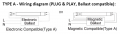
I did try a little googling on the subject, and apparently some LED bulbs are compatible with electronic ballasts, but not with magnetic ones (not sure why that would be.) This does not seem to be the case for these bulbs, as their instructions clearly show compatibility with both types in this image:
My gut feeling is that everything is fine and I should just move on with my life, but I'd feel better if I understood what actual risks (if any) I'm taking on by using these LED light tubes with a ballast that may not be compatible. Can anyone here explain to me what would make some ballasts incompatible, and what risks I might be assuming by using these bulbs with this ballast? Thanks all!
My issue is that a couple T12 fluorescent tubes in the kitchen of the house we rent were dead. I went to get replacements, but all the store had were LED versions. I didn't mind the idea of switching to LEDs, so I bought some, and the ones I got (see here) claim to be totally compatible with ballasts - no wiring needed:
I chose them specifically because this is a rental house, so I don't think I should be re-wiring the place. Otherwise, I'd replace the fixture entirely, or at least remove the ballasts and go with direct-wired LED tubes.The Sylvania Universal Hybrid ALL IN 1 (Type A plus B) 4 ft. T8/T12 LED bulb is ideal for easily upgrading fluorescent fixtures to LED. It provides flexibility for the end user and contractor with 1 product that works in any fixture, satisfying either operation with a ballast or directly on line voltage.
Anyway, I got them in place and they appeared to be working, and then for some reason I decided to read the instructions afterwards (I realize this is the wrong order!) The instructions (which I found online here) specifically say that you must verify compatibility based on ballast part numbers from a chart in a separate document. Of course, the web address for the separate document is dead, and no amount of google searching has turned up the compatibility list for this particular bulb.
Oh yeah - almost forgot to tell you about the ballast. It's a Magnetek "43...-TC-P." Based on google hits, I'm guessing that's either "438-L-TC-P" or "439-L-TC-P." In any case, it appears to be the common, garden-variety magnetic two-tube rapid-start ballast style that's ubiquitous here in the USA.
So, at this point, it appears that I have working lights, but I have no way to verify "compatibility" with my ballast. This leaves me wondering what "compatibility" even means in this case. What would go wrong? Would the LED lights fail to turn on? Would one or more things eventually catch on fire? Would everything basically work, but just not last as long? I don't fully understand fluorescent lights, nor their ballasts, but my limited understanding makes me think that, as far as the LED bulb is concerned, all the ballast is doing is limiting input current. As long as the LED bulb assy. can run happily on less current than the ballast can provide, it should be happy. I can't understand what the big "compatibility" question is, nor what the risks of ignoring that question would be.
I did try a little googling on the subject, and apparently some LED bulbs are compatible with electronic ballasts, but not with magnetic ones (not sure why that would be.) This does not seem to be the case for these bulbs, as their instructions clearly show compatibility with both types in this image:
My gut feeling is that everything is fine and I should just move on with my life, but I'd feel better if I understood what actual risks (if any) I'm taking on by using these LED light tubes with a ballast that may not be compatible. Can anyone here explain to me what would make some ballasts incompatible, and what risks I might be assuming by using these bulbs with this ballast? Thanks all!