Facebook
 Google
 GitHub
 Linkedin

Hello,
Today I was watching a gif image of a transistor NOT Gate

They used a npn transistor, but it seems that here the output is not actually the emitter pin, it is the Led.
I was thinking the only way to turn the Led off was to equal the voltage of both led's pins, but then I figure it out that the npn transistor might have a small resistance from colletor-emitter that is in series with a 1k ohms resistor which causes a big drop voltage when transistor in fully on.
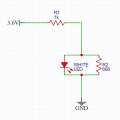
So I tried to do a similar exercise with the stuff I have at home, I don't have that kind of transistor so I just used 2 resistors, one led and 3NiMh batteries in a battery holder.
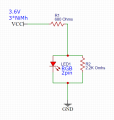
I calculated first the voltage at the resistor divider point by removing the led of the circuit: (with Dv I mean drop voltage not sure if is correct)
Rt = 680+2.2k = 2880 ohms
I = 3.6V / 2.88k Ohms = 0.00125A
R1Dv = 0.00125A * 680 omhs = 0.85v
R2Dv = 0.00125A * 2.2k omhs = 2.75v
R1Dv + R2Dv = 3.6v
So in the resistor divider point the voltage is 2.75v without the led attached to the circuit, was 2.75-2.76v measured with the multimeter, then I connected the RGB 2 pin led, sometimes voltage in the divider point was 2.63v and sometimes 2.39v and 2.08v due the forward voltage of each color tho.
What I would like to know it is how the current flows, I mean at the startup does the current first flows throught the led or R2? how it is stablished the voltage in the resistor divider point when there is a led in parallel to R2 out of formulas, is there a kind of visual flow of electricity for this example like those of water?
It is a bit confusing I can think first it is defined by the resistor divider and if there is enough voltage to turn on the led, then the led redefines the dropout voltages with its forward voltage.
If I change the R1 value to 970 omhs and R2 to 680 omhs, the voltage in the divider point is 1.482v so in this case the led doesn't turn on.
I'm not an electrical or circuit engineer.
Today I was watching a gif image of a transistor NOT Gate
They used a npn transistor, but it seems that here the output is not actually the emitter pin, it is the Led.
I was thinking the only way to turn the Led off was to equal the voltage of both led's pins, but then I figure it out that the npn transistor might have a small resistance from colletor-emitter that is in series with a 1k ohms resistor which causes a big drop voltage when transistor in fully on.
So I tried to do a similar exercise with the stuff I have at home, I don't have that kind of transistor so I just used 2 resistors, one led and 3NiMh batteries in a battery holder.
I calculated first the voltage at the resistor divider point by removing the led of the circuit: (with Dv I mean drop voltage not sure if is correct)
Rt = 680+2.2k = 2880 ohms
I = 3.6V / 2.88k Ohms = 0.00125A
R1Dv = 0.00125A * 680 omhs = 0.85v
R2Dv = 0.00125A * 2.2k omhs = 2.75v
R1Dv + R2Dv = 3.6v
So in the resistor divider point the voltage is 2.75v without the led attached to the circuit, was 2.75-2.76v measured with the multimeter, then I connected the RGB 2 pin led, sometimes voltage in the divider point was 2.63v and sometimes 2.39v and 2.08v due the forward voltage of each color tho.
What I would like to know it is how the current flows, I mean at the startup does the current first flows throught the led or R2? how it is stablished the voltage in the resistor divider point when there is a led in parallel to R2 out of formulas, is there a kind of visual flow of electricity for this example like those of water?
It is a bit confusing I can think first it is defined by the resistor divider and if there is enough voltage to turn on the led, then the led redefines the dropout voltages with its forward voltage.
If I change the R1 value to 970 omhs and R2 to 680 omhs, the voltage in the divider point is 1.482v so in this case the led doesn't turn on.
I'm not an electrical or circuit engineer.
Last edited: