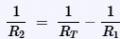
This is wrong from the start -- The left term has units of resistance, while the remaining terms have units of inverse resistance (i.e., conductance). If an equation is not dimensionally correct, it is not correct.
Furthermore, 1/R1 = 1/R2 can only be correct if R1 and R2 are the same.
You need to start from a correct starting point.
Since your title indicates a desire to derive the parallel resistor equation, let's start there, and then solve for one of the resistors given the value of the other resistor and the combined equivalent.
By Ohm's Law for the individual resistors, we have:
If they are in parallel, the voltage across everything is the same, but the current in the equivalent resistance is the sum of the two individual resistances.
Another approach think about it, rather than memorizing formulas....
Think about total current. OK you need to know that I=V/R. But if that much is a problem then perhaps you are in the wrong hobby/profession.
Adding resistors in parallel adds the conductance and adds the current. So lets say that I have 12V and I want parallel resistors to handle 17 mA = 0.017 Amps. 12V/0.017 Amps = 706 ohms (rounded).
Let's start with a 1.5K = 1500 ohm resistor. That will conduct 12V/1500 = 8 mA. Hmm. That is less than half of our 17 mA target. But if we use two of them in parallel, we will get 2 x 8 mA = 16 mA which gets us close.
So now we want to get a bit more = 17 mA - 16 mA = 1 mA. For that, we need 12V/1 mA = 12K ohms. So now we have three resistors in parallel (1.5K, 1.5K and 12K) to get us our 706 ohms parallel total for 17 mA.
As other posters have mentioned there is more than one formulaic method for this, but I prefer to keep it simple: Conductance is the inverse of Resistance, so we add conductance in parallel, and take the inverse again to get parallel resistance. In other words:
While I definitely advocate knowing the formulae for calculating parameters, a very useful tool to avoid the tedium of repeated calculations, I recommend the Android app Electrodoc Pro. It has a wealth of calculators, among them series and parallel resistors and capacitors, LED series resistors and many others as shown here.
Other useful sections include pinouts of MANY connectors, tables of standard resistor and capacitor values and the never-going-to-die ASCII character table.
This is an app I'm always using on my phone. There's a free version, but the pro version adds features and is well worth the $5 or so cost.
The dispersion of charge in a galvanometer was nulled to balance parallel and series resistances and later revisited in a different instrument called a bridge. As a result of different studies using these electrical measurement apparatus on different approaches to understand charge dispersion. The electrical chemical cell had become available and became a standard. Because of the chemical decomposition and electrode potential caused variance, scientist wanted George Ohm to explain. He and others adjusted his statement of inverse proportion to be: Current = Electromotive Force / Resistance. This was more widely taught and accepted. When more people got into the act with all the variety of bridge circuits, nodal analysis was again needed to explain the balancing act of branches of a circuit had a sum of parts equaling the whole. The parallel resistance is only a subset of the actual resistivity within a precision LED circuit.
Studies done by less prominent mathematicians and electrical scientist of the bridge circuit era derived mathematical equations of nodal analysis.
These studies found their way into the matrix. It is likely that this synchronicity and race to discovery will continue to not recognize origins of discovery.
A diode and RF, a special case will complicate the best explanation of equivalent resistance:
Iwas looking for a single equation to plug the values into, I use my phone and computer calculator. You can usually get within 1% with a parallel resistor.
You might be referring to something else. If you get to pick both R1 and R2 when trying to achieve a particular Req, then you can usually find standard values that can nominally get you pretty close.
Here you are given two values, which means the nominal third value is determined and all you can do is use the nearest standard value to it (unless you are using a pot or something like that). That constrains your ability to hit it super close.
Here's a handy calculator that determines the optimum two resistors (series or parallel) to get a given arbitrary resistance value.
The tolerance of that arbitrary value then, of course, equals the resistor tolerance.
Statistically, two resistors of similar value in parallel will have a better tolerance than a single resistor. (It improves by the square root of the number of resistors)
Practically, the two resistors won't be randomly selected, because they probably come from the same batch and are both exactly the same value.
If placing two resistors in parallel and one is more than twenty* times the resistance of the other, then it is a waste of time, because of the tolerance of the smaller one.
(* for 5% resistors, 100 for 1%)

 Facebook
 Google
 GitHub
 Linkedin