LCD basics. color and Mono

Thread Starter

Joseph Beasley 1

Joined Feb 16, 2017
14
this may seem like a dumb question, but I've always wondered this.
How does a color TFT LCD display monochrome images?

from what I understand, a TFT display has 3 RGB subpixels which are artificially colored by filters.
each sub pixel is either on or off in such a way to display any of the millions of color combinations of Red Green and Blue.
When a pixel is open it allows light to pass through from backlamp. When closed it's totally dark or I guess, dark on one or more colors?
If all 3 are closed this is black. what is white?

Also how do the color filters work? If each pixel is a liquid crystal cell that either passes light, or does not, what type of filter is used to make the rgb? how do they make it so small?
 
Last edited:

bertus

Joined Apr 5, 2008
22,920
Hello,

Read this:
2.3 Color Displays: Gray Scales and Bits

Due to the overall poor performance of Passive Matrix color displays, only active matrix displays will be specifically discussed. However, major points are applicable to both display addressing technologies. Unlike an analog CRT, in a digital color TFT active matrix display, you literally get what you buy...forever. Even if you upgrade to a new video driver or display card, you will still have the same number of colors and gray scales. The number of colors is a direct result of the number of gray scales a display can reproduce. The standard VGA format is rated to display 256 colors, however it can select from a 18 BIT CLUT (color look up table) which means the choice of 262,144 colors(this calculation is based on a bit calculation for a pixel triad -- 2 ^ 18 --- see later section on calculations). Intrinsic gray scale reproducibility for TFT displays is a result of two factors: the quality of the driver ICs used on the display and the resistance of the gate metal(the rows of the display). The gate metal must carry a clear and undeformed pulse from one end of the display to the other( 640 X 3 = 19200 lines). If the pulse is not maintained the TN curve will not charge to the desired level and the correct color can not be displayed. Therefore, the more gray scales required, the greater the control that must be exerted over the gate lines. For example, most displays sold today can display 256 colors out of 4092 or 512. The 256 colors is based on the VGA video controller, the 4092 is a display limitation. 4092 possible colors indicates that a display can reproduce 16 gray scales. This is derived from 16 (red) X 16 (blue) X 16 (green) = 4092 possible colors. Once again, dithering can be used to extend this, but there are displays in limited production that can reproduce 256 gray scales or more than 16 million colors ! Most current TFT color displays feature 3 bit drivers (where 2 raised to the third power yields 8); these drivers can produce a total of 512 colors. This is more than adequate unless later on you decide you wish to pursue some multimedia functions which require more than 32 levels of gray scale. Although the controller and the computer may be fast enough to handle the functions, 8 or 16 gray scales will be inadequate-- your image will not be what you expect (It will look like a collection of color shadows). Sharp has recently demonstrated 10 inch 640 X 480 displays running on Apple Macintoshes displaying 64 gray scales. These 6 bit drivers are supposedly entering production and will enter the commercial market shortly. The color reproduction of these displays is excellent.
There is a calculation error in the text, it says 4092 wich should be 4096.

This quote comes from this page:
http://margo.student.utwente.nl/el/misc/lcd_faq.htm

Bertus
 

DickCappels

Joined Aug 21, 2008
10,661
upload_2017-6-11_15-15-59.png

(Nearly) All images in a color LCD are made of pixels that display Red, Green, and Blue primary colors in subpixels. If you look at a desktop color LCD screen with a magnifying loupe or microscope you should be able to see the individual colored sub-pixels.

The primary colors are usually generated by filtering "white" light. The amount of light that passes through each subpixel is controlled independently by the voltage across each subpixel.

Without magnification the subpixels and to some extent the pixels become blurred, which means that the three colors are mixed when they eventually land on the cones in your your retina where the colors are detected.

The ability to display a wide range of intensities in each subpixel allows the generation of what are perceived to be a wide range of hues.

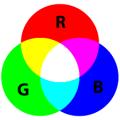
Mixing all three colors in the right proportions produce white. If all the subpixels block light, that is your black (affected by incident illumination and the reflectivity of the LCD panel).
 

Thread Starter

Joseph Beasley 1

Joined Feb 16, 2017
14
View attachment 128720

(Nearly) All images in a color LCD are made of pixels that display Red, Green, and Blue primary colors in subpixels. If you look at a desktop color LCD screen with a magnifying loupe or microscope you should be able to see the individual colored sub-pixels.

The primary colors are usually generated by filtering "white" light. The amount of light that passes through each subpixel is controlled independently by the voltage across each subpixel.

Without magnification the subpixels and to some extent the pixels become blurred, which means that the three colors are mixed when they eventually land on the cones in your your retina where the colors are detected.

The ability to display a wide range of intensities in each subpixel allows the generation of what are perceived to be a wide range of hues.

Mixing all three colors in the right proportions produce white. If all the subpixels block light, that is your black (affected by incident illumination and the reflectivity of the LCD panel).
thanks, this makes sense.

so is the picture we're seeing actually described as an analog signal or digital?
all modern LCDs are addressed digitally; is the display controller ( T-con ) converting the video back to analog before it goes to the panel?

I'm guessing if the voltages going to the subpixels are varying then its analog?
 

DickCappels

Joined Aug 21, 2008
10,661
You understand correctly. It is digital going in, the rows and columns are addressed digitally but the video is converted to analog then applied to the subpixels.

An exception: Cannon had a very high contrast monochrome display in which white pixels were made up of white subpixels whose areas were binary weighted. Thus, by driving selected subpixels fully on or off the pixel luminance was varied digitally. Not sure whether or not it made it into mass production.
 
Top