Latching DOWN a voltage comparator

AnalogKid

Joined Aug 1, 2013
12,141
Back in my TV days we had pulse clocks throughout the station. The ones on the studio walls were18" - 24" diameter. To get a crisp snap of the second hand took some torque, and a relatively high solenoid current. This was an all-parallel system.

For the Daylight Saving Time changes, I built a multi-amp driver that was inserted between the master clock and the building clock wiring. It ran the system at 2x speed for just under 1 hour, or stopped the system for just over one hour, and then reconnected the master clock to the building. The idea was that the electronics would get the clocks close to the new time unattended overnight, and then they would be stepped to the correct time in the morning with a manual pulser. Worked for decades.

ak
 

MisterBill2

Joined Jan 23, 2018
27,547
Once again, it can be done wit a charged capacitor. But probably it will make more sense to charge the cap during the pulse and then trigger the solenoid after the pulse.
And also it appears that the TS is not interested in anything except a turn-key design, no experimenting or adjustment.
 

Thread Starter

Steve200

Joined Jun 22, 2024
68
Why not connect them in series as designed?

So there is no problem with connecting the clocks to main's power to operate the clock's coil?

What's the maximum number of clocks you will likely have?
I need to quieten them if I am going to put them up around the house, and there is very little you can do electrically if they are all connect in series.
They cant be connect directly to the mains, they turn into smoke machines if you do that. They can only work with something generating accurate pulses of DC power every half-minute.
There could be anything up to 10 clocks eventually.
regards steve
 

Thread Starter

Steve200

Joined Jun 22, 2024
68
Are the DC pulses switching between 24v and Gnd? or 24v and floating?
Im not sure i follow.

The pulses can be fed however I choose, if that be via transistor high side, low side, or with a relay switching either the + or - or both.

regards steve
 

crutschow

Joined Mar 14, 2008
38,520
I need to quieten them if I am going to put them up around the house, and there is very little you can do electrically if they are all connect in series.
Sure you can.
You can add a circuit (similar to the one in post #15) to limit the master clock output pulse duration and/or voltage/current.
They cant be connect directly to the mains, they turn into smoke machines if you do that.
Then where are you getting the power to operate the circuit you proposed?
 
Last edited:

Thread Starter

Steve200

Joined Jun 22, 2024
68
Once again, it can be done wit a charged capacitor. But probably it will make more sense to charge the cap during the pulse and then trigger the solenoid after the pulse.
And also it appears that the TS is not interested in anything except a turn-key design, no experimenting or adjustment.
Im unsure where you get that idea. The whole point of this is to try different ways and decide on the best. Im more than happy to experiment etc.
 

Thread Starter

Steve200

Joined Jun 22, 2024
68
Sure you can.
You can add a circuit to limit the master clock output pulse duration and/or voltage/current.
Then where are you getting the power to operate the circuit you proposed?
From the pendulum master clock. It sends DC pulses out every 30 seconds. The idea is to have each slave clock fitted with some sort of circuitry to reduce the noise. Ive experimented with the output pulses in the past, but trying to get multiple different clocks of varying sizes and construction to all operate reliably and quietly proved a bit too hard, hence why i'm looking at the individual control of them and why they are to be connected in parallel as opposed to series. It also means i can use the network of telephone sockets around the house to power them instead of running wires everywhere.
The object is to have a soft impact (or maybe none) with the backstop during energisation, and then a method to slow down the release. I have already crudely achieved this in the past using a reed switch and a shunt resistor, i was simply exploring potentially better ways.

regards steve
 

MisterBill2

Joined Jan 23, 2018
27,547
OK, so now the clock devices may be different. For each device a capacitor of some value, charged through s diode to provide isolation, charged to some voltage, should be able to supply the solenoid with just enough energy to drive it through the stroke so that it has very little kinetic energy at the end of the stroke. It does seem likely that if that common pulse is too long, that a mechanical switch will be required to open contacts so as to reduce the power to what will hold the solenoid current for the balance of the pulse.
 

dl324

Joined Mar 30, 2015
18,333
What I potentially need is a circuit whereby once the input voltage falls below approx 0.8v, the comparator output goes low and stays low until power is removed to the whole board and re-applied again. The output would be driving the base of an NPN transistor to switch this between high and low. Supply voltage needs to be as low as possible.
Scanned the whole thread and didn't see any mention of where this input voltage comes from or how it comes up when power is applied.

I don't see posts from members on my ignore list...
 

crutschow

Joined Mar 14, 2008
38,520
You didn't answer my question about how the power for your circuit is derived.

If you want to avoid having to plug in a mains power supply for each clock, you could send DC power on the line to charge up capacitors to power the circuits, and then send a pulse or AC signal on top of that to trigger the circuit in each clock.
 

Thread Starter

Steve200

Joined Jun 22, 2024
68
You didn't answer my question about how the power for your circuit is derived.

If you want to avoid having to plug in a mains power supply for each clock, you could send DC power on the line to charge up capacitors to power the circuits, and then send a pulse or AC signal on top of that to trigger the circuit in each clock.
It's a 24v DC pulse every 30 seconds for around 1 sec duration. Positive goes down one wire, negative or ground returning down another. That can come from a relay, transistor or whatever. How better could I explain this? The master clock sets the pulse interval, but it can be manipulated with other circuits however you like. Nothing is set up yet, so it can be set up however is best, within reason.
Steve
 

crutschow

Joined Mar 14, 2008
38,520
It's a 24v DC pulse every 30 seconds for around 1 sec duration.
Okay, so that's going to require a 1.8A pulse if all ten clock solenoids are as low an impedance as the one you mentioned.
Can the pulse driver provide that much current or would you have to add a buffer driver?
 

MisterBill2

Joined Jan 23, 2018
27,547
Have you considered the option of rewinding the solenoids?? four ohms will draw a lot of current at 24 volts. six amps, in fact that is a whole lot of power.
In fact, I suggst experimenting with a series resistor before going much farther. get a 500 ohm power rheostat and put it in series.
 

Thread Starter

Steve200

Joined Jun 22, 2024
68
The original series setup has a series resistor which should be set in the 220ma ballpark. But as I'm operating them in parallel, I would look at providing each slave clock with a buck converter to keep the supply currents low.
Steve
 

MisterBill2

Joined Jan 23, 2018
27,547
The original series setup has a series resistor which should be set in the 220ma ballpark. But as I'm operating them in parallel, I would look at providing each slave clock with a buck converter to keep the supply currents low.
Steve
Start by considering the start up time of that buck converter. Then consider the complexity of it. Then think about how a suitable series resistor will also limit the current in the coil that it is in series with. Is the greater efficiency worth the additional complexity of a buck converter at each clock package??? AND, given the initial request to slow the solenoid impact, will a buck converter do that??? Or maybe not?
 

AnalogKid

Joined Aug 1, 2013
12,141
The original series setup has a series resistor which should be set in the 220ma ballpark. But as I'm operating them in parallel, I would look at providing each slave clock with a buck converter to keep the supply currents low.
Many commercial switching buck converter modules have soft-start circuitry to reduce inrush current. They might not start up fast enough for each pulse.

ak
 

Thread Starter

Steve200

Joined Jun 22, 2024
68
I could make the pulse longer if required. I could ramp up the pulse slowly. I could do both. I could potentially even move onto a three wire system and have +,- and a trigger. I could do what crutschow suggested above and send a trigger along the +.
The buck converter would be to power the clock coil AND any additional circuitry to slow it down, assuming I decided to go down that route of course. Im open to all ideas.
Steve
 

MisterBill2

Joined Jan 23, 2018
27,547
How about this option, which would replace the solenoid with a small gearmotor driving a cam to provide the same displacement, but over a time of a few seconds, That could be nearly silent and not have much of an inrush, and consume much less current.
 

crutschow

Joined Mar 14, 2008
38,520
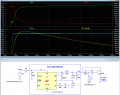
Okay, below is the LTspice sim of a circuit using a typical 5V output buck regulator IC powered by the 24V, 1s pulse, that may work for you:

The regulator only takes about 10ms to generate 5V at the output after the start of the pulse.

The solenoid pulse time can be adjusted by 2kΩ pot U2 to get the desired solenoid current response (yellow trace) to minimize the noise.

R2 is to reduce the initial input inrush current that charges C3.
You can limit that inrush further, if needed, by ramping up the 24V pulse.
Also the /SHDN (enable/shutdown) input can be used to delay the regulator start until the capacitor has charged to near 24V, or perhaps if you want to stagger the startups to minimize the initial pulse current from the generator.

Edit: Modified sim to generate 4V output from the converter, which gives a peak solenoid current of about 220mA.
Edit: You could likely use a cheap module for the converter (
example).

1720734108665.png
 
Last edited:
Top