Latching DOWN a voltage comparator

Thread Starter

Steve200

Joined Jun 22, 2024
68
Hello all, a query.

I have not yet got a drawing for this because I want to check that this is feasible in the first place.

I have come across lots of information regarding latching comparator outputs on, but is it possible to latch one off with a FALLING input voltage.
What I potentially need is a circuit whereby once the input voltage falls below approx 0.8v, the comparator output goes low and stays low until power is removed to the whole board and re-applied again. The output would be driving the base of an NPN transistor to switch this between high and low. Supply voltage needs to be as low as possible.

Thanks in anticipation, Steve
 

ericgibbs

Joined Jan 29, 2010
21,391
Hi Steve,
You could consider a LM393 or similar comparator with a diode as part of the hysteresis path.

Post a draft circuit when ready.
E
 

Attachments

Thread Starter

Steve200

Joined Jun 22, 2024
68
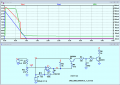
Hi Eric, this is what ive come up with.

It doesnt simulate in circuitlab, the output goes high when the input rises so it isnt latching regardless of what resistor is in the hysterisis path.
Any ideas? (hopefully this wont be as hard as the last project)

Kind regards Steve
 

Attachments

Thread Starter

Steve200

Joined Jun 22, 2024
68
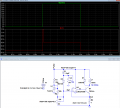
thanks for that, i believe i have found another limitation of free simulation software.

But what happens when VP rises again? Id expect that vp will start at around 1.5v on power up, drop to around 0.8v and then rise again before the circuit powers down.

This idea is to use a hall effect sensor to slow down a solenoid and then cut the power to it once it reaches a certain distance. The comparator would need to latch low until the incoming feed (a 1 second pulse every thirty seconds) has gone low.
In your LTspice drawing, v1 represents the hall sensor, R6 represents the solenoid coil. C1 is to slowly release the solenoid back to resting position.

regards steve
 

MisterBill2

Joined Jan 23, 2018
27,186
Slowing a solenoid based on a hall sensor and then cutting power a a specific position seems like a difficult task to even make perform poorly. Solenoids response is directly increased as the air-gap narrows and so any feedback loop will be terribly nonlinear second order. Plus the shape of the magnetic field varies with the position of the moving part, as does the inctance also varies as it moves and the gap changes.
 

Thread Starter

Steve200

Joined Jun 22, 2024
68
Hi mrbill2,

I appreciate the difficulties in controlling solenoids. This does not have to happen with much accuracy. Basically this is a solenoid that drives a ratchet when it receives a short pulse. The aim is to stop the armature hitting it's backstop so hard and reducing the inherent noise this creates. I've already took some measurements of how much current is required to get it to move at different air gaps. Linearity isn't much of a problem as long as the coil current always slightly exceeds what is needed to maintain movement. Cutting the power to it at a certain point also needs not be too accurate, as long as the ratchet has engaged onto the next tooth of the count wheel, plenty of margin here too.

Kind regards Steve
 

MisterBill2

Joined Jan 23, 2018
27,186
OK, now that the purpose and intention is clarified, which is to reduce the impact energy of the solenoid plunger, the electrical requirements are clearer, and quite likely simpler to obtain. The main requirement for a simpler solution would be that the effort required to be delivered thru the solenoid travel be consistent, rather than changing due to some external variable. That consistency will remove the requirement for feedback to control the solenoid drive level.
There has already been a lot of research in the related area of reducing solenoid holding current requirements, and a lot of solutions have been developed and published.
So it should not be terribly complicated to adapt one of those schemes to reducing the drive power during the time that the solenoid is moving. That might be as simple as powering the solenoid from a charged capacitor, selected to quickly reduce the voltage as it discharged during the solenoid stroke's travel.
Mostly the solutions have been aimed at reducing the holding power dissipation, but exactly the same scheme should be able to reduce the drive power during the motion.

In addition, if this is a battery powered device, the voltage divider for the inverting input is way to low a resistance. 820K and 270K would be better choices.
In fact, if it is a battery powered device, letting the battery charge a capacitor to power the solenoid will be a very good choice, similar to a few of the reduced holding current solutions I have seen.
 
Last edited:

AnalogKid

Joined Aug 1, 2013
12,045
I don't see anywhere an explicit statement of the controlling input signal voltage range. What is it, and can it ever equal or exceed the power source for the circuit?

ak
 

Thread Starter

Steve200

Joined Jun 22, 2024
68
The input voltage is 24vdc pulses of around a second duration every 30 seconds. Not shown on the drawing as its only an idea at this stage would be a 3.7v buck converter or similar voltage to run the board pictured. Id need to mock up a sensor in real life to find out the exact input voltages, but the hall sensor would also be fed of the 3.7v so it couldn't possibly be higher than the supply.
regards steve.
 

AnalogKid

Joined Aug 1, 2013
12,045
Fewer parts. Also, if you do want to run the circuit on a lower voltage, the operating current will be so low that I don't think a switching buck regulator is needed. A low power linear regulator should work, and maybe just a zener diode and resistor.

ak
 

crutschow

Joined Mar 14, 2008
38,323
Rather than messing with complicated feedback, how about hitting it with a short pulse to get it moving and then drop the current to just enough to move it to the end of the stroke?
Below is the LTspice sim of a conceptual circuit for that:
It uses a TL431 reference for the current level, and an LM324 op amp to control the current.

Pot U3 adjusts the length of the initial, full-amplitude pulse, and pot U4 adjusts the current for the rest of the pulse.
By empirically adjusting the initial pulse width and the following current level while testing the circuit, you should be able to arrive at settings the will pulse the solenoid with minimum noise.

It is powered by the 24V, 1s pulse.

1720479401196.png
 
Last edited:

MisterBill2

Joined Jan 23, 2018
27,186
If the pulse rate and the solenoid motions are to be exactly related, and if the 24 volt pulses have an adequate current capability then it should be possible to charge a capacitor with the right voltage so that the solenoid velocity drops as it heads toward the impact position. The only issue would be the solenoid coil heating and changing the resistance.
That is to say that with the right discharge profile, based on voltage and capacitance, a consistent low energy impact should be possible.
 

Thread Starter

Steve200

Joined Jun 22, 2024
68
Hi all, there's some interesting ideas here, all of which I'd like to try.
I have some more detail to add.
The solenoid is 4 ohm, but of rather large construction. It requires 180ma to get it to move from rest and around 70ma to get it to hold. The coils are rated at 270ma max. Can the above be made to work with those figures? Also in my own iteration, I've provided a capacitor to slowly ramp down the solenoid so as to reduce the noise as it settles back to normal. Is this feature also possible with the above ideas?
The idea of the switching regulator is to keep current down to an absolute minimum as there could potentially be multiples of these clocks running off the same 24v pulses.

Kind Regards Steve
 

Thread Starter

Steve200

Joined Jun 22, 2024
68
A pendulum master clock generates the pulses via a relay.
Slave clocks with low resistance coils were designed to be connected in series, the current adjusted depending on how many clocks were in the circuit. I'll be wiring mine in parallel.
The slave clock mechanisms are quite large for what they do hence the reason for the high current and large coil.
regards steve
 

crutschow

Joined Mar 14, 2008
38,323
Why not connect them in series as designed?

So there is no problem with connecting the clocks to main's power to operate the clock's coil?

What's the maximum number of clocks you will likely have?
 
Last edited:
Top