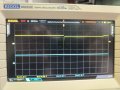
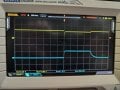
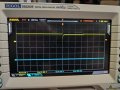
They are included im my previous post. Images #2,#4,#6. Or you need something else?So I need to see all the voltages while it's ON with the button pressed, trying to turn it off.
It's not clear what trace is what voltage.They are included im my previous post. Images #2,#4,#6. Or you need something else?
On all the images, yellow is Vg2 and blue are Vg1, Out, V2. Load is mentioned relay with HF41F relay. Do you want me to put a 1kOhm resistor and make an oscilloscope images again?It's not clear what trace is what voltage.
With the output on (with a 1kΩ load), then press and hold the push-button.
With the button pressed, show and label the voltages at nodes out, G1, G2, and 2.
Did you not have an output load previously?Do you want me to put a 1kOhm resistor and make an oscilloscope images again?


Added 10uF and now it worksOkay.
It appears that it is trying to turn off (the Vg2 negative going spike), but C1 is not large enough to hold G2 low, long enough.
Try increasing the value of C1 to a few microfarad and see if that helps.
The wire length should have zero effect on any of the circuit's time constants.This delay between switching ON and then be able to switch OFF depends on C1? Does it also depend on the line length between momentary switch and circuit?
Yes. the delay before you can either turn it ON or OFF Is determined by the R2C1 time-constant.This delay between switching ON and then be able to switch OFF depends on C1?
Those connections have a high DC impedance, but the impedance to AC noise is determined by the values of C1 and C3.The circuit shown last is not noise resistant on the push button connections. Those are moderately high impedance points..
Making twisted pair as described produces a poor version because each wire is also twisted. AND the twisting is never uniform along the length.for installing that system in a house or anything except a very small room, buy the cheap alarm cable which is twisted pair uniformly without the wound up conductors.Yes. the delay before you can either turn it ON or OFF Is determined by the R2C1 time-constant.
If you look at the purple trace V(2) in post #53 you will see the rise/fall time for that.
Since it is now working, you can likely reduce C1 some, to reduce that time while still having the circuit work, if you want that time to be shorter..
Those connections have a high DC impedance, but the impedance to AC noise is determined by the values of C1 and C3.
Using twisted-pair wire to the switch should reduce the sensitivity to noise, with shielded twisted-pair wires (tie shield to circuit common) even better.
(Note, you can readily twist two wires by putting one end of the pair in a vice, and the other pair end to a drill chuck. Holding the wires taut will then allow the drill to rapidly twist the wires).
What's a "twisted" wire and why is it a problem?Making twisted pair as described produces a poor version because each wire is also twisted.
Good idea if you are running more that a few feet of twisted wire.buy the cheap alarm cable which is twisted pair uniformly without the wound up conductors.
Again, why?each wire twits about it's own central axis.that is undesireable in a cable of any length beyond a few inches.
.Again, why?
Do you know for a fact that they do the wire twist commercially with twisting the wire?