Tested circuit posted on #4 with R2=220kOhm and C1=430nF (soldered 4 capacitors in parallel to get that value). Test results are:
- momentary switch connected to 5cm wire: circuit switches ON but on next "connection" of momentary switch, circuit switches OFF and then back ON after .5s (relay goes off and back on).
- 10m wire and momentary switch: circuit switches ON but pressing again doesn't either for a moment switch off the circuit.
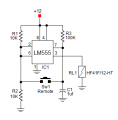
Modified version from post #31. Since the HF41F/12-HT relay has a coil resistance of only 848 ohms it can be driven directly by the 555. View attachment 310803
To be clear, that works only with a bipolar version of the 555 - NE555, LM555, MC555, etc. A CMOS version does not have enough output current capability.
Consider connecting R3 between the 555 output and C1, abandoning the Discharge output (input?) pin 7. You get symmetrical recovery times, and you don't have an IC output dead-shorting a 1 uF cap.
There is, and has been for MANY years, an easier way to remotely control lights that satisfies code requirements and does not burn standby power and is noise immune. That is a solenoid operated switch, already UL approved and ready to install.
If you are going to embed something in your house that is to contol multiple lighting circuits, I suggest you use some already proven system. That would be far more reliable and minimise any risk of burning the house down or electrocuting someone.
Or is it a toy / dolls house?
Finding a circuit diagram, with no clue how it works and asking people on an internet forum to fault find on it, IMO, is frankly ridiculous.
The 24 volt, maintained contact remote switch controlled system has several advantages over other schemes: There can be multiple control points for each circuit, they meet all applicable code requirements, and they are very durable, and easy to install. Aside from those benefits, they generate no noise, are noise immune, so no unintended triggering, consume no power when not changing states. An extra benefit is that they are totally immune to external hacking
If there was a central control position, adding computer control would be quite simple.
AND, unlike the alternate-action from a simple push-button scheme, the state of each controlled circuit is predictable without knowing what state it was in prior to the command given.
Thank you very very much for your help. I can connect oscilloscope to the circuit and see what's happening. Perhaps there is a way to try to make this circuit work...
Thank you very very much for your help. I can connect oscilloscope to the circuit and see what's happening. Perhaps there is a way to try to make this circuit work...
Below shows what the voltages at the various nodes should look like:
If they don't reasonably match what you see, then there's some problem with your circuit.
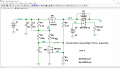
Note that you need to have a load on the circuit output for proper operation.
Give this circuit a try, its slightly different than the circuit in post #4.
However, please do not make value substitutions as this type of circuit (and post #4) is inherently sensitive to component values and tolerances. That's why this type of circuit is a poor choice.
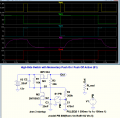
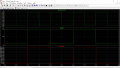
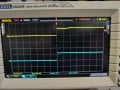
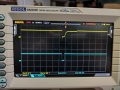
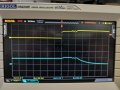
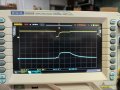
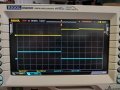
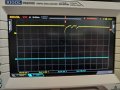
I only have 2 channel oscilloscope so I did some testing. Yellow channel is Vg2 while blue are Vg1, out and V2. I put images of switching off to on and when I press momentary switch while circuit is on (but it doesn't switch off).
Vg2 vs out off to on:
In some circuit designs component values are quite critical, which is the whole reason for the existence of parts with 5% and 1% tolerance ratings. If you measure the voltages at the various points in the circuit with the output off and with it on, it should be possible to see which part values matter the most. It may also help with understanding exactly how this circuit functions.
This circuit belongs in the class of "Bistable trigger circuits", which are one of the trickier types to create and make work well.
ALSO, beware that both of the connections to the push-button are fairly high impedance and thus subject to external noise causing unintended operation. So I suggest using shielded 2 conductor cable with the shield tied to the circuit common, the supply negative side.

 Facebook
 Google
 GitHub
 Linkedin