Laser diode driver oscillating output

Thread Starter

fdc2k17

Joined May 15, 2017
29
OK, I had not thought about startup conditions. Sorry about that. And it was a quite small capacitor, just enough to reduce the frequency response. to avoid the oscillation.. Now a question: I have designed, and our company built and sold a bunch of them, devices for measuring speed based on an object breaking two laser beams in sequence, and accurately measuring the time between breaks. Each unit utilized 4 ready-made laser assemblies, usually 2 or 3 milliwatts. On the opposite side were 4 sensors, first we used the Honeywell digital sensors, then the Fairchild ones. Fairchild sensors have a real problem with the location of their sweet spot, which causes all kinds of problems. Those original laser devices are now at least 15 years old, and the lasers no longer are quite as bright. Are you designing small laser devices to be sold to OEMs??
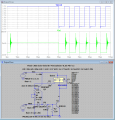
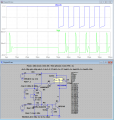
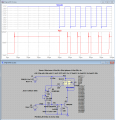
Here are the results using different cap values at the base of Q2...
 

Attachments

MisterBill2

Joined Jan 23, 2018
27,530
Here are the results using different cap values at the base of Q2...
OK, and I see. And none of those had the capacitor tied base to emitter on Q2, which is what I had suggested. But now I am suggesting to do it in simulation, which is less destructive of expensive parts. and also use a smaller cap, possibly 47pF or 100pF.
 

Thread Starter

fdc2k17

Joined May 15, 2017
29
OK, and I see. And none of those had the capacitor tied base to emitter on Q2, which is what I had suggested. But now I am suggesting to do it in simulation, which is less destructive of expensive parts. and also use a smaller cap, possibly 47pF or 100pF.
Hi MisterBill2,
My sincere apology, I had misread your suggestion.
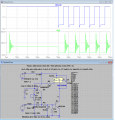
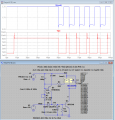
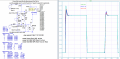
Now I've simulated your suggestion correctly, I hope. Both capacitances suggested provided very similar results, hence I've attached only the simulation for 100pF and no capacitor. The improvement doesn't seem to be that significant.
The component that seems to have the most influence in the oscillation/ringing is C1, at the base of BFR540. Its capacitance helps stop the oscillation and its ESR affects the amplitude of the ringing.
 

Attachments

MisterBill2

Joined Jan 23, 2018
27,530
OK, I see that the base capacitor does indeed reduce the ringing, my concern had been in affecting the modulation characteristics, and so I was reluctant to consider that. Possibly a larger capacitor than 100pF would be in order. It does appear that it does not cause an increase in the current spike amplitude. But the whole driver optimization process is fairly complex, although having a good simulation model certainly helps. That is why for my project I chose a whole module, which also included a lense and having the beam precisely aligned with the body axis. Avoiding the alignment step saved lots of hours of calibration time.
 

Bordodynov

Joined May 20, 2015
3,431
Unfortunately, I can't give you my modulated driver schemes (company secret). I have used other principles of schema building. But on low-frequency transistors (Ft=100-200 MHz) I got the maximum modulation frequency of 100-200 kHz. This was not enough for me. And I used microwave transistors. I got the modulation frequency of 5 MHz and 3 ns pulse fronts.
 

Thread Starter

fdc2k17

Joined May 15, 2017
29
Unfortunately, I can't give you my modulated driver schemes (company secret). I have used other principles of schema building. But on low-frequency transistors (Ft=100-200 MHz) I got the maximum modulation frequency of 100-200 kHz. This was not enough for me. And I used microwave transistors. I got the modulation frequency of 5 MHz and 3 ns pulse fronts.
Bordodynov,
You have helped me beyond what I was expecting, I couldn't ask for more.
There is only one thing that I would still like to learn from this circuit, which is to find its transfer function to see how the resistances and capacitances, and which of them, affect the closed loop stability.
Basically, this is a control systems problem but my knowledge in this area is a little bit rusty. This issue must be related to the Nyquist criteria for stability.
 

MisterBill2

Joined Jan 23, 2018
27,530
I investigated modulated transistors for my application and it was not cost effective. IN my application they are switched off by two sequential pulses to simulate the passage of an object. So only the delay between power off and light off matters, and that seems to be similar even between production runs a year apart. It probably does not relate to either of your applications unless you are building a product to compete with mine, which I doubt.
 

Bordodynov

Joined May 20, 2015
3,431
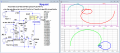
I use AC analysis to determine the stability of the circuit. I made this analysis and replaced the usual (amplitude and phase depending on frequency) output on Nyquist's chart. Enough to determine the stability to consider only the point of impact of the generator current. But to be sure, you must change the mode (e.g. reduce the laser output power with a potentiometer). The stability may be different for different laser currents (and output transistor currents).DrajverV4_AC.png
 

Attachments

Bordodynov

Joined May 20, 2015
3,431
Setting a circuit in the low-signal analysis of AC 1 Ampere to a node, we get the impedance of this node of the circuit. If you want to get the result in Ohms, divide the output voltage by 1A.
 
Top