Laser diode driver oscillating output

Thread Starter

fdc2k17

Joined May 15, 2017
29
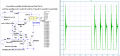
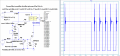
I'll download the schematic for LTspice tomorrow. I don't have access now. I forgot to upload it to the cloud. There is a line of basic laser parameters on top of it. This is the rated power, rated current, threshold current and photodiode current. I took this data from the data sheets. There are other parameters: average capacities of a photodiode and a laser diode. Also parameters of p-n transition of the laser (defines voltage drop on the laser). I have no output transistor in my library. I set the model as text (small font on the right). I will add this transistor to my collection tomorrow.
Hi, looking at the properties of some of the laser models in your library I saw that you define a few basic laser parameters as you mention and some other parameters.

I didn't have problems simulating the BFR540, I just used the same model as in your figure. What I couldn't find was the laser diode you used.

I have some knowledge of pspice, but I wasn't aware that the parameters you used were available. I'm also keen to know where you got the values for the other laser parameters (non-basic parameters). My understanding is that these will be inherent to the physical design of the laser itself, or am I mistaken?In which case you'd have to find out how they were made (?).

Lastly, is defining only the basic laser parameters enough for simulation of different diodes?
Sorry for all the questions, but I think this knowledge will help me "fix" the current circuit as well as help me with future designs I might think of.

Thanks
 

Bordodynov

Joined May 20, 2015
3,431
The volt-amer characteristic of the laser is described by the spice diode parameters. The main parameters are n,is and Rs. I have added suffixes. It is possible to select these coefficients quite accurately. But I limit myself to nLd and rsLd. I pick up the direct voltage drop on the laser and do not get caught up in an exact fit. There are also laser diode and photodiode time constants. Don't be surprised that my lasers are called Lazers. My native language is Russian and this is a consequence. If I had foreseen 15 years ago that I would be distributing my models, I would have named them differently. There are models with inductive conclusions. This is especially important for pulsed lasers. I also have models of photodiodes, including avalanche ones.
ORCAD has models of lasers, but despite the claim to accuracy they are not complete. They do not model overload correctly.
 

Thread Starter

fdc2k17

Joined May 15, 2017
29
I'll download the schematic for LTspice tomorrow. I don't have access now. I forgot to upload it to the cloud. There is a line of basic laser parameters on top of it. This is the rated power, rated current, threshold current and photodiode current. I took this data from the data sheets. There are other parameters: average capacities of a photodiode and a laser diode. Also parameters of p-n transition of the laser (defines voltage drop on the laser). I have no output transistor in my library. I set the model as text (small font on the right). I will add this transistor to my collection tomorrow.
Do you have a real electrical circuitry with a power supply capacitor?
Hi, forgot to reply to your question here... yes, I have the circuit in a PCB already (prototype).
 

Thread Starter

fdc2k17

Joined May 15, 2017
29
Thank you so much for this!
Your simulations look very similar to what I measure in my prototype.
I eventually managed to get the simulation working by initially changing the laser parameters to match those in the laser's datasheet and checking that the L-I curve was similar to the datasheet. Then I built the complete circuit.
One difference I notice is the "advanced" parameters you used for the laser. For instance, I left my cph=40p whereas you used cph=60p.
Would you be able to tell me where you got your values from or how could I work them out if I were to use a different laser diode?
 

Bordodynov

Joined May 20, 2015
3,431
The capacity of the photodiode depends on the voltage. I have met a laser for which the capacity of the photodiode has been specified. In my drivers on the photodiode, the voltage is about 2.5 volts. On yours, about 0.7 volts. I.e. your variant is worse and the capacity of the photodiode will be higher. This capacitance gives an additional phase shift, which is worse for stability. You can measure the capacity of the photodiode with a meter. I prefer to count on the worst case scenario. Look at the parameters of the individual photodiodes. Some photodiodes have a significant delay (on the order of tens of nanoseconds). I have entered the parameter tauFd for this purpose. A more advanced model for Lazer2 (compared to Lazer). I gradually complicated the models.
 

Thread Starter

fdc2k17

Joined May 15, 2017
29
Hi Bordodynov,
Just replacing BFT93 by MMBTH81 in my prototype causes the output to oscillate, as per simulation. I then increased the value of C1 to 27nF to see if "slowing" the current at the base of BFR540 would help. Initially trying in the simulation and then in the prototype.

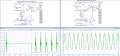
This helped to stabilize the output in CW mode and to show ringing like the left plot in the simulation figure above.
I tried to attenuate/remove the ringing by playing with different values of C1's series resistance in the simulation and I found that using a 10ohm resistance helped.

However, when I tried this in the prototype the output oscillated again. Just to clarify, I placed C1 (27nF) in series with a 10ohm resistor since I don't have a 27nF cap with 10ohm ESR (I'm not even sure if that exists). I also tried using a 5ohm resistor, to account for the capacitor's ESR, but obtained the same result...oscillation.

Is it possible that the parasitic inductance of the SMD's lead is playing a significant role here?
I also realized that the gain of the feedback transistor (BFT93/MMBTH81) would have an effect, therefore I tried changing the hfe value of the MMBTH81 to a lower value (hfe 133->33) and this also improved the ringing. Note: this was done in the simulation.

I will try to find other PNP transistors that have similar bandwidth to the MMBTH81 but lower hfe and see if that works.

Let me know if you find anything wrong with the tests I made or with what I'm suggesting.
 

Thread Starter

fdc2k17

Joined May 15, 2017
29
How about damping the gain with a "small" emitter resistor in one of the transistors?
I thought of that too and I was just simulating the output when a resistor is added to the emitter of either transistor. No improvements.
The only parameters that seem to improve the output (in the simulation) are: C1 (capacitance and ESR) and Q2 hfe.

I'm open to more suggestions. If it can be done just by changing the values of the components that would be ideal since I already have a prototype PCB built which I can use to test these changes. Mind you, there's only so much change that I can make to the current PCB.
 

Bordodynov

Joined May 20, 2015
3,431
Don't you have a bft92W transistor? They are not out of production.
The parasitic inductances of capacitors and conductors and especially the power supply conductors can affect stability. I don't like your protection. Permissible reverse voltage of laser diode 2 Volts. I usually place the BAS70 Schottky diode parallel to the laser. It has a small parasitic tank. And the BAS70H has a small body and fits between the board tracks.
 

Thread Starter

fdc2k17

Joined May 15, 2017
29
The resistor in the output transistor emitter can help. I sometimes put 2 to 5 Ohms.
This helped, both in the simulation and in the prototype. I might have to make modifications to the PCB in this case.
I'm thinking that I may get around the emitter resistor if I replace BFR540 by another transistor with lower bandwidth and hfe (maybe?).
 
Last edited:

Thread Starter

fdc2k17

Joined May 15, 2017
29
Don't you have a bft92W transistor? They are not out of production.
The parasitic inductances of capacitors and conductors and especially the power supply conductors can affect stability. I don't like your protection. Permissible reverse voltage of laser diode 2 Volts. I usually place the BAS70 Schottky diode parallel to the laser. It has a small parasitic tank. And the BAS70H has a small body and fits between the board tracks.
Thanks again for your reply.
I had searched for the BFT92W but, unless I'm mistaken, it is also obsolete. At least it is not available in farnell, nor RS, nor Mouser, nor Digikey, nor any of the suppliers I know of in the UK. The BFT92W was my very first idea of a replacement for the BFT93, but as I mentioned, not available also.

As for the protection.... I agree with you and will change this in the next iteration of the PCB.
 

MisterBill2

Joined Jan 23, 2018
27,522
Once again, I am suggesting that the oosillation, now reduced to ringing, is caused by the temperature compensation transistor. Si once again I am suggesting adding a small capacitance between the base and the emitter of Q2, the PNP transistor. Ringing is caused by not enough gain to maintain oscillation, so if you reduce the gain a bit more the ringing should be gone.
 

Thread Starter

fdc2k17

Joined May 15, 2017
29
Once again, I am suggesting that the oosillation, now reduced to ringing, is caused by the temperature compensation transistor. Si once again I am suggesting adding a small capacitance between the base and the emitter of Q2, the PNP transistor. Ringing is caused by not enough gain to maintain oscillation, so if you reduce the gain a bit more the ringing should be gone.
Hi MisterBill2,
Thanks for your input.
I had already tried your suggestion before posting this thread. Placing a capacitor where you suggest damaged the laser diode. In fact I damaged 2 of them and that's when I decided to seek help, because I can't afford to get it working via trial and error.
Bordodynov's insight into simulating the laser diode has been a huge help. When I simulated the circuit with a capacitor between the base and emitter of Q2, I understood why my laser diodes went puff. Adding the capacitor causes a fairly large peak of current across the laser diode. I'll post some figures of the simulation results tomorrow.
 

MisterBill2

Joined Jan 23, 2018
27,522
Hi MisterBill2,
Thanks for your input.
I had already tried your suggestion before posting this thread. Placing a capacitor where you suggest damaged the laser diode. In fact I damaged 2 of them and that's when I decided to seek help, because I can't afford to get it working via trial and error.
Bordodynov's insight into simulating the laser diode has been a huge help. When I simulated the circuit with a capacitor between the base and emitter of Q2, I understood why my laser diodes went puff. Adding the capacitor causes a fairly large peak of current across the laser diode. I'll post some figures of the simulation results tomorrow.
OK, I had not thought about startup conditions. Sorry about that. And it was a quite small capacitor, just enough to reduce the frequency response. to avoid the oscillation.. Now a question: I have designed, and our company built and sold a bunch of them, devices for measuring speed based on an object breaking two laser beams in sequence, and accurately measuring the time between breaks. Each unit utilized 4 ready-made laser assemblies, usually 2 or 3 milliwatts. On the opposite side were 4 sensors, first we used the Honeywell digital sensors, then the Fairchild ones. Fairchild sensors have a real problem with the location of their sweet spot, which causes all kinds of problems. Those original laser devices are now at least 15 years old, and the lasers no longer are quite as bright. Are you designing small laser devices to be sold to OEMs??
 
Top