Facebook
 Google
 GitHub
 Linkedin
Hello Everyone,
I have been trying to get a voltage follower to work for my application with no success.
I am using voltage followers in my design in several places and have no problems, but for this particular configuration my input voltage is very small ( 0.17 mV) and I am measuring 60 to 80mV output voltage at the output.
I read several papers and tried different approaches ( on this website and other ) but I can't seem to find a way around this issue.
My input voltage comes from a thermistor linearizing resistor network and will range from 0.17 ( T=25C) to 0.28mV ( T=50C)
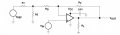
Here is my initial setup :
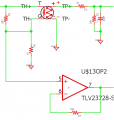
I started with the TLV2370 .which has an input offset voltage in the order to ~2mV. I though that was my problem so I switched to an LTC2050 ( have it handy) with input offset voltage is in the uV range.
I still measure about the same output voltage of around 60 to 80mV.
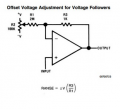
I tried this setup ( Although some member of this forum disapproved in some posts ) and it didn't help. I was able to increase the offset but not decrease it.
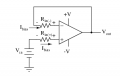
I also tried matching the feedback resistor with an input resistor (here) ( 1K trying to limit the input bias current ) but still measure the same output voltage of 60mV when the the input is 0.16 mV.
I do not want to use an opamp with a nulling input and endup with a pot on the board.
I think I am missing something and can;t figure it out by myself. I hope someone smarter can help me out here.
Thanks
AJ
I have been trying to get a voltage follower to work for my application with no success.
I am using voltage followers in my design in several places and have no problems, but for this particular configuration my input voltage is very small ( 0.17 mV) and I am measuring 60 to 80mV output voltage at the output.
I read several papers and tried different approaches ( on this website and other ) but I can't seem to find a way around this issue.
My input voltage comes from a thermistor linearizing resistor network and will range from 0.17 ( T=25C) to 0.28mV ( T=50C)
Here is my initial setup :
I started with the TLV2370 .which has an input offset voltage in the order to ~2mV. I though that was my problem so I switched to an LTC2050 ( have it handy) with input offset voltage is in the uV range.
I still measure about the same output voltage of around 60 to 80mV.
I tried this setup ( Although some member of this forum disapproved in some posts ) and it didn't help. I was able to increase the offset but not decrease it.
I also tried matching the feedback resistor with an input resistor (here) ( 1K trying to limit the input bias current ) but still measure the same output voltage of 60mV when the the input is 0.16 mV.
I do not want to use an opamp with a nulling input and endup with a pot on the board.
I think I am missing something and can;t figure it out by myself. I hope someone smarter can help me out here.
Thanks
AJ