Charging Supercapacitors - Charge Small Supercapacitor First Then Auto Switch Over To Charging Large Supercapacitor

Thread Starter

Mahonroy

Joined Oct 21, 2014
417
I am building an energy storage device with supercapacitors instead of lithium batteries.

I have an input voltage that varies from 3VDC to 12VDC. I am currently bucking this voltage down to 2.5VDC to charge a 2.7V supercapacitor. I then have a voltage boosting circuit that takes 0.5VDC to 3VDC as an input, and boosts it up to 5VDC.

The problem I am facing is that if the supercapacitor is completely dead, it takes a while for it to charge up to that initial 0.5VDC for the boosting circuit to start working. I need it to start working faster.

So my thought was to have two supercapacitors - a small one and a large one. My thought was if I could have everything running off the small capacitor first, then the 0.5VDC could be reached faster and the boosted 5V would come on quicker. Once the small supercapacitor reaches something like 2.5VDC, the charging circuit would then start charging the large supercapacitor. Once the large supercapacitor reaches 0.5VDC, then it could switch over to the large one. Once the large one drops below 0.4V it could switch back over to the small one.

Is this a reasonable way of accomplishing this, or is there a better way? How is this supposed to work exactly? I am not sure how to do the circuit switching portion. I'm guessing it will use some op-amps to compare voltages, and mosfets, but I'm confused how to do this.

Thanks and any help or advice is greatly appreciated!
 
Last edited:

DickCappels

Joined Aug 21, 2008
10,661
What is the current output capability of the power source you are using to charge the capacitors, and what is the total capacitance you are trying to charge?
 

Tonyr1084

Joined Sep 24, 2015
9,744
My thought was if I could have everything running off the small capacitor first, then the 0.5VDC could be reached faster and the boosted 5V would come on quicker.
Adding a cap in parallel with the big cap will only make everything take longer to charge. Think of having a barrel and filling it with water. It takes time. Clearly a bucket will fill much quicker. The hose can only provide so many gallons per minute. If you're filling both at the same time then it will take as long as if the big cap was just a little bigger. Your thought won't work the way you think it might.
 

Tonyr1084

Joined Sep 24, 2015
9,744
Is this a reasonable way of accomplishing this, or is there a better way?
Each time you change a voltage you introduce inefficiency. Bucking and boosting back and forth wastes energy. I would think that if you want to charge a super capacitor (SC) faster then you need a stronger power source. Not a higher voltage source but a source that can put out more amperage. But I'm no expert on SC's. There MIGHT be a limit to how fast you can charge a SC. I just don't know that much about them.
 

crutschow

Joined Mar 14, 2008
38,316
The supercapacitor is being used as energy storage. I don't want to use lithium ion batteries here.
Why the rush to start the 5V converter?

How big is the battery and how much energy do you want to store?
It takes a very large capacitor to store as much energy as a small lithium-ion battery.

As noted the scheme proposed is rather inefficient.
 

Thread Starter

Mahonroy

Joined Oct 21, 2014
417
What is the current output capability of the power source you are using to charge the capacitors, and what is the total capacitance you are trying to charge?
The power source can output 4 amps. I simulated this scenario with 10,000F capacitor and a 0.64 ohm current limiting resistor, and it took 23 minutes to reach the initial 0.5V for the circuit to start.

Adding a cap in parallel with the big cap will only make everything take longer to charge. Think of having a barrel and filling it with water. It takes time. Clearly a bucket will fill much quicker. The hose can only provide so many gallons per minute. If you're filling both at the same time then it will take as long as if the big cap was just a little bigger. Your thought won't work the way you think it might.
I was not suggesting to charge both capacitors in parallel at the same time, that would result in both capacitors charging at the same time (slowly) and this is not what I want. I was suggesting charging the small capacitor independently first, then charging the second one.

Why the rush to start the 5V converter?

How big is the battery and how much energy do you want to store?
It takes a very large capacitor to store as much energy as a small lithium-ion battery.

As noted the scheme proposed is rather inefficient.
The power source can output 4 amps. I simulated this scenario with 10,000F capacitor and a 0.64 ohm current limiting resistor, and it took 23 minutes to reach the initial 0.5V for the circuit to start. In this scenario I need it to reach 0.5V within 1 minute not 23 minutes. But I still need the capability of 10,000F capacitance (for storage) if you decide to charge it long enough. I already mentioned that a lithium-ion battery is not an option. I am not interested in lithium-ion batteries and I am well aware that supercapacitors take up 10X the amount of room and cost more.
 

Tonyr1084

Joined Sep 24, 2015
9,744
I was not suggesting to charge both capacitors in parallel at the same time, that would result in both capacitors charging at the same time (slowly) and this is not what I want. I was suggesting charging the small capacitor independently first, then charging the second one.
My error. Can you draw a picture of how the two caps are independently charged?
 

Thread Starter

Mahonroy

Joined Oct 21, 2014
417
My error. Can you draw a picture of how the two caps are independently charged?
I can't - that is basically the point of my question. I know they need to be independently charged but I don't know how its supposed to work. I don't know if the caps are supposed to be in series along with some kind of comparitor and mosfet to switch charging at some point... I just don't know, that is what I am wondering.
 

Tonyr1084

Joined Sep 24, 2015
9,744
I can't - that is basically the point of my question. I know they need to be independently charged but I don't know how its supposed to work. I don't know if the caps are supposed to be in series along with some kind of comparitor and mosfet to switch charging at some point... I just don't know, that is what I am wondering.
So my thought was to have two supercapacitors - a small one and a large one. My thought was if I could have everything running off the small capacitor first, then the 0.5VDC could be reached faster and the boosted 5V would come on quicker. Once the small supercapacitor reaches something like 2.5VDC, the charging circuit would then start charging the large supercapacitor. Once the large supercapacitor reaches 0.5VDC, then it could switch over to the large one. Once the large one drops below 0.4V it could switch back over to the small one.
So it sounds like you have a small cap being charged independently from the big cap. Once the small cap reaches a charge level it turns on the charging system for the larger cap. This would need two separate chargers. Is this what you're planning?
 

crutschow

Joined Mar 14, 2008
38,316
they need to be independently charged but I don't know how its supposed to work.
Edit: Modified circuit to add D1

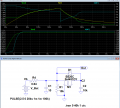
Below is the LTspice sim of a simple circuit that should basically do what you want:

It initially charges the small C1 capacitor until the P-MOSFET source voltage reaches its Vgs threshold voltage (green trace), and then C2 starts to also charge (blue trace).
The P-MOSFET conducts in both directions when ON, so the output load can draw from both C1 and C2 when both are charged (Changeover from charge to discharge occurs at 20Ks).

The Schottky diode D1 allows C2 to discharge below the MOSFETs threshold voltage with minimum voltage drop.

The M1 Vgs(th) voltage determines when it turns on so you want a logic-level type with a low maximum Vgs(th).
It also should have an on-resistance low enough so the voltage drop from the charging and load current is negligible.

I know this doesn't meet your exact requirements, but to do that would require significantly more circuitry.
That can be done if necessary.

1752286005678.png
 
Last edited:

Thread Starter

Mahonroy

Joined Oct 21, 2014
417
Okay.
Below is the LTspice sim of a simple circuit that should basically do what you want:

It initially charges the small C1 capacitor until the threshold voltage of the M1 MOSFET is reached, and then C2 starts to also charge.
The P-MOSFET conducts in both directions when ON, so the output load can draw from both C1 and C2 when both are charged.

The M1 Vgs(th) voltage determines when it turns on so you want a logic-level type with a low maximum Vgs(th).
It also should have an on-resistance low enough so the voltage drop from the charging and load current is negligible.

I know this doesn't meet your exact requirements, but to do that would require significantly more circuitry.
That can be done if necessary.

View attachment 352443
Thank you for taking the time to put this together. This does look like it would do the trick. I am working on digesting exactly how it works and modeling it up myself. Thanks again!
 

MisterBill2

Joined Jan 23, 2018
27,159
What I am guessing is that the TS has some unknown "power source that can deliver from three volts up to 12 volts at a current of four amps.
Somehow this power source is to feed a power converter that delivers five volts to some load for some unknown purpose.

What is totally not stated is why the magical power converter is not able to use the power directly from the three to 12 volt, 4 amp power source directly, with the balance of the power being used to charge the capacitors.
OT is there some unmentioned additional constraint that does not allow power splitting???
 
Top