Large Ferrite Core Used on 120 cycles ?

Thread Starter

russwr

Joined Aug 29, 2017
123
Comments needed regarding use of large GRAY ferrite toroid of 2millihenry inductance , only 23 turns, as used with high voltage, low ma. current, 120 cycles full wave DC Ripple. I just assumed that being large and very low current , it may not saturate. My other machined laminations bar inductor with bobbin, is 2millihenry with magnet wire, but am assuming it will short through the wires , as not meant for high volts. The toroid FT240-31 has ignition cable rated 10kv. If I rewired the bar, it would be over 300 turns of small cable 3kv., with layered tape wrappings, and a lot of work. The inductor is just for time delay use, not filter inductor.


A toroid ferrite core is a magnetic component made from ferrite, a material composed of iron oxide and other metal oxides. Ferrite cores offer excellent magnetic properties and low losses at high frequencies,
 
Last edited:

Papabravo

Joined Feb 24, 2006
22,066
"120 cycles DC", appears to be an oxymoron, a term with contradictory terms. For such a low frequency, a ferrite core may not be the best choice.
 

MisterBill2

Joined Jan 23, 2018
27,358
I am GUESSING thatthe120 Hz "DC" is full wave rectified from a transformer, and that the series coil is to serve as a filter.
FIRST: The filter inductance is placed AFTER the first capacitor in the filter section of the supply, UNLESS it is a switching mode supply. Next, that small amount of inductance is not going to provide enough ripple reduction to be worth the effort..
 

MrChips

Joined Oct 2, 2009
34,713
We need to be pedantic about units if we want to communicate properly.

Doing 120 cycles around a track means I went around the track 120 times. It does not describe how fast I ran around the track. There is no unit of time stated.

120 Hz means 120 cycles per second.

There is no such thing as 120 Hz DC. It would mean I went around the track 120 times in one second but stood still.

In frequency space, DC means 0 Hz = zero frequency.
 

Thread Starter

russwr

Joined Aug 29, 2017
123
We need to be pedantic about units if we want to communicate properly.

Doing 120 cycles around a track means I went around the track 120 times. It does not describe how fast I ran around the track. There is no unit of time stated.

120 Hz means 120 cycles per second.

There is no such thing as 120 Hz DC. It would mean I went around the track 120 times in one second but stood still.

In frequency space, DC means 0 Hz = zero frequency.
120 Htz of a full wave rectified Power Supply output means 120 cycles ripple frequency per second positive DC without filter capacitor. The question only had to do with design of an inductor. No reference to a filter unit on output.
 

MrChips

Joined Oct 2, 2009
34,713
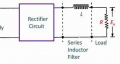
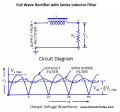
You mean 60 Hz fullwave rectified output with series inductor filter.

1748118583529.png

1748118610438.png

Now, in order to specify an inductance, you need to specify the output voltage, the amount of ripple allowed and the value of the purely resistive load. If the load is reactive then that is a completely different ballgame.
 

Papabravo

Joined Feb 24, 2006
22,066
120 Htz of a full wave rectified Power Supply output means 120 cycles ripple frequency per second positive DC without filter capacitor. The question only had to do with design of an inductor. No reference to a filter unit on output.
Can I ask why you originally chose a ferrite core for such a low frequency application?
 

Ian0

Joined Aug 7, 2020
13,117
If it's a ferrite toroid, it will saturate at DC current unless it is gapped.
But T240-32 sounds like a Micrometals part number. Are you sure it's not iron powder?
 

schmitt trigger

Joined Jul 12, 2010
2,056
But T240-32 sounds like a Micrometals part number. Are you sure it's not iron powder?
My same thoughts.
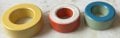
Question for the TS, is the toroid core painted in bright colors? if so it is a color code to describe the material’s magnetic properties.
For instance, a yellow or yellow-white core is material 26, an orange-white is material 8, blue-green is material 10. IMG_1237.jpeg
 

MisterBill2

Joined Jan 23, 2018
27,358
We need to be pedantic about units if we want to communicate properly.

Doing 120 cycles around a track means I went around the track 120 times. It does not describe how fast I ran around the track. There is no unit of time stated.

120 Hz means 120 cycles per second.

There is no such thing as 120 Hz DC. It would mean I went around the track 120 times in one second but stood still.

In frequency space, DC means 0 Hz = zero frequency.
CERTAINLY there can be both AC voltage and DC voltage on a wire at the same time.
It was very obvious to me that the TS was describing the 120 Hz RIPPLE portion on a DC voltage. Of course I have had to design filtering to remove that ripple a few times. I have seen ferrite beads on rectifier leads, I never asked about them and It is not likely I would use them in anything that I designed or built. BUT I have seen small pulses with higher frequency components on the rectified DC in tube circuits back when some silicon power diodes seemed to not switch off instantly as the waveform polarity reversed. That required adding a 0.1 MFD cap across the rectified DC input to the filter string.
 

Ian0

Joined Aug 7, 2020
13,117
So it is FT240-31 not T240-31. That does make a difference.
Al=3180 which gives a reluctance of 314500.
Ae (cross sectional area) = 161x10^-6 m^2
For a flux density of 250mT (Saturation) you need 12.6A Magnetomotive force.
For 23 turns it saturates at 550mA.
 

Thread Starter

russwr

Joined Aug 29, 2017
123
So it is FT240-31 not T240-31. That does make a difference.
Al=3180 which gives a reluctance of 314500.
Ae (cross sectional area) = 161x10^-6 m^2
For a flux density of 250mT (Saturation) you need 12.6A Magnetomotive force.
For 23 turns it saturates at 550mA.
Wow! Thanks! series current is way less than 1/2 Amp flow, and end use is 34% duty cycle, and used for time delay only.
 
Last edited:
Top