Keeping fridge ON if used only for parties?

Thread Starter

c627627

Joined May 18, 2011
63
[EDITED to replace a kW typo with kW•h]

I used Kill a Watt EZ to measure a room temperature refrigerator I plugged in to use for a 1 night party:
It used 8.01 kW•h in the next 114 hours, starting from room temp.

114h later, I then reset it and measured its usage for the next 27h 11 min: 1.68 kW•h.

[EDIT: It was at operating temp and that the fridge wasn't opened during those 27 hour 11 minutes].

Should I unplug this fridge if it is only used:
once a week for a 1 night party,
vs.
once every other week for a 1 night party,
vs.
once every three weeks for a 1 night party?
 
Last edited:

MrChips

Joined Oct 2, 2009
34,956
kW is the unit of power, not energy.
Are you measuring average power?

Energy should be measured in kWh, i.e. power multiplied by time, or kW multiplied by hours.
 

WBahn

Joined Mar 31, 2012
32,979
I used Kill a Watt EZ to measure a room temperature refrigerator I plugged in to use for a 1 night party:
It used 8.01 kW in the next 114 hours, starting from room temp.

114h later, I then reset it and measured its usage for the next 27h 11 min: 1.68 kW.

Should I unplug this fridge if it is only used:
once a week for a 1 night party,
vs.
once every other week for a 1 night party,
vs.
once every three weeks for a 1 night party?
Assuming that your measurements are in kWh and not kW, then it is hard to tell from the limited data.

The missing piece of information is how long it took the fridge to cool down from room temperature to its operating temperature.

Assuming that it reached operating temp before you reset the meter and that the fridge wasn't opened during the next 27 hours, then it consumes about 70 Wh/h (or 70 W) to keep it at temp.

Using this as a baseline for the initial 114 hours, then that would have been 7.98 kWh just to keep it cold, which would mean that it only took an additional 30 Wh to bring it from room temp to operating temp. Normally I would have a hard time believing this, but the coefficient of performance is better with less temperature differential, so maybe it's not that far out of line. It might also mean that this thing is going to pull about 70 W regardless of inside temp -- which should mean that the compressor is running almost continuously even after it's cold. Many newer refrigerators are designed to do pretty much just that.

So that would say that you should plug it in just far enough in advance to get everything cold in time for your party.

Now, what I don't know is whether thermal cycling (versus maintaining operating temp) places more wear and tear on any of the components.
 

WBahn

Joined Mar 31, 2012
32,979
kW is the unit of power, not energy.
Are you measuring average power?
Highly unlikely. At 120 V, that would be about 67 A to get 8 kW.

I had the impression that this is a fairly small fridge for weekend parties -- but maybe his idea of a party is much larger than mine and this is a big commercial walk-in fridge.
 

oz93666

Joined Sep 7, 2010
742
A very big factor in power consumption is how often the fridge door is open ...

Every time this happens all the cold air comes tumbling out very quickly , and is replaced by warm air . This is why a well stocked fridge uses less power than a fairly empty fridge , a full fridge has less air inside ....

When should you plug in your fridge ??? ...........When you need to keep things cold is only sensible answer ...

If you want to keep costs down , only power it when electricity is cheaper at night, putting bottles of water inside will assist this , particularly in the freezer where they freeze when the fridge is powered , when unplugged the inside still stays at 0C for a day as the ice returns to water. .
 

Alec_t

Joined Sep 17, 2013
15,132
putting bottles of water inside will assist this , particularly in the freezer where they freeze when the fridge is powered
Just make sure the bottles are plastic, not glass ....... and don't forget to leave some space for the booze :).
 

MrChips

Joined Oct 2, 2009
34,956
Highly unlikely. At 120 V, that would be about 67 A to get 8 kW.

I had the impression that this is a fairly small fridge for weekend parties -- but maybe his idea of a party is much larger than mine and this is a big commercial walk-in fridge.
Silly me. I should have paid attention to the numbers and done the calculation.
Assuming 8kWh for 114 hours = 70W which appears to be in line with an energy efficient fridge (50-100W) and better than less efficient ones (100-200W).

You should calculate the actual dollar cost to leaving the fridge running for 24 hours.
How much are you paying per kWh?

Use this calculator:

http://energyusecalculator.com/electricity_refrigerator.htm

70Wh @ $0.10 per kWh will cost you about $5.11 per month.
 

Thread Starter

c627627

Joined May 18, 2011
63
With apologies for copy/pasting without the full value: of course this device
http://www.p3international.com/products/p4460.html
measures kW•h not kW. This Electricity Usage Monitor device is the source of all measurement values:

KillAWatt.png

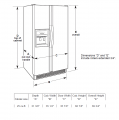
Fridge was also of course, at operating temp after 114h and the fridge was *not* opened even once during the additional 27 hour 11 minutes when the second measurement was taken]. Whirlpool ED5VHGXM 25.3 cu. ft. Side-by-Side Refrigerator [originally at room temperature.]
Refrigerator was plugged in to use for a 1 night party:

ED5VHGXM.png


So: Whirlpool ED5VHGXM 25.3 cu. ft. Side-by-Side Refrigerator at room temperature.
Refrigerator was plugged in to use for a 1 night party:
It used 8.01 kW•h in the next 114 hours, starting from room temp, according to
Kill A Watt® EZ model P4460:
http://www.p3international.com/products/p4460.html

114h later, I then reset it and measured its usage for the next 27h 11 min: 1.68 kW•h.

It was at operating temp at that time and the fridge wasn't opened during those 27 hour 11 minutes.

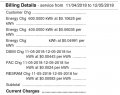
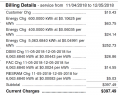
This what my power company in Kansas City metro charges:

EnergyRates.jpg


According to this ↑, what value do I plug in for RATE inside the Kill A Watt® EZ P4460 in order to measure the actual money value of individual device consumption over time using the Kill A Watt device?

And the thread question is, should this refrigerator be unplugged after the party and then plugged back in the day of the next party to save money... if the parties are:
• Once a week
• Once every other week
• Once ever three weeks
 

WBahn

Joined Mar 31, 2012
32,979
Without knowing the details of how Kansas City tiers its rates, it's impossible to be sure.

Since the energy usage will be marginal (as in the last unit of electricity used), you want to use the marginal rates.

Since the 600 kWh and 400 kWh values are nice, round figures, I'm guessing those are the first two tiers. IF that's the case, then it would appear that your marginal rate is 4.991 cents/kWh. Another thing I can't tell, because you've removed the kWh readings that they were applied to, is which portion of the energy used is subject to those three later charges. But assuming that they apply to all usage, they only add up to 0.766 cents/kWh. IF that's the case, then you would be looking at a marginal cost of about 5.76 cents/kWh.

At 70 W average use, you would be looking at a monthly cost of just under $3/mo to run that fridge. How much effort are you going to go to trying to save that $3?
 

Thread Starter

c627627

Joined May 18, 2011
63
How much effort are you going to go to trying to save that $3?
You've asked a very important question that transcends this thread.
On forums exactly like this, people like me go through the effort to post all this detailed info - not to save three dollars - but to learn how things work and leave a trail for others to learn the same.

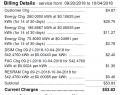
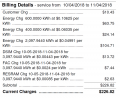
I have removed the actual usage figures because of the unusual out of the ordinary figures on it (long story) there was an issue with the heater which made it run excessively - running up an extraordinarily large power bill, so it wasn't typical, so I removed those numbers, but left in the rates.

These issues have now just been fixed so future bills will be more indicative of typical, but here are three in a row before the issue was fixed, I am still unclear how charges are calculated, what number to put into the Kill A Watt device for RATE so that I can calculate how much a device, any device uses, again, *not to save fifty cents* but to have the knowledge how to do it, for my specific location, and circumstances, based on rates presented here from the back of my power bill:

2018-10.png 2018-11.png 2018-12.png
 

oz93666

Joined Sep 7, 2010
742
I wouldn't get too tangled up in the details of all these numbers ....

If used constantly You need a timer switch that only powers the fridge when electricity is at the cheapest , fill up spare space with (plastic) bottles full of water.

But there is no point in running a fridge if you don't use it , it will waste electricity ... if not in use for 2 days or longer unplug it.
 

MrChips

Joined Oct 2, 2009
34,956
You need to stock the fridge before a party, correct?
If your billing rate averages out to $0.06 per kWh, this would be my solution:

Fill the fridge with beer (or whatever is your medicine) and leave it plugged in permanently. This way there is less wear on the compressor.

This way you always have a cold beer when you want one.:)
 

Thread Starter

c627627

Joined May 18, 2011
63
There are a lot of incorrect assumptions about reasons of leaving the fridge on. So let me clarify:
So this is not a primary fridge that is in actual home use. Guests bring drinks, so the fridge is 100% empty except for the evening of the event. I have no need to use it, think of this fridge as inaccessible except for the evening of the event when guests fill it up.
I have a surge protector with individual ON/OFF switches easily powering the fridge ON/OFF with a pres of a button. So there is zero reason for fridge to be left running of the type your are mentioning, like "having a cold beer in it all the time", none of that is relevant in this particular individual example case, this is not about "who cares about $3" and not about "why not have a cold beer in there, who cares"... this is about numbers and how to calculate them, because this stuff is obscure to most people, how to calculate these things - that is the point of this thread.

So unless... there is a rational actual reason to leave it on... and the poster above is the first person who has provided one, compressor wear? So the lifetime of the fridge will be reduced if I switch it ON/OFF once a week?
What kind of a lifespan reduction do you assume would take a toll on a fridge being powered ON/OFF once a week?

Also, is the RATE figure for Kill A Watt $0.06 for this example case?
With different rates on the power bill screen shots above, how did you get the $0.06 figure from the screen shots for measuring how much my fridge, computer, TV costs to run?
 
Last edited:

MrChips

Joined Oct 2, 2009
34,956
You raise some interesting and valid points.

What you are trying to find is what is the MTBF (mean time before failure). I would hazard a guess that no one here knows the answer without having conducted extensive testing. You would have to take 100 fridges of different sizes and models and leave them running all the time. Simultaneously, you would have 100 similar fridges being put into service at the desired duty cycle.

Engineers do this kind of testing, both destructive and non-destructive testing. In destructive testing, you can determine the operating limits of a component by testing samples until they fail, for example, load testing of rope, steel structures, and concrete. There are ways of performing accelerated MTBF tests, for example, the number of steps taken before a shoe breaks. In non-destructive testing, you can run the device for a length of time and then examine the wear on the device, for example, the wear on engine piston rings.

Personal anecdotal evidence has revealed that MTBF of electronic equipment is reduced when power is cycled more often. In other words, it was better to leave computers with the power on permanently. Granted, a fridge compressor is not electronics. However, one can theorize that an empty fridge will cycle on and off more frequently than a full fridge. Would the duty cycle be different for the two cases? That I do not have an answer without having done a rigorous analysis of the thermodynamics and compressor efficiency.

One can also surmise that starting a fridge from ambient temperature would demand more effort from the compressor than if the fridge were left operating at the desired target temperature. The longer a compressor has to run, the hotter it gets, the higher the temperature, the less efficient it becomes.

OT, interestingly, there is an article making the argument that parachutes don't save lives.

As for the charge rates, the data you have provided shows three rates, $0.10, $0.06, and $0.05. You can calculate the average rate. Or I took WBahn's lead in using the marginal rate of $0.06. This is a valid assumption. Since you have indicated that the cost saving is of no concern to you, then it doesn't matter what is the rate.
 

Alec_t

Joined Sep 17, 2013
15,132
Won't the cost per unit of running the fridge depend on which day of the charging period (month?) it's switched on? At the start of that period all use at the property will be charged at the highest tier rate. At the end of the period the charge will be at a lower tier rate (assuming all quotas for the higher rates have been used by then).
 

oz93666

Joined Sep 7, 2010
742
Less wear on the compressor to leave it on ??? I don't know where that idea comes from !!

The averaged fridge switched on and off a dozen times a day by it's built in temp sensor ...

TS .... This is not rocket science ... if the fridge is plugged in it uses power ! why have it plugged in if it's not in use ... you wouldn't leave the lights on in a room day and night ...

So just plug it in 12 hrs before your party so every thing has enough time to get cold .
 

atferrari

Joined Jan 6, 2004
5,018
At lost about why the plastic bottles. Will they stay cold for a longer period? If so it will take longer for them to be cold.

Glass does it faster and metallic ones even more.
 

MrChips

Joined Oct 2, 2009
34,956
Less wear on the compressor to leave it on ??? I don't know where that idea comes from !!

The averaged fridge switched on and off a dozen times a day by it's built in temp sensor ...

TS .... This is not rocket science ... if the fridge is plugged in it uses power ! why have it plugged in if it's not in use ... you wouldn't leave the lights on in a room day and night ...

So just plug it in 12 hrs before your party so every thing has enough time to get cold .
Thermal cycling. An incandescent light bulb will last longer if you leave it on.
 
Top