Keeping fridge ON if used only for parties?

MrChips

Joined Oct 2, 2009
35,018
Here is another argument to be made for leaving the fridge running.

When you pull the plug, you should defrost the freezer, clean the fridge, wipe the walls and racks, and leave the door ajar... every time.

If you care to bother, you can read through this forum.
 

oz93666

Joined Sep 7, 2010
742
On the contrary.

This is akin to rocket science. I bet there are not too many people who know how to determine the efficiency of a refrigerator compressor.
I disagree .... the idea that unplugging the fridge for a week will cause more wear than having it running!!! words fail me !!! when running for a week the compressor will be switched on and off perhaps a 100 times by the thermostat!

Why on earth would you run an empty fridge for weeks with nothing inside ????

Three weeks !!! TS has said sometimes there are no parties for 3 WEEKS

Is anyone going to suggest he leaves the fridge running for 3 weeks without use???
 

MrChips

Joined Oct 2, 2009
35,018
I disagree .... the idea that unplugging the fridge for a week will cause more wear than having it running!!! words fail me !!! when running for a week the compressor will be switched on and off perhaps a 100 times by the thermostat!

Why on earth would you run an empty fridge for weeks with nothing inside ????

Three weeks !!! TS has said sometimes there are no parties for 3 WEEKS

Is anyone going to suggest he leaves the fridge running for 3 weeks without use???
Well, if you enjoy having to defrost and clean your fridge every 3 weeks, go ahead. That's fine by me.
 

Thread Starter

c627627

Joined May 18, 2011
63
Just to make a quick correction - overall cost *is* a concern.
I would appreciate it if someone could post what all the different rates on the power bill are for, how do you figure out the cost so that you can use Kill A Watt devices to measure what individual appliances *actually* cost to run?

To the poster above who mentioned how obvious it was to just turn the fridge off - yes - the question is how much more money does it cost, to go from room temp to operating temp vs. maintaining the operating fridge temp. [This is a standard half freezer/half fridge we are talking about made in circa 2004.]
And then [also cost related but this time for the lifespan of the fridge] we had these points raised: One that mentions the stress on the compressor and the counter argument that the compressor will be stressed regardless.

So to clearly state the the questions that I still have as topics of this thread:

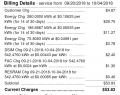
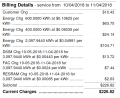
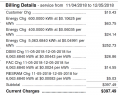
1. Would you look at these screen shots below and please post what all these numbers for rates mean?
2. Are we in agreement that COST-WISE if at least 6-7 days pass between *any* need to use (an empty) fridge, that it's best to press a button on a surge protector and simple power it off for 6-7 days?

2018-10.png 2018-11.png 2018-12.png
 

MrChips

Joined Oct 2, 2009
35,018
Have you read about mold (or mould) growing in the fridge when you turn off the power and have you included the cost of replacing the fridge?
 

BR-549

Joined Sep 22, 2013
4,928
Is the refrigerator being moved from one location to another......such as on a truck? If you are laying frig down, you might want to wait a few hours before turning it on.

Otherwise....keep it powered. The frig and door gasket will last longer. And it keeps the cats out.

Most frigs are very reliable and long lived. Many 30 yr. old units can be made new with a door gasket and clean coils.

Fridge comes from a particular refrigerator......Frigidaire.

Everyone says refridgerator.....but mean refrigerator. The english language puts a d in it.

It is spelled...re...friger...ator.......one who re-frigers.

First used in battlestar galactica.......to FRIG someone.

Lets try to keep this stuff straight, ok?
 

Thread Starter

c627627

Joined May 18, 2011
63
Fridge is not being moved.
If no food is ever stored in a clean fridge, would mold still be a concern?
This is an extra fridge that I happen to have - and have no use for it - nor does anyone I know, so instead of being "thrown away" or sold for cheap, it is being put to use for party needs. But I take it the last two posters questions are abut the accelerated death of the fridge if it's powered off & on once a week vs. being left to run permanently?

So let me ask you this directly related to your questions: would you venture an educated wild guess on how much longer the fridge would last if left to run permanently vs powered off once a week when emprty?
 

Alec_t

Joined Sep 17, 2013
15,149
Would you look at these screen shots below and please post what all these numbers for rates mean?
Have you checked your Service Agreement or the utility company web-site? Both should have an explanation of the tariffs and how they are applied.
 

WBahn

Joined Mar 31, 2012
33,074
Just to make a quick correction - overall cost *is* a concern.
I would appreciate it if someone could post what all the different rates on the power bill are for, how do you figure out the cost so that you can use Kill A Watt devices to measure what individual appliances *actually* cost to run?

To the poster above who mentioned how obvious it was to just turn the fridge off - yes - the question is how much more money does it cost, to go from room temp to operating temp vs. maintaining the operating fridge temp. [This is a standard half freezer/half fridge we are talking about made in circa 2004.]
And then [also cost related but this time for the lifespan of the fridge] we had these points raised: One that mentions the stress on the compressor and the counter argument that the compressor will be stressed regardless.

So to clearly state the the questions that I still have as topics of this thread:

1. Would you look at these screen shots below and please post what all these numbers for rates mean?
2. Are we in agreement that COST-WISE if at least 6-7 days pass between *any* need to use (an empty) fridge, that it's best to press a button on a surge protector and simple power it off for 6-7 days?

View attachment 167340 View attachment 167341 View attachment 167342
I'm having to infer some things here, but I think I probably am getting it correct.

You have tiered billing where the first 600 kWh of electricity you use is charged at a little over 10 cents/kWh, the next 400 kWh are billed at a little over 6 cents/kWh, and everything about 1000 kWh is billed at just under 5 cents/kWh. In addition to this "commodity charge" you are charge three specific taxes/fees/surcharges (or whatever name they choose to call it) that total about 0.77 cents/kWh, though this appears to vary a bit month to month, probably in part to adjust for spot changes in the cost of fuel or energy purchased. This is charged on every kWh from the first to the last. If you have a partial month, the tiers are prorated based on a 30-day month.

Since it appears you are always above 1000 kWh/mo, running or not running the fridge will only affect the usage that gets billed that final tier, so we are talking about a total of about 5.76 cents/kWh. Since it appears that your fridge is pretty consistent at about 70 W average draw, that means that it is costing you about 9.7 cents a day to run the fridge.
 

WBahn

Joined Mar 31, 2012
33,074
Fridge is not being moved.
If no food is ever stored in a clean fridge, would mold still be a concern?
Yes, but that certainly helps.

Unless you are in a completely arid climate, you WILL condense some moisture in the fridge and freezer and there WILL be bacteria and various nasty stuff in there as well (because it's in the air). Enclose it in a warm, airtight container for a few weeks and you are going to have things growing there -- again, on a much smaller scale that it would be otherwise.
 

dl324

Joined Mar 30, 2015
18,447
would you venture an educated wild guess on how much longer the fridge would last if left to run permanently
My second refrigerator and upright freezer have been running pretty much constantly for over 25 years. The refrigerator came with the house my Wife and I bought just before we got married; 32 years ago.
 

shortbus

Joined Sep 30, 2009
10,049
Why not just readjust the temp controller to the highest temp when not in use? This will end up doing two things, cutting the amount of power used because of less running, and keep it from getting a bad smell inside. Even if no food is in it the bacteria and mold spores from the items being put in it will grow, and that equals bad smells.
 

atferrari

Joined Jan 6, 2004
5,020
Yes, but that certainly helps.

Unless you are in a completely arid climate, you WILL condense some moisture in the fridge and freezer and there WILL be bacteria and various nasty stuff in there as well (because it's in the air). Enclose it in a warm, airtight container for a few weeks and you are going to have things growing there -- again, on a much smaller scale that it would be otherwise.
Yes. A serious concern in vessels regarding:

The chambers where the provisions are maintained at lower temperatures (vegetables / fruits....)

Cargo in the holds, where ship sweating could damage it seriously after a long sea passage where ventilation was neglected or was impossible to carry out.
 

MrChips

Joined Oct 2, 2009
35,018
We have now nailed it down to three deliberations:

1) The cost savings attained by turning the fridge off when not in use.

2) The longevity of the fridge by turning it off vs leaving it on.

3) The intensity of mold growth in a closed moist container.

Did someone say this is not rocket science?
 

BR-549

Joined Sep 22, 2013
4,928
There is also a safety hazard. Small children and drunks can't get in an occupied refrigerator.

Charge a beer storage/cooling fee for your neighbors.
 
Top