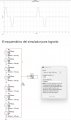
Look, courtesy of another colleague with labview, I just have to study to do it and I don't know if the computer's audio card must have any conditions to faithfully output what is seen on the screen
It is difficult for me to acquire it. Not because of price, but to get to Cuba. You should also look at its quality, many of these devices per week have a defect.
It is difficult for me to acquire it. Not because of price, but to get to Cuba. You should also look at its quality, many of these devices per week have a defect.
I have not seen any ECM ignition module at anything close to dirt cheap, at least not one that would last more than a week.
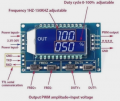
And now that I understand that the TS is wanting to research the programming of the electronic portion, rather than the actual operation of an engine, I suggest that using a signal generator and the digital scheme will provide more accurate data by means of repeatable pulse creation.
What sort of engine would that be for?? The last MOPAR ECM module, no computer function at all, just aftermarket replacement electronic ignition, was $89 a lot of years ago. And a friend also used that one for his kamazi-750 motorcycle because it was half the price of the OEM module.
The "GY6" is a Chinese/Honda-Clone, and there is a huge number of aftermarket-parts for them.
If your Scooter has a 50cc 4-Stroke-Engine, it's probably a Chinese-made-GY6.
The GY6 has 2 basic Ignition set-ups, one is "AC-Powered",
and the other is "DC-Powered" for more expensive Scooters that have a Battery and Electric-Start.
But, of course, there are a handful of "one-off" special "odd-balls" that may be seen from time to time.
There are many different and assorted 2-Stroke-Powered Scooters, world-wide,
which are generally not as popular in the USA, probably because of Emissions-Requirements.
But, even though the 2-Stroke-Engines are quite different,
the Ignition-Systems may have many "apparent" similarities with the GY6-4-Stroke-Engines.
And, the Alternator, Ignition-Trigger-Pickups, CDI-Ignition-Boxes, and Ignition-Coils,
may "look" almost identical on the outside, except for having a different part-number.
However,
2-Stroke and 4-Stroke-Engines have substantially different Ignition-Advance-Curve-Requirements.
The TS is wanting to find, and document, the Ignition-Advance-Curves of
various part-numbers of CDI-Ignition-Boxes which may be interchangeable between various Engines,
either for Engine-Performance-comparisons, or for parts-consolidation-purposes,
where one part-number may be able to replace ~4 or ~5 different part-numbers.
.
.
.
What sort of engine would that be for?? The last MOPAR ECM module, no computer function at all, just aftermarket replacement electronic ignition, was $89 a lot of years ago. And a friend also used that one for his kamazi-750 motorcycle because it was half the price of the OEM module.
I don't have a specific motorcycle. I intend to know the ignition curves, by knowing them I will know their equivalences, electronics and software also when I have more time.
An Engine-Dynamometer, or a Chassis-Dyno is absolutely required to tune
your own custom Ignition-Advance-Curves.
Guessing will just create problems, and those problems could turn-out to be destructive to the Engine.
You won't find anyone on YouTube that will take their own expensive Dyno-Time to walk-You through
the very time-consuming, step-by-step procedure, required to come up with
the ideal Ignition-Advance-Curve, for a particular Engine, with a particular set of modifications done to it.
Many years of experience with junk Motors, and lots of Book-Study-Time will be required before
You can just walk right-up and say, "that looks-like a "close-to-correct" curve for this Engine".
You have to understand what effects Combustion-Chamber-Design, Compression-Ratio,
and Camshaft-Timing have on the "probable" Ignition-Advance-requirements that may be beneficial
to Engine performance, and/or, Engine-Efficiency.
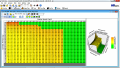
Just for interest, below is the Ignition-Advance-Map for my Truck, which is near perfection
for every condition the Truck is subjected to, including occasional Drag-Racing.
It gets ~20MPG-City, and 25MPG-Highway, and makes almost exactly ~200-Horsepower from 262 Cubic-Inches, ( 4.3-Liters ).
.
.
.
.
An Engine-Dynamometer, or a Chassis-Dyno is absolutely required to tune
your own custom Ignition-Advance-Curves.
Guessing will just create problems, and those problems could turn-out to be destructive to the Engine.
You won't find anyone on YouTube that will take their own expensive Dyno-Time to walk-You through
the very time-consuming, step-by-step procedure, required to come up with
the ideal Ignition-Advance-Curve, for a particular Engine, with a particular set of modifications done to it.
Many years of experience with junk Motors, and lots of Book-Study-Time will be required before
You can just walk right-up and say, "that looks-like a "close-to-correct" curve for this Engine".
You have to understand what effects Combustion-Chamber-Design, Compression-Ratio,
and Camshaft-Timing have on the "probable" Ignition-Advance-requirements that may be beneficial
to Engine performance, and/or, Engine-Efficiency.
Just for interest, below is the Ignition-Advance-Map for my Truck, which is near perfection
for every condition the Truck is subjected to, including occasional Drag-Racing.
It gets ~20MPG-City, and 25MPG-Highway, and makes almost exactly ~200-Horsepower from 262 Cubic-Inches, ( 4.3-Liters ).
.
.
. View attachment 327516
.
An Engine-Dynamometer, or a Chassis-Dyno is absolutely required to tune
your own custom Ignition-Advance-Curves.
Guessing will just create problems, and those problems could turn-out to be destructive to the Engine.
You won't find anyone on YouTube that will take their own expensive Dyno-Time to walk-You through
the very time-consuming, step-by-step procedure, required to come up with
the ideal Ignition-Advance-Curve, for a particular Engine, with a particular set of modifications done to it.
Many years of experience with junk Motors, and lots of Book-Study-Time will be required before
You can just walk right-up and say, "that looks-like a "close-to-correct" curve for this Engine".
You have to understand what effects Combustion-Chamber-Design, Compression-Ratio,
and Camshaft-Timing have on the "probable" Ignition-Advance-requirements that may be beneficial
to Engine performance, and/or, Engine-Efficiency.
Just for interest, below is the Ignition-Advance-Map for my Truck, which is near perfection
for every condition the Truck is subjected to, including occasional Drag-Racing.
It gets ~20MPG-City, and 25MPG-Highway, and makes almost exactly ~200-Horsepower from 262 Cubic-Inches, ( 4.3-Liters ).
.
.
. View attachment 327516
.
Your car seems to be gasoline based on the rpm it reaches and have electronic assistance, since it can sense the air-fuel mass ratio (maf, map, oxygen, etc.)
It has a Mass-Air-Flow-Sensor,
plus it monitors Inlet-Air-Temperature, and Inlet-Air-Absolute-Pressure,
to do continuous calculations to determine the exact weight, in grams,
that the Air entering the Engine weighs at any given time frame.
It compares this "weight" number with the RPM that the Engine is operating at to
determine what the pressure will be in the Cylinders right before Combustion should take place.
The exact same calculations are used to determine the Fuel-Injector-Pulsewidth,
to inject the perfect amount of Fuel for the current-outside-conditions that the Engine is experiencing.
But, of course, the Fuel-Injectors have their own Map, which is very similar to the Ignition-Timing-Map.
And then there are additional "adjustment" Inputs that can alter
the Ignition-Timing or Fuel-AFR as external conditions change.
There may be as many as 6 different "adjustment-Maps", or just simple "adjustment-Curves" for each
of the Fuel and Ignition Main-Maps to further refine the Engine's operation.
.
.
.
An engine will run over a huge spread of timing and fuel/air ratios. I observed that while supporting the development of a new system for one of "the big3" well before Y2K. This claim is backed up by those incredible dragster engines trowing a spay of unburned fuel while delivering 2000+ horsepower. And those lean-burn engines on the other extreme F/A ratio scale.
So the TS wanting to plot the advance versus RPM is just gaining them some insight on the commercial products presently available. No engine dyno needed, just the setup on a test bench, a decent scope, and a lot of patience.
And I still favor the digital counter scheme for adjusting the duty cycle because it will allow more consistent data. Analog adjustments may be easier, but they take a lot more effort to repeat.
It has a Mass-Air-Flow-Sensor,
plus it monitors Inlet-Air-Temperature, and Inlet-Air-Absolute-Pressure,
to do continuous calculations to determine the exact weight, in grams,
that the Air entering the Engine weighs at any given time frame.
It compares this "weight" number with the RPM that the Engine is operating at to
determine what the pressure will be in the Cylinders right before Combustion should take place.
The exact same calculations are used to determine the Fuel-Injector-Pulsewidth,
to inject the perfect amount of Fuel for the current-outside-conditions that the Engine is experiencing.
But, of course, the Fuel-Injectors have their own Map, which is very similar to the Ignition-Timing-Map.
And then there are additional "adjustment" Inputs that can alter
the Ignition-Timing or Fuel-AFR as external conditions change.
There may be as many as 6 different "adjustment-Maps", or just simple "adjustment-Curves" for each
of the Fuel and Ignition Main-Maps to further refine the Engine's operation.
.
.
.
That's it. I have read about the topic because I like it and I always keep this hobbit. I use an anyscan a30m from xtools that they gave me as a gift with which I can do some things, including entering the injector adjustment configuration or calibration. In the specific case of these types of motorcycles, they do not have any sensor, they only sense rpm, one of them receives a signal from 3rd to gnd from the gearbox that I want to see simulate that it changes in the curve.

 Facebook
 Google
 GitHub
 Linkedin