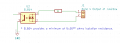
Jukebox Playing Detection ....

MisterBill2

Joined Jan 23, 2018
27,514
I don't know why we need to "load" the amplifier output. Yes the amplifier might go non-linear without an expected load, but we only want to detect an output, not use it for audio purposes. And we'd be wasting energy dissipating it into heat, which we have to get rid of somehow....
The need for a load resistor exists on some versions of amplifiers that include an output transformer , and mostly those amplifiers with vacuum tube output stages. So it is not likely to actually NEED a load resistor for the original purpose, but certainly a load resistance will not be a poor choice. It will reduce whatever amplifier instability might happen from a no-load operation.
My comment about the opto-isolator was based on thinking that the circuit shown in post #10 was an actual circuit. The fact is that the IC contains a great deal more circuitry than is shown. And usually I do not look up the detailed data sheets of components being discussed here. Typically that leads to getting all sorts of advertising emails.
For muting the jukebox in the event of a fire alarm condition, a suitable relay activated from the alarm sounder output could be the solution. The relay could switch off the mains power to the jukebox. If you go with the fire alarm sounder relay installation you will need a series diode so as not to upset the supervisory circuits. I discovered that when I added fire door release magnets in a building. Evidently it is OK because the alar system has passed the yearly inspection for ten years since the installation.
 
Last edited:

AnalogKid

Joined Aug 1, 2013
12,130
I feel like I ought to add some over-voltage protection on the opto diodes, but because it's an AC signal I'm not sure how to.
I don't think you need this because the 10K or 100K pot will be a more-than-adequate current-limiting resistance. If you're still nervous, use a 10K pot with a 10K fixed resistor in series. Even if the pot is turned all the way up by accident, the fixed 10K is large enough to protect against direct connection to the AC mains.

ak
 

Thread Starter

daba1955

Joined Apr 27, 2019
218
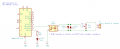
This is what I have decided to go with - thanks for everyone's comments. PCBs are in production now.

We will have the ability to set the volume on the jukebox's zone 4 output (which isn't driving a speaker), and it can be locked at that volume to prevent inadvertant changes from the jukebox's remote control.

Power for the MCU will be from one of the jukebox's USB ports. I have checked the current requirements, and it draws 70mA when quiescent, and about 130mA when actually transmitting on WiFi, easily accommodated by a standard USB 2.0 port.

1688989787867.png
 

AnalogKid

Joined Aug 1, 2013
12,130
Transient clipping. My guess is that they are not needed, and that the pot will be almost wide open once the circuit is tried.

ak
 

sghioto

Joined Dec 31, 2017
8,634
I believe that's what the TS is thinking but the two IR LEDs in the PC814 will shunt out the LEDs.
Using that circuit I would set the pot at midway and adjust the output from zone 4 until the PC814 is reliably switched.
 

Dodgydave

Joined Jun 22, 2012
11,395
Sound Leisure jukeboxes used to have a micro switch on the turntable , that was operated when the stylus arm was in the home position, and at the end of the record, so i used to slave a relay off the home switch to mute the background sound.
 

Thread Starter

daba1955

Joined Apr 27, 2019
218
What is the purpose of the two LEDs?
Has this circuit actually been tested?
Not tested....
The grn LEDs are just for visual indication that the IR LEDs in the EL814 might be being illuminated. Not that we would see anything if they are, both because they are encapsulated, and are IR LEDs. They could easily be left out if they prevent the EL814 working.
 

AnalogKid

Joined Aug 1, 2013
12,130
On average, IR LEDs have a lower forward voltage (Vf) than visible ones, so the IR LEDs might prevent the visible ones from being visible even when working correctly.

A better indicator is having the visible LEDs in series with the IRs. For this you will need a higher driving voltage. I do the same thing with solid state relays because many of them have no visible indication that they are receiving a driving current.

ak
 

Thread Starter

daba1955

Joined Apr 27, 2019
218
Sound Leisure jukeboxes used to have a micro switch on the turntable , that was operated when the stylus arm was in the home position, and at the end of the record, so i used to slave a relay off the home switch to mute the background sound.
Back in the day yeah... But this is a digital jukebox, playing mp3 files from a huge hard disk. If the selected track isn't on the disk, the machine downloads it from their servers before playing it.

I can remember downloading a 3 minute track on a dial-up modem used to take several minutes, but it has got a little bit better these days :)
 

Thread Starter

daba1955

Joined Apr 27, 2019
218
On average, IR LEDs have a lower forward voltage (Vf) than visible ones, so the IR LEDs might prevent the visible ones from being visible even when working correctly.

A better indicator is having the visible LEDs in series with the IRs. For this you will need a higher driving voltage. I do the same thing with solid state relays because many of them have no visible indication that they are receiving a driving current.

ak
Commissioning will determine if we are hitting the EL814 LEDs to derive the fact that the jukebox is playing something. That is the purpose of the blue LED, driven by software in the MCU, to say that detection has taken place.

With debounce, I'm postulating the MCU input will be driven low almost constantly while music is playing, but there'll also be a delay built in before we say there's nothing playing, possibly 3 seconds or more. I really don't care if the venue's audio is not restored quickly.

If the visible LEDs are not needed, then I'll leave them out, but thought it wise to put them on the PCB anyway. It's not something you can add easily later .....
 
Last edited:

Thread Starter

daba1955

Joined Apr 27, 2019
218
Well I finally got a chance to try my detection circuit, and managed to set a volume on the "spare" speaker output, and a setting on my multi-turn trimpot that gave me detection of a "signal".

Thought we had it cracked, but then I hit "Pause" on the jukebox, and I did not lose the "detected" state.

I've got a sneaky suspicion that one, or more, of the following is occurring....

1. the amplifier does not like the 10K load I have put on it, and is producing "hum", ripple or just going into instability ....

2. the channel is not being fed with the same audio that the wired output channels are.

Next opportunity to have a play is next week, and I'm going to try some things....

1. Put an 8ohm speaker on that output channel and find out for definite that it is audio and not just noise...

2. Determine if it gets muted the same as the other outputs when on Pause (why would it not?) ...

3. put a scope on it to see what the signal is we might be dealing with...

Tend to think sghioto's suggestion of a loading resistor might be the way to go forward on this...
 

Audioguru again

Joined Oct 21, 2019
6,826
You do not need to optically-isolate the bridged speaker outputs.
A bridged output uses 2 amplifiers, one non-inverting plus an inverting amplifier.
Instead of using the bridged outputs for detecting a signal, use one signal wire (the non-inverting) and ground. The signal wire will have half-the DC supply voltage on it then your detection circuit might need an input coupling capacitor.
 

Thread Starter

daba1955

Joined Apr 27, 2019
218
Does that D6/MISO pin need a pullup resistor on the output of the opto?
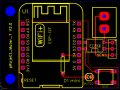
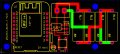
Yes it does, and I have had to add one manually by linking D6 to D3, which has a 10K pullup. The next iteration of PCBs and coding will use D3 directly, as the D1 mini is flipped over, which I believe to be the preferred orientation....2023-08-17_012646.jpg
 

Thread Starter

daba1955

Joined Apr 27, 2019
218
You do not need to optically-isolate the bridged speaker outputs.
A bridged output uses 2 amplifiers, one non-inverting plus an inverting amplifier.
Instead of using the bridged outputs for detecting a signal, use one signal wire (the non-inverting) and ground. The signal wire will have half-the DC supply voltage on it then your detection circuit might need an input coupling capacitor.
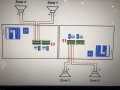
No-one has ever mentioned that the speaker outputs are bridged, and the configuration screens says nothing is bridged.
2023-07-31 15.35.50.jpg
The installation is just using Zones 1 and 2 to separate speakers, and we are attempting to use Zone 4, which can be set at a suitable "volume" and then locked.
2023-07-31 15.35.18.jpg

2023-07-31 15.35.37.jpg

There is confusion over the fact that they have configurable Amplifier "Zones", and wired Speaker (geographical) "Zones" ...
 
Last edited:

Thread Starter

daba1955

Joined Apr 27, 2019
218
My bet is on scenario #2 and possibly not muted.
Making plans to add a load resistance, and possibly doing away with the 28-turn pot, just set the volume of the channel and lock it.

2023-08-17_154212.jpg

Having said that though, I'm still nervous of not having any over-voltage protection on the opto-isolator - the manufactures and tech support have remote management of the jukebox, and concerned if they did a firmware update or a factory reset if they felt the need to, this might lead to a failure of the opto-coupler diodes.

It would be simple to protect the opto diode if it was just the one, but can't think of a way to protect the back-to-back 2 diodes.
 
Top