Jones chopper design analysis

Thread Starter

salhi

Joined Nov 29, 2023
86
I want to understand how this circuit works on its several time lapses, we consider the \( I_s \) current as constant current:
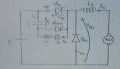
1717329433512.png
If there is a write-up about this exact version of the chopper can someone refer me to it, instead of writing everything here, infinite thanks!
 

MrAl

Joined Jun 17, 2014
13,667
I want to understand how this circuit works on its several time lapses, we consider the \( I_s \) current as constant current:
View attachment 323716
If there is a write-up about this exact version of the chopper can someone refer me to it, instead of writing everything here, infinite thanks!
Hi,

I found this:
Jones Chopper - Circuit Diagram, Working & Advantages (electronicsmind.com)

It's a slightly different circuit though.

I do not care for circuits that require that kind of commutation, but sometimes it becomes necessary. Then again the phenomenon of resonance has become more used as of late in order to boost the efficiency of converters.
 

Thread Starter

salhi

Joined Nov 29, 2023
86
Hi,

I found this:
Jones Chopper - Circuit Diagram, Working & Advantages (electronicsmind.com)

It's a slightly different circuit though.

I do not care for circuits that require that kind of commutation, but sometimes it becomes necessary. Then again the phenomenon of resonance has become more used as of late in order to boost the efficiency of converters.
Thank you so much, i had already read that writeup but i want to see like graphs in time of how each current/voltage look like, can you simulate this ? specially the current in the capacitor
 

MrAl

Joined Jun 17, 2014
13,667
Thank you so much, i had already read that writeup but i want to see like graphs in time of how each current/voltage look like, can you simulate this ? specially the current in the capacitor
Hi,

Right now I can't but maybe at a later date. Don't they show that already though?
 

MrAl

Joined Jun 17, 2014
13,667
ah yes infinite thanks another day, they dont show the capacitor current, can you tell me where they do?
Hi,

I see what you mean. I suppose you can gather that info from the capacitor voltage using the differential definition of the capacitor:
i=C*dv/dt

They show nice straight-line waveforms for the capacitor from one time point to the next, so you could assume some time values and maybe some capacitor values and see what you get.

Following the waveforms you may be able to do a simulation and that would show a lot more.

Don't you hate it when these seemingly informative articles do not give any real examples. Real examples help to solidify the exposition of the theories involved. I wish more authors would realize that someday.

I think I can see the main purpose for designing a circuit like this.
Back in the 1980's I had experimented with commutating a triac, which is just a dual polarity SCR more or less. I realized that if you could "short it out" when you wanted to turn it off, you could reduce the triac current to zero and thus it would turn off. What I found though was that the turn off time had to be too long for what I wanted to use it for. For a motor controller though it may be ok because you do not need a super fast switching period.
I looked into this back then because transistors were more expensive and even 15 amp triacs were relatively cheap. I did not need motor control at that time though I needed fast switch for a sine synthesized converter. It was just too slow for that. Looking at the Jones circuit and related circuits, I see that might have helped, but they do seem to be limiting its use to motor control applications also.

The main idea is that if you have an alternate path for the current, you can turn the SCR off whenever you want to. To get that though you have to use an alternate source of power so you can get the current to bypass the SCR when it's 'on'. It might not be enough to just short it out because the underpowered SCR turn off time might be too long.
Unfortunately, I do not remember the time lengths involved it was a long time ago. It's not hard to experiment with this though at low voltages.
 
Last edited:
Top