Issue With Multimeter in Series

Thread Starter

Fish_Biologist

Joined Jan 22, 2018
4
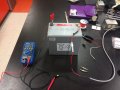
I've been trying to use a Mastercraft multimeter (Model No. 052-0052-2) to measure the current of a Lotek Wireless SRX800-D Telemetry Receiver. When I hook the receiver directly to a 12V battery, it powers on without issue but when I incorporate the multimeter into the circuit, the receiver won't power on and I get a reading of 2.5μA. The troubleshooting I've done hasn't revealed any answers though. Measuring the resistance of the meter by touching the leads gives me 0.1Ω, all the fuses seem to be intact, the battery of the multimeter should be fine as it is brand new and the power source is it 12.75V. I hooked up a light bulb and had the same issue, so I don't think the power cable of the receiver is causing the issue. I've attached a picture of my set up, in case there's something wrong with that.

Is this a multimeter issue or am I doing something wrong?
 

Attachments

Thread Starter

Fish_Biologist

Joined Jan 22, 2018
4
It is. In the image it's set to measure uA but I have the same issue with any setting. I've also tried to measure voltage, and current on the mA, and A settings but had the same issue. The "INPUT" terminal measures up to 400mA and the 10A measures between 400mA and 10A, switching between the two terminals hasn't helped either.
 

Thread Starter

Fish_Biologist

Joined Jan 22, 2018
4
hi FB,
It is possible that you have blown the current limit fuse in the multimeter.
Do a quick check.
E
So I'm very new to this stuff and when I opened up the meter, the fuse was a opaque white without any obvious signs of being blown. I was expecting a glass tube with a piece wire in it, like the 10A 250V fuse in the power cable of the receiver. How can I test the fuse in the multimeter?
 

WBahn

Joined Mar 31, 2012
32,823
And, just to be sure, the fuses that you checked include the fuse inside the meter? How did you check them? Visually, or with the ohmmeter?

The 10 A setting should be unfused (it is on most meters) and generally requires both using the other terminal and putting the selector in the 10 A position? I take it you've done this for your lightbulb test?

Is this the only meter you have?

Do you have a fairly low value resistor? If so, the better way to make current measurement (usually) is to put a low value resistor in series with line you want to measure the current in and then measure the voltage across the resistor. Pick a resistor so that the voltage drop across it is relatively small compared to the voltage across the circuit you are making the measurement in. In most cases if you shoot for something in the 100 mV range you'll me okay.
 

WBahn

Joined Mar 31, 2012
32,823
So I'm very new to this stuff and when I opened up the meter, the fuse was a opaque white without any obvious signs of being blown. I was expecting a glass tube with a piece wire in it, like the 10A 250V fuse in the power cable of the receiver. How can I test the fuse in the multimeter?
Just treat it like a resistor and measure it's resistance with the meter. The ohmmeter function appears to be working and the fuse is not used for that. You should get a very low resistance value.
 

dl324

Joined Mar 30, 2015
18,326
Is this a multimeter issue or am I doing something wrong?
Yes and yes.

The current meter in a multimeter has resistance. The magnitude of that resistance depends on the current range selected.

You'll have a better experience if you insert a small value resistor of sufficient wattage in series with your load, measure the voltage drop on that resistor, and calculate the current.

The 200uA range on my Simpson 467 has a resistance of 1k ohms. No one in their right mind would consider inserting a 1k resistor in series with their load, but that's essentially what you're doing. It's a common newbie mistake.
 

MrSoftware

Joined Oct 29, 2013
2,273
Do you have the leads in the proper holes on the multi meter? On most meters you have to move the probes to different holes to measure current. If you're able to touch the leads together and measure resistance then I suspect they are in the wrong holes.
 

radiohead

Joined May 28, 2009
514
I've been trying to use a Mastercraft multimeter (Model No. 052-0052-2) to measure the current of a Lotek Wireless SRX800-D Telemetry Receiver. When I hook the receiver directly to a 12V battery, it powers on without issue but when I incorporate the multimeter into the circuit, the receiver won't power on and I get a reading of 2.5μA. The troubleshooting I've done hasn't revealed any answers though. Measuring the resistance of the meter by touching the leads gives me 0.1Ω, all the fuses seem to be intact, the battery of the multimeter should be fine as it is brand new and the power source is it 12.75V. I hooked up a light bulb and had the same issue, so I don't think the power cable of the receiver is causing the issue. I've attached a picture of my set up, in case there's something wrong with that.

Is this a multimeter issue or am I doing something wrong?
It looks like you have the red lead in the wrong input jack. Try moving the red lead to the jack at the bottom left of the meter. Plus, what the others have advised, put a resistor in series with the battery. That way, you won't blow a fuse.... Test the fuse: Put your meter in continuity mode then jumper the red lead from the Volt-Ohm jack to the 10A jack (red jack to red jack), the meter should emit a tone if the fuse is good. No tone, blown fuse (probably from trying to measure amp capacity of a batter without a load).
 

Owais451

Joined Jan 22, 2018
10
I've been trying to use a Mastercraft multimeter (Model No. 052-0052-2) to measure the current of a Lotek Wireless SRX800-D Telemetry Receiver. When I hook the receiver directly to a 12V battery, it powers on without issue but when I incorporate the multimeter into the circuit, the receiver won't power on and I get a reading of 2.5μA. The troubleshooting I've done hasn't revealed any answers though. Measuring the resistance of the meter by touching the leads gives me 0.1Ω, all the fuses seem to be intact, the battery of the multimeter should be fine as it is brand new and the power source is it 12.75V. I hooked up a light bulb and had the same issue, so I don't think the power cable of the receiver is causing the issue. I've attached a picture of my set up, in case there's something wrong with that.

Is this a multimeter issue or am I doing something wrong?
As per picture shown you have connected positive probe on voltage and resistance check range input. As per my assumption your meter has mili amps range with same input jack for voltage testing
 

Owais451

Joined Jan 22, 2018
10
D
It looks like you have the red lead in the wrong input jack. Try moving the red lead to the jack at the bottom left of the meter. Plus, what the others have advised, put a resistor in series with the battery. That way, you won't blow a fuse.... Test the fuse: Put your meter in continuity mode then jumper the red lead from the Volt-Ohm jack to the 10A jack (red jack to red jack), the meter should emit a tone if the fuse is good. No tone, blown fuse (probably from trying to measure amp capacity of a batter without a load).[/QUOTE
Radio Head I think his wiring for series connection is not proper means that meter is not connected properly in series with load. If connection is not correct light bulb will also not on.
 

Thread Starter

Fish_Biologist

Joined Jan 22, 2018
4
And, just to be sure, the fuses that you checked include the fuse inside the meter? How did you check them? Visually, or with the ohmmeter?

The 10 A setting should be unfused (it is on most meters) and generally requires both using the other terminal and putting the selector in the 10 A position? I take it you've done this for your lightbulb test?

Is this the only meter you have?

Do you have a fairly low value resistor? If so, the better way to make current measurement (usually) is to put a low value resistor in series with line you want to measure the current in and then measure the voltage across the resistor. Pick a resistor so that the voltage drop across it is relatively small compared to the voltage across the circuit you are making the measurement in. In most cases if you shoot for something in the 100 mV range you'll me okay.
This is the only multimeter we have, we don't do a lot of electronic work or repairs.
So the fuses are definitely blown. There was a 600V 10A fuse in the 10A setting and the INPUT setting has a 600V 400mA fuse. Both read "O.L." when I tried to measure their resistances. Once I track down some new fuses, I'll try the method you suggest above to test the current.

I don't know the resistance of this receiver (I assume that's the resistor you're referring to) as there's nothing written on it to indicate voltage or amperage. Lotek, the company that makes these didn't release a manual for this particular model so we don't know the exact specifications, which is what we want.

Thanks so much for all the help!
 
Top