Facebook
 Google
 GitHub
 Linkedin
hi folks
installing a second battery in my 2014 Ford transit connect to turn it into a micro camper.
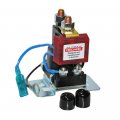
Bought a battery isolator (this one: https://www.amazon.ca/NOCO-IGD140HP...9224149&sr=1-1&keywords=noco+battery+isolator) to separate the batteries but apparently this version of Ford has a 'smart charge' alternator which is foiling me.
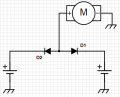
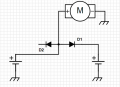
When wired as suggested (a1.png) I get a battery warning light, and no output from the alternator (abusing motor symbol in my schematic). I'm guessing since it detects no voltage at the junction of the diodes the 'smart charge' turns off the alternator.
I've wired it as in a2.png, with the 'house battery' wired directly to the alternator to outsmart the smart charger - now the alternator outputs a charging voltage. I've chosen to isolate the ignition battery in case I leave something running off the house battery, I can still start the van.
I'm a bit worried about starting current draw from the house battery - I've used 4Ga to connect the house battery, and the run is about 10 feet. I'm hoping the resistance of this connection to the starter motor will be higher than the connection from the starter battery so most of the cranking current will still come from the starter??
Aside from having paid $70 for a high current diode, does anybody see a problem with this set up?
installing a second battery in my 2014 Ford transit connect to turn it into a micro camper.
Bought a battery isolator (this one: https://www.amazon.ca/NOCO-IGD140HP...9224149&sr=1-1&keywords=noco+battery+isolator) to separate the batteries but apparently this version of Ford has a 'smart charge' alternator which is foiling me.
When wired as suggested (a1.png) I get a battery warning light, and no output from the alternator (abusing motor symbol in my schematic). I'm guessing since it detects no voltage at the junction of the diodes the 'smart charge' turns off the alternator.
I've wired it as in a2.png, with the 'house battery' wired directly to the alternator to outsmart the smart charger - now the alternator outputs a charging voltage. I've chosen to isolate the ignition battery in case I leave something running off the house battery, I can still start the van.
I'm a bit worried about starting current draw from the house battery - I've used 4Ga to connect the house battery, and the run is about 10 feet. I'm hoping the resistance of this connection to the starter motor will be higher than the connection from the starter battery so most of the cranking current will still come from the starter??
Aside from having paid $70 for a high current diode, does anybody see a problem with this set up?
Attachments
-
 10.6 KB Views: 7
 -
 13.7 KB Views: 6