Adum 1201 Magnetic Isolator Help Needed

Thread Starter

JavaWorld1000

Joined Feb 9, 2025
10
Hi everyone,

I am new to building electronics and working with microcontrollers, very new. I am working on a project where I want to isolate signals from my controllers (pi and Arduino). Before this, I made the mistake of cooking both controllers with one misplaced wire. Since then, I bought some new controllers, optocouplers, and magnetic Isolators on amazon to create full isolation for new controllers. I got the optocouplers working fine, BUT, I for the life of me cannot get the Adum 1201 to work... I may be going about it wrong. I wanted to simulate sending a signal with a breadboard set up before actually hooking it up, now here is the problem, when I powered each side of board with its own power (3.3v) the signal (VIA, VOB, VOA, VIB) pins have a voltage. I've tried a lot of configurations and can't seem to figure out how to get them to operate. I thought that they would work as optocouplers do, signal in, signal out, however the pins already have a voltage, I was thinking that these pins need to be at 0v so that when I send a non gpio signal from controller to device, they turn on. Like I said, the only way I could get them to simulate a transfer was by disconnecting the ground of its pair across the magnetic bridge. I've looked at the sheets, searched youtube, asked GPT to no avail. Please help me community. Please ask for clarifications.
 

WBahn

Joined Mar 31, 2012
32,706
It would be very helpful if you provided more information. Such as:

A link to the datasheet for the part.
Exactly which part you are working with.
The schematic for how you have things wired up.
What voltages you are measuring where under what conditions.

Remember, we are not mind readers.
 

Thread Starter

JavaWorld1000

Joined Feb 9, 2025
10
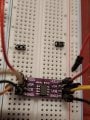
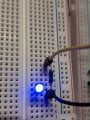
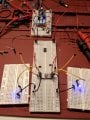
I should have been more clear, I will upload module info and my configuration. Again, my goal is to replicate a signal transfer on breadboard before connecting to micro controllers. I read in the description that the ADUM 1201 could also transfer GPIO signals so I thought the breadboard would work as a reliable test. I have power from two separate sources at 3v, I have VDD1paired with GND 1, connected to 3v, and I have VDD2 paired with GND 2, connected to a separate 3v source, VOA (left YELLOW) and VOB (right YELLOW) are each connected to the anode of their LED though a 1K ohm resistor, each cathode is connected to the ground of its power source. VIA (right ORANGE) and VIB (left ORANGE) when not connected (floating) = both LEDS on. When VIB grounded and VIA floating = Left LED on (across the bridge) . When VIA grounded and VIB floating = Led 2 (across the bridge) is on. When I ground VIA then VIB = both LEDS off, but if I pull VIA off its ground while VIB is still connected, both remain off until I let VIB float and it resets, both are on. However right LED always turns on when I let VIB float regardless of VIA. Hopefully someone can help figure this out. So my question, is this normal behavior of a magnetic coupler. I thought that the pins would just turn on when its partner pin across the bridge would have a voltage applied to it, not a ground. When the non-GPIO pins on a controller transfers a signal isn't that a positive voltage not a break in voltage? Any and all help would be appreciated. If further clarification is needed please let me know. thanks in advance to anyone will might take the time to answer this!
 

Attachments

WBahn

Joined Mar 31, 2012
32,706
What happens when the inputs are properly set at either 0 V or 3 V?

That is what really matters.

It is always a bad idea to let inputs float unless the data sheet specifically indicates that the device is designed to operate a certain way in that condition.

Have you looked at the data sheet? I'm guessing not, since you didn't provide a link to it like I requested. Please don't make us go hunting down datasheets for your parts, we often have to guess and never know that we have found the right one.

Here's the one that I am guessing applies:
https://www.analog.com/media/en/technical-documentation/data-sheets/ADuM1200_1201.pdf

If an input is floating, you have no idea what logic level that input will be seen as. It may also be very susceptible to noise and change as a result of seemingly unrelated things changing around it -- someone turns on a light switch and the EMI that results is enough to change the input state as seen by the internals of the device.

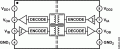
Also, look at the Application information in the datasheet:

1739238408141.png

I see no indication of the proper bypassing on your breadboard. These will make the circuit much more susceptible to noise, as will putting the circuit on a breadboard to begin with.
 

Thread Starter

JavaWorld1000

Joined Feb 9, 2025
10
WBahn,

I really appreciate your time. Like I said, I'm very new to electronics.... I am just trying to learn what I can. The voltage of each side is set at 3v, I'm not sure what you mean by "inputs properly set"... I thought if the inputs were set to ground (lights off), then I applied a voltage to those pins, it would create a short, so i didn't do that. Maybe I am going about this totally wrong, I just thought that its suspicious that a voltage is already at the VOLTAGE IN (VIs) when powered. Is there better way of testing these before connecting them to the controllers? I placed a 0.1uf capacitor on each power rail between + and - and found same results. Can you think of a better way to test the function of the Adum 1201 before directly connecting to controllers? I apologies for not providing the datasheet. Thanks again!
 

WBahn

Joined Mar 31, 2012
32,706
Your two inputs should always be connected either to the positive supply or the negative supply for the chip. Don't leave them unconnected except momentarily when you switch states.

The voltage you are seeing at the inputs is probably from the internal circuitry that is creating the hysteresis, but that's a guess.
 

WBahn

Joined Mar 31, 2012
32,706
So, in short, there is no way of testing these without having them connected to true data transferring devices?
I didn't say that. Take a wire and connect it between one of the inputs and the low supply for that side of the chip. Measure the voltage at the output.

Then move the wire from the low supply to the high supply for that side of the chip. Measure the voltage at the output.

Then move the wire back to the low side of the supply for that side of the chip. Measure the voltage at the output. (This is so that you test both a L-H and a H->L transition.)
 

Thread Starter

JavaWorld1000

Joined Feb 9, 2025
10
Thank you both. This is with all pins connected according to designations, I connected an additional wire to one of the inputs and ground... read 0V. Then, connected that same wire to the positive rail and got 2.85V at output, back to ground, back to 0V. I also observed that if I left that pin on positive for more than a few seconds my power supply beeped and stopped supplying a voltage which I assume is due to a short circuit on the supply side. Is this normal behavior... or would these momentary shorts smoke my controllers? Thanks again guys!
 

sarahMCML

Joined May 11, 2019
695
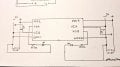
Here it is. The "or" wire is what connected with - or + for the test.
Your diagram appears to show your Inputs connected to 0V with permanent wires, and a separate wire then being used to connect to either 5V OR 0V as the input. You don't need the permanent connection to 0V. only the test wire connecting to 5V OR 0V for the test. This is why your PSU beeps: you're shorting it out when you connect the test wire to 5V!
 

MisterBill2

Joined Jan 23, 2018
27,187
The only "magnetic isolator" devices I am familiar with are transformers and relays, and transformers, bu themselves, only work with AC signals of some kind. Opto-Isolators of the LED/photo-transistor type require an external voltage and resistor to deliver a signal.
 

BobaMosfet

Joined Jul 1, 2009
2,211
Hi everyone,

I am new to building electronics and working with microcontrollers, very new. I am working on a project where I want to isolate signals from my controllers (pi and Arduino). Before this, I made the mistake of cooking both controllers with one misplaced wire. Since then, I bought some new controllers, optocouplers, and magnetic Isolators on amazon to create full isolation for new controllers. I got the optocouplers working fine, BUT, I for the life of me cannot get the Adum 1201 to work... I may be going about it wrong. I wanted to simulate sending a signal with a breadboard set up before actually hooking it up, now here is the problem, when I powered each side of board with its own power (3.3v) the signal (VIA, VOB, VOA, VIB) pins have a voltage. I've tried a lot of configurations and can't seem to figure out how to get them to operate. I thought that they would work as optocouplers do, signal in, signal out, however the pins already have a voltage, I was thinking that these pins need to be at 0v so that when I send a non gpio signal from controller to device, they turn on. Like I said, the only way I could get them to simulate a transfer was by disconnecting the ground of its pair across the magnetic bridge. I've looked at the sheets, searched youtube, asked GPT to no avail. Please help me community. Please ask for clarifications.
Let's start with something more basic- Let's learn about putting a fuse in your circuit so that if too much current is drawn, it will blow and save your circuit. Same think about a diode to ensure you can't connect power backwards.
 

BobaMosfet

Joined Jul 1, 2009
2,211
WBahn,

I really appreciate your time. Like I said, I'm very new to electronics.... I am just trying to learn what I can. The voltage of each side is set at 3v, I'm not sure what you mean by "inputs properly set"... I thought if the inputs were set to ground (lights off), then I applied a voltage to those pins, it would create a short, so i didn't do that. Maybe I am going about this totally wrong, I just thought that its suspicious that a voltage is already at the VOLTAGE IN (VIs) when powered. Is there better way of testing these before connecting them to the controllers? I placed a 0.1uf capacitor on each power rail between + and - and found same results. Can you think of a better way to test the function of the Adum 1201 before directly connecting to controllers? I apologies for not providing the datasheet. Thanks again!
Here's a really fast way to get you up to speed on basic electronics:

Title: Understanding Basic Electronics, 1st Ed.
Publisher: The American Radio Relay League
ISBN: 0-87259-398-3

Then later, once you're more confident:

The Art of Electronics 3rd Ed.
Author(s) Horowitz & Hill
ISBN-10: 9780521809269
 

Thread Starter

JavaWorld1000

Joined Feb 9, 2025
10
Yes, I could just put a fuse in my circuits, however, I didn't know how to fuse a data line, or if data can be transferred through a fuse. I appreciate the resources Boba... Ill look into those! I only grounded the input pin because I thought that is what was being said. My initial concern/question is, why is it that my led across the bridge lights up the very second, I disconnect the ground? My intuition would be that the input pins would remain floating until a voltage was input (signal), and then in would flow to input-out.
 

MisterBill2

Joined Jan 23, 2018
27,187
WHAT IS A MAGNETIC ISOLATOR???? I am familiar with isolation transformers that are often used to avoid shock hazards. But usually they are not used for digital switching signals. So who makes "magnetic isolators? and how are they described??
 

Thread Starter

JavaWorld1000

Joined Feb 9, 2025
10
Think I figured half of it out guys. On the breadboard, I put a diode between chip grounds and real grounds. Also, I put a button switch at input A and B. Seems to work perfect with the LEDs now. However, I noticed that with the buttons, I have a voltage at both outputs around 200mv... guessing this is just due to the fact that the buttons are cheap and may be leaking some voltage...?
 

Thread Starter

JavaWorld1000

Joined Feb 9, 2025
10
Mister Bill,

I am definitely not qualified to give real answer.... but I found them on amazon. Look up "Adum 1201" and you'll find it. My understanding is that its similar to optocouplers in that it can isolate a signal, but at a much faster rate if needed, which makes it appropriate for certain non-gpio (on off) signals). I'm sure one these intelligent people who have been helping me can provide a much better answer for you.
 
Top