Isolate microcontroller circuit?

Thread Starter

jgrv

Joined Mar 2, 2018
36
Hi,

I need some help deciding if I need to isolate my microcontroller circuit from the 24V circuit I have.

The application/PCB:
24V power supply. A linear voltage regulator drops 24V to 5V to supply a microcontroller. The microcontroller controls 24V to several solenoids drawing around 0.5A. Cables from PCB to solenoids can be anything from 2 to 50 meters. I’m thinking of driving the solenoids using the High Side Driver ITS716. I also have buttons out there located close to the solenoids. They are also connected to the PCB, and connected to microcontroller inputs through opto-couplers.

So… I need some help from someone with a little more experience than me. Should the microcontroller circuit be completely isolated from the 24V circuit? And is the only way to do this by using an isolated DC/DC converter? I’ve looked into some DC/DC converters, and they all have a no-load current of 10mA. My 5V circuit will only draw around 1-2mA, and I need something efficient - if it exists?

Thanks!
 

tindel

Joined Sep 16, 2012
939
The answer is that it depends. If you think the buttons need to be isolated, the solenoids probably do too. It will increase reliability making it less likely for a failure of a solenoid or back EMF to damage the micro. These kind of long cable lengths also lend itself to power the solonoids locally perhaps making it better to isolate depending on your grounding scheme.

For non-isolated, then google "Star Grounding" to research proper non-isolated grounding techniques. 0.5A is quite a lot of current so you must also watch wire gauges to make sure IR losses and ground bounce doesn't become an issue.

Without schematics and pictures/block diagrams it's hard to give specific advice.
 

Thread Starter

jgrv

Joined Mar 2, 2018
36
The answer is that it depends. If you think the buttons need to be isolated, the solenoids probably do too. It will increase reliability making it less likely for a failure of a solenoid or back EMF to damage the micro. These kind of long cable lengths also lend itself to power the solonoids locally perhaps making it better to isolate depending on your grounding scheme.

For non-isolated, then google "Star Grounding" to research proper non-isolated grounding techniques. 0.5A is quite a lot of current so you must also watch wire gauges to make sure IR losses and ground bounce doesn't become an issue.

Without schematics and pictures/block diagrams it's hard to give specific advice.
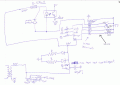
Ok, I just quickly drew up how I’m thinking of doing it without isolated 5V. Circuit is not finished yet, but this is what I’m thinking it could look like. See here. Don’t laugh, haha. I’m no da Vinci or anything.

The ITS716 High side driver claims it can handle inductive loads, so I suppose I don’t need any flywheeling diode for the solenoids.

I just added some zener diodes that could protect against overvoltage, and a capacitor to smooth any noise out.

There will be more screw terminals than shown in the drawing, but this is the concept.

I’m thinking of having one 0V plane for everything on the PCB. Earth ground will not be in this PCB. Earthing will have it’s own earth bar.

If you think the buttons need to be isolated
Here I could use some help in deciding. How do I decide if something needs to be isolated?

Thanks
MOD: added your image.

AA1 28-Nov-18 09.34.gif
 

tindel

Joined Sep 16, 2012
939
If you keep the high side driver and opto close to the micro, then you're probably okay without isolating the driver. Be sure to send power through adequately large cables to handle 0.5A with low R. Remember that the ground near your switch will not be 0V! it will be some voltage greater than 0V due to voltage drop in the cable. Keep your power returns separate from your digital returns until they get right up to the power supply to eliminate ground noise getting into the micro - again google "star grounding".

I like your R's going to the high side driver. There is probably some failure mode where the 24V can go out those pins. A decently large resistor (4.99k or so) will keep from frying your uC in such a failure.
 

ebp

Joined Feb 8, 2018
2,332
I see no reason to isolate the inputs to the high-side drivers, nor do I see any reason to added external resistors between the processor and the inputs to the driver. There are already nominally 4k resistors internal to the driver input. Those are quite impressive drivers, but they should be for the price.

Using optocouplers for the switch inputs probably is worthwhile due to the long cables and the possible large voltage difference between "0V" at the far end and processor circuit common. The optocouplers will also go a long way toward protecting the processor inputs from transients that might be induced on the long cables.

I have no idea what the resistors and zeners(?) adjacent to the 50 µF capacitor are supposed to do.

For such a small current, linear regulation from 24 V to 5 V is quite sensible. Be sure to have some amount of electrolytic capacitor (10 µF or more) near the input of the regulator. If you use only ceramic and apply the 24 V by switching the DC voltage rather than the AC input to the power supply you can sometimes get some nasty ringing between the inductance of connecting wires and a ceramic capacitor with the rapid rise of applied voltage. The ringing can be bad enough to exceed the absolute maximum input voltage rating of the regulator. A bulk capacitor will help prevent that problem.

Always try to keep your power wiring arranged in pairs where the "out" and "return" conductors are either twisted or otherwise closely fastened together. This allows the opposing magnetic fields to at least partially cancel, which reduces the inductance and helps prevent problems due to that inductance.
 

Thread Starter

jgrv

Joined Mar 2, 2018
36
Thank you guys, for your tips and feedback! :D

I added the zener there just as another safety feature in case of voltage spikes caused by whatever. But the bulk capacitor mentioned will probably handle this issue by itself? Unless the voltage remains high over time for some reason.

What are your views on this?
 

danadak

Joined Mar 10, 2018
4,057
When doing bypass applications not all C technologies equal -


Note some regulators have a MIN requirement on output cap
ESR for stability concerns. Read datasheet carefully.

Regards, Dana.
 

tindel

Joined Sep 16, 2012
939
There are already nominally 4k resistors internal to the driver input.
Good catch. I didn't look at the datasheet that closely. I just calculated that they should be on the order of 5k in case of failure to keep too large of current flowing into a standard uC output of ~25mA per pin or so. So I was in the same ballpark!

If I needed extremely high reliability I'd keep the external resistors for fear of those resistors being bypassed on the die. If you're doing some low reliability stuff, I'd agree with removing them.
 
Top