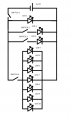
Is this circuit correct and will it work?

Thread Starter

sjwomersley

Joined Oct 4, 2023
8
Hi There,

I have designed the attached circuit and just want to sense check that it will work, or for someone to point out any errors I have made.

I know there are no resistors in this circuit, I am using MS Paint for diagrams and just couldn't be bothered drawing them all!

Am I correct in thinking:

1) Switch 1 controls power to the whole circuit and when closed LED 1 will act as a power indicator light.
2) Switches 2 & 3 control power to LEDs 2 & 3 independently, i.e. either can be on / off / both.
3) Switch 4 controls power to LEDs 4 - 10 and they will all be on / off at the same time.
4) The arrangement of Switch 4 and LEDs 4 - 10 is still a parallel circuit so the 5v power supply will be enough for this many LEDs?

Any help would be really appreciated, thanks in advance!

Sam
 

Attachments

Jon Chandler

Joined Jun 12, 2008
1,596
So in other words, assume resistors in all the places resistors should be, and assume they are of a reasonable value, and that there aren't resistors of the wrong values in the wrong places? And assume that you know that LEDs in parallel are not a good idea?

Plus some assumption about whether the unspecified power supply can supply whatever current the unknown resistors will require?

Making all those assumptions, the answer to the question "Will this work?" Is NO. The polarity is incorrect.

There are many easy-to-use tools to draw schematics available free. Try EasyEDA from JLCPCB. It will make it easy to draw LEDs and resistors so what you have in mind is clear.
 

Papabravo

Joined Feb 24, 2006
22,082
In order for an LED to illuminate, the anode (triangle part) must be at a higher potential than the cathode (line part). Each LED of a given type will have a forward voltage drop from the anode to the cathode when illuminated. The voltage drop across the diode plus the voltage drop across the current limiting resistor must equal the power supply voltage.
 

Thread Starter

sjwomersley

Joined Oct 4, 2023
8
So in other words, assume resistors in all the places resistors should be, and assume they are of a reasonable value, and that there aren't resistors of the wrong values in the wrong places? And assume that you know that LEDs in parallel are not a good idea?

Plus some assumption about whether the unspecified power supply can supply whatever current the unknown resistors will require?

Making all those assumptions, the answer to the question "Will this work?" Is NO. The polarity is incorrect.

There are many easy-to-use tools to draw schematics available free. Try EasyEDA from JLCPCB. It will make it easy to draw LEDs and resistors so what you have in mind is clear.
Thanks for your reply.

The diagram is very crude. I haven't done any electronics work for 15 years and didn't realise the power supply symbol is the wrong way around.

The power supply will be a USB power bank that can provide a maximum current of 5.4A.
 

Thread Starter

sjwomersley

Joined Oct 4, 2023
8
How many microseconds will the LEDs survive without you doing some essential calculations?
Not sure what makes you think I haven't done any essential calculations. Are you able to answer the questions in my post?

Mainly, I just want to sense check that - once essential calculations have been done and required resistors are included etc. - the circuit will work as intended.
 

BobTPH

Joined Jun 5, 2013
11,516
The problem is we don’t know what your idea of the required resistors is. I my would work (after reversing the battery) with what I know are the correct resistors, but I cannot say the same about what you might use.
 

eetech00

Joined Jun 8, 2013
4,705
Hi There,

I have designed the attached circuit and just want to sense check that it will work, or for someone to point out any errors I have made.
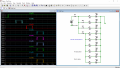
I've re-drawn your circuit based on previous comments (see below). The graph show the LED current as each switch is thrown in sequence.
For the comments below, I've made an assumption that the 5v power supply can provide the needed current to drive the entire circuit.

I know there are no resistors in this circuit, I am using MS Paint for diagrams and just couldn't be bothered drawing them all!

Am I correct in thinking:

1) Switch 1 controls power to the whole circuit and when closed LED 1 will act as a power indicator light.
Yes

2) Switches 2 & 3 control power to LEDs 2 & 3 independently, i.e. either can be on / off / both.
Yes.

3) Switch 4 controls power to LEDs 4 - 10 and they will all be on / off at the same time.
Yes

4) The arrangement of Switch 4 and LEDs 4 - 10 is still a parallel circuit so the 5v power supply will be enough for this many LEDs?
Yes. But its not the most efficient way to drive multiple LED's.
A more efficient way would be to connect them in series. Connect three strings of two LEDs in series each with a 100 ohm resistor.

Any help would be really appreciated, thanks in advance!

Sam
You re-drawn circuit is below.
You could reduce power requirements if LED4-LED10 were connected as three strings of two LEDs in series each with a 100 ohm resistor

Hope that helps...


1697652200045.png
 
Last edited:

Jon Chandler

Joined Jun 12, 2008
1,596
You could reduce power requirements if LED4-LED10 were connected as three strings of two LEDs in series each with a 100 ohm resistor
Only true if Vf of the LEDs is low enough. Since the LEDs color(s) haven't been specified, it may or may not work. Also, the resistor values may need to be changed, and not even all the same depending on the LED colors.
 

eetech00

Joined Jun 8, 2013
4,705
Only true if Vf of the LEDs is low enough. Since the LEDs color(s) haven't been specified, it may or may not work. Also, the resistor values may need to be changed, and not even all the same depending on the LED colors.
Yes, true, but for purposes of my comments, I specified the currents and voltages on the schematic.
 

Thread Starter

sjwomersley

Joined Oct 4, 2023
8
I've re-drawn your circuit based on previous comments (see below). The graph show the LED current as each switch is thrown in sequence.
For the comments below, I've made an assumption that the 5v power supply can provide the needed current to drive the entire circuit.


Yes


Yes.


Yes


Yes. But its not the most efficient way to drive multiple LED's.
A more efficient way would be to connect them in series. Connect three strings of two LEDs in series each with a 100 ohm resistor.


You re-drawn circuit is below.
You could reduce power requirements if LED4-LED10 were connected as three strings of two LEDs in series each with a 100 ohm resistor

Hope that helps...


View attachment 305265
Thank you so much for your advice and taking the time to redraw the circuit for me.

I understand what you mean about 3x strings of 2x LEDs but that won't work for me because they will be warm white LEDs with Vr of 3.1v each.
 

Audioguru again

Joined Oct 21, 2019
6,826
Did you consider that all LEDs have a range of forward voltage? Your white ones might have some at 2.7V and have others at 3.5V and you get an assortment of voltages unless you buy hundreds then test and sort them?

Fed with resistors then some LEDs will appear bright and others will be dim. Or you can feed them with accurate current sources instead of resistors.
 

eetech00

Joined Jun 8, 2013
4,705
Thank you so much for your advice and taking the time to redraw the circuit for me.

I understand what you mean about 3x strings of 2x LEDs but that won't work for me because they will be warm white LEDs with Vr of 3.1v each.
The forward voltage is important, but so is the forward current. As mentioned in post #12, Vf/If varies and can be adjusted as needed. Ideally, a constant current power supply, of a higher voltage, driving all six LEDs (LED4-9) in series would be most efficient. Can you post an LED part number so we can review the IV curve?
 
Top