is this an ok circuit?

Thread Starter

Alext

Joined Jan 13, 2018
2
Hello all!

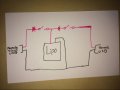
im trying to make a little altoid tin charger mark 2. my mark one was just a 9v battery with a lead to a taken-apart car charger. this time around i want to make a battery with a lipo instead and also an input so i can charge the lipo. Before you all barrage me about lipos, i have used and treated lipos before so im not a complete newb in that field. My question today is whether or not this circuit is a sound one: (pink=positive, black=negative)
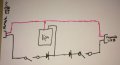
mk2_Alext.jpg
 

ElectricSpidey

Joined Dec 2, 2017
3,334
The simple answer is probably no, because lipo batteries need a very precise charging scheme.

Now if that square called "lipo" also contains all of the current limiting and voltage detecting circuits...etc...then could be ok.
 

spinnaker

Joined Oct 29, 2009
7,830
Not safe. LiPo batteries can catch fire or explode when abused.

You need to use a proper charging circuit.

IMHO, homemade chargers for batteries like this should be on the list of forbidden subjects to discuss. Screw up on a transformerless project and you kill yourself. Screw up on a lipo battery charger and you can kill your whole family.
 

OBW0549

Joined Mar 2, 2015
3,566
Not safe. LiPo batteries can catch fire or explode when abused. You need to use a proper charging circuit.
IMHO, homemade chargers for batteries like this should be on the list of forbidden subjects to discuss. Screw up on a transformerless project and you kill yourself. Screw up on a lipo battery charger and you can kill your whole family.
I agree with both these posts, 1000%. Lithium batteries in the hands of someone who is not completely competent to handle them are an invitation to disaster.
 

spinnaker

Joined Oct 29, 2009
7,830
Yea, don’t instruct people of the dangers of what they are thinking about doing…just turn your back and wash your hands instead.

o_O

Uh telling someone what they are trying to do is not turning your back and washing your hands. Do you expect someone to go into the physics of what happens if they stick their hands into a flame or would you just tell them not to stick their hands into a flame or they will get burned and hurt?

Not warning them is turning your back. That is NOT what happened here.

And I think the dangers of lipo batteries are very well know. Just look at the news. It isn't hard to figure out.
 

AnalogKid

Joined Aug 1, 2013
12,126
My question today is whether or not this circuit is a sound one:
No. A rechargeable LiPo battery is not a 5 V device. It cannot be charged by connecting it to a 5 V source. Destroyed, yes; charged, no.

Also, a 3.6 V (or 7.2 V, or whatever) battery cannot power a 5.0 V USB connection. 3.6 is less than 5.0. That you seem to have missed that most basic concept means you are not as up on batteries as you think you are.

ak
 
There are small, inexpensive circuit boards which are made to take USB power and charge a single LIPO cell. If that is sufficient voltage for the T.S purpose then yes, it can be done. Probably the diode and switch on the input are both unnecessary and I would guess (depending on the use) the switch on the output can be eliminated if the Altoids box is only plugged in when it is in use.
 

BobaMosfet

Joined Jul 1, 2009
2,211
Yea, don’t instruct people of the dangers of what they are thinking about doing…just turn your back and wash your hands instead.
This statement is irresponsible. The people most likely needing the warning are the ones that are admittedly the least knowledgeable in a given subject. Batteries and battery charging is arguably an entire field of study within electronics, and should be treated with that level of caution and respect. In order to charge batteries properly you need a great deal more advanced knowledge than most basic, or even arduino-type hobbyists know. Case size and dimension, thermal characteristics, voltage and current characteristics are just some of the things that must be understood and monitored for charging various types of batteries.
 
This statement is irresponsible. The people most likely needing the warning are the ones that are admittedly the least knowledgeable in a given subject. Batteries and battery charging is arguably an entire field of study within electronics, and should be treated with that level of caution and respect. In order to charge batteries properly you need a great deal more advanced knowledge than most basic, or even arduino-type hobbyists know. Case size and dimension, thermal characteristics, voltage and current characteristics are just some of the things that must be understood and monitored for charging various types of batteries.
www.addicore.com/TP4056-Charger-and-Protection-Module-p/ad310.htm
 

ElectricSpidey

Joined Dec 2, 2017
3,334
No…BobaMosfet, you are taking the comment out of context. It is in fact the result of the statement that is irresponsible.

But thanks for making my point.
 

-live wire-

Joined Dec 22, 2017
959
Your best option is, if using a LiPo, to just get a commercial charge/protect/boost circuit. You do not want to deal with flaming lithium chunks when you try to charge your appliance. They need a ton of complicated and annoying things to charge properly. Unless you are really an expert, as I said before, just get a commercial charge/protect/boost circuit.
 
This circuit won't work for charging or discharging. Sadly, batteries can't be charged by putting them in parallel with a power supply (technically you could for some chemistries, but you would have to monitor the voltage and current carefully and adjust them as the battery charges, but it's much easier to have circuitry do it instead). The charging circuit you have set up would probably make the battery explode. Lithium based batteries (Lithium Ion and Lithium Polymer) charge to at most 4.2 to 4.4 volts. Charging them to a higher voltage would probably end badly. The second problem is that the voltage of a single lithium battery isn't enough to charge a USB device. They need 5 volts. I would suggest using a TP4056 circuit to charge the battery. They are dirt cheap and easy to use. I used one in an electric screwdriver I modified to use an 18650 instead of NiCD batteries and it works quite well. The TP4056 still pits out insufficient voltage for the USB, so I would suggest a 3.7 to 5 volt boost converter module. Many of them come with a USB port attached to make life simpler. Here are some links to the TP4056 and a boost converter module.
TP4056 module
https://www.amazon.com/Makerfocus-C...pID=517vcWLccGL&preST=_SY300_QL70_&dpSrc=srch
Boost module
https://www.amazon.com/DZS-Elec-2-5...pID=41PdQLizOXL&preST=_SY300_QL70_&dpSrc=srch
Here is a board that has both built into one. I haven't used this one, but I thought it might be good to mention it as well.
https://www.amazon.com/Onyehn-Lithi...sr=8-7&keywords=3.7+to+5+volt+boost+converter
Best of luck! :)
 
Top