Except that the AC meter we are talking about is either a moving iron meter, which doesn't care about the polarity of the current, or a moving coil meter with a rectifier. Either way it will only indicate upwards.
Except that the AC meter we are talking about is either a moving iron meter, which doesn't care about the polarity of the current, or a moving coil meter with a rectifier. Either way it will only indicate upwards.
Moving iron: The magnetic field from a fixed coil attracts a piece of iron attached to the pointer.
Moving coil: The pointer is attached to a coil which moves in a fixed magnetic field.
Moving iron: The magnetic field from a fixed coil attracts a piece of iron attached to the pointer.
Moving coil: The pointer is attached to a coil which moves in a fixed magnetic field.
No. It only affects the way the meter can use an AC input, and that the moving iron meters generally non-linear scales while moving coil meters generally have linear scales.
Moving iron: The magnetic field from a fixed coil attracts a piece of iron attached to the pointer.
Moving coil: The pointer is attached to a coil which moves in a fixed magnetic field.
Isn't it a Moving Iron Vane? There are really only three common meter movements. This pretty much covers it. In short from the link:
Meter Movement Summary:
D’Arsonval - A DC moving coil movement where the moving coil is suspended between the poles of a permanent magnet restrained by helical springs, and the measured current flowing through the moving coil produces a torque on the attached pointer proportional to the current.
Electrodynamometer - The moving coil and attached pointer are suspended between and connected in series with the two stationary field coils so that the same current flows through each. A measured current flowing through the three coils in either direction causes a magnetic repulsion between the field coils and the moving coil. The magnetic repulsion exerts a force against the spring and provides a measurement of either DC or AC current.
Moving iron vane - The moving iron vane meter operates on the principle of magnetic repulsion between like poles. The measured current flows through a field coil which induces a like magnetic field into a fixed and moving vane causing the moving vane to deflect a pointer in proportion to the current or voltage applied to the coil.
No. It only affects the way the meter can use an AC input, and that the moving iron meters generally non-linear scales while moving coil meters generally have linear scales.
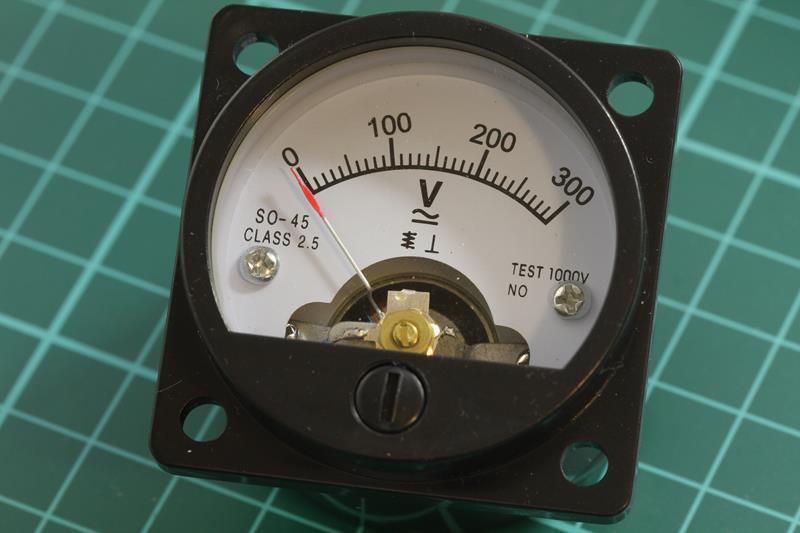
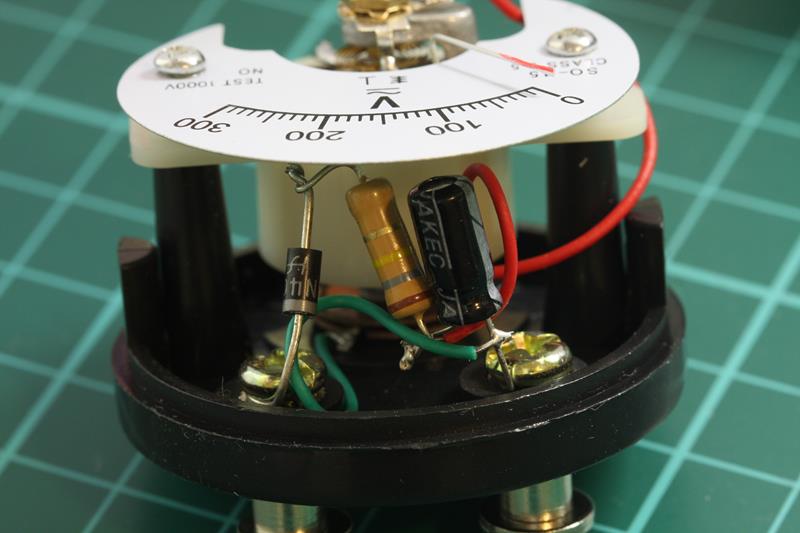
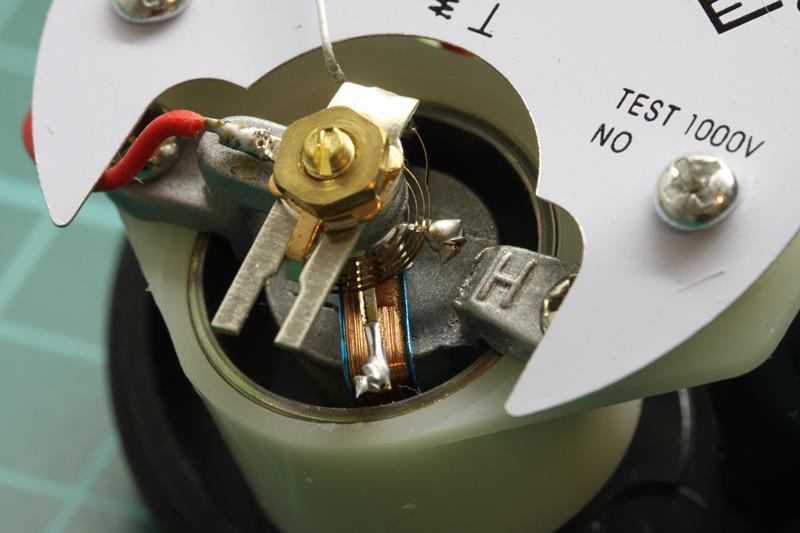
You are not alone in the universe. Someone else ordered what looks to be the same meter and took one apart with pictures. Have a look here. That looks to be your meter. Desopite conversation in the thread the meter movement looks to be a PMMC (Permanent Magnet Moving Coil) type which would agree with the guys who made it. Shenzhen Hanlongjia Technology Co., Ltd. it would seem is the manufacturer. Within the descriptions they mention "Brand New 300V AC moving coil meter". The comments from the autopsy reveal "A diode, a 180k resistor and a 47uF cap (only 25V rating!?)". The author concludes with:
Anyway, not being a particularly patient guy, I started messing with one. I hooked up 12V DC and the needle budged a bit, so I dropped the voltage to 5V, took out the 180k resistor, hooked up my decade resistor box and ended up with 5k5 resistor as being adequate for the job. Not having one at hand, a 4k7 + 1k combo turned out to be a suitable replacement.
Measuring the current of the modified meter, it only draws 0,7mA at 5V (full deflection), so that's good news.
A simple PWM sketch shows linear behavior.
All in all, I find these quite promising. Disassembly is easy (only two screws holding the case together), modification is trivial and cheap. I think I might like them!
Apparently the goal was to PWM the movement using an Arduino so what you have in mind shows some promise. Should be an interesting project. While anything I ever did was by hand decades ago there is some pretty cool software out there for drawing meter faces. Here is an example: The Windows ® programs for drawing analog meter scales. A Google of Meter Face Software should bring up plenty of hits.
The one disassembled is certainly a moving coil meter. If you look at the pictures of the dial you can see that between 0 and 100 and between 100 and 200 there are ten subdivisions with a longer mark halfway between.
If you look at the dial of the meter proposed in this thread you will see only six subdivisions between 0 and 100, but ten between 100 and 200 and those subdivisions look to be equal sizes. This says that the meter is not linear and that suggests that it is a moving iron type.
As already stated, the meter type doesn't cause the TS any problem.
Note that the meter that was disassembled is not the same as the one spinnaker posted.
spinnaker's meter:
Meter disassembled and described in the arduino forum:
spinnaker's meter has a non-linear scale.
The arduino meter has a linear scale.
Everything that AlbertHall stated about a moving iron meter is correct. For your benefit, I disassembled a similar 100VAC meter and found a single 110kΩ resistor in series with the meter. The meter works fine with either AC or DC.
You should have no problem with either type of meter for your application.

 Facebook
 Google
 GitHub
 Linkedin