Is this actually a 0-300VAC meter?

BR-549

Joined Sep 22, 2013
4,931
Ok...just want to get this straight.

1. We can not tell the difference between a moving coil and a moving iron coil.....

a. by the scale. Because the scale of moving iron can be made linear by shaping the inner cup. Although there was a difference in this example.

b. or by the scale symbols. Both the iron coil and moving coil had the same symbols in this example.

2. The only way to make sure is by eyeballing the movement.

And I would assume that the moving iron can take much more abuse than the moving coil. (other than bending the needle).
 

GopherT

Joined Nov 23, 2012
8,009
Ok...just want to get this straight.

1. We can not tell the difference between a moving coil and a moving iron coil.....

a. by the scale. Because the scale of moving iron can be made linear by shaping the inner cup. Although there was a difference in this example.

b. or by the scale symbols. Both the iron coil and moving coil had the same symbols in this example.

2. The only way to make sure is by eyeballing the movement.

And I would assume that the moving iron can take much more abuse than the moving coil. (other than bending the needle).
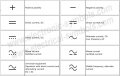
The two meters in post 35 show one with a ~ symbol (AC) and the other shows a ~ symbols with a bar below it (means AC OR DC).
 

AlbertHall

Joined Jun 4, 2014
12,628
1a. The moving coil meters I have come across have linear scales. The moving iron meters I have come across have non-linear scales. YMMV
1b. The scale symbols are different. Look immediately under the 'V'. I have no idea whether this difference is significant.
2. Looking through the front will do the job, but presumably the manufacturers know what they are making.

I would agree that moving iron movements are likely to be more electrically robust but the mechanical robustness is likely to be similar.
 

BR-549

Joined Sep 22, 2013
4,931
Alrighty.......thanks to all. I wonder what the vertical resistor symbol means.......if that is what that is. Perhaps a resistor in series? a horizontal symbol...a shunt?

And what of that upside down T?
 

Thread Starter

spinnaker

Joined Oct 29, 2009
7,830
And what of that upside down T?[/QU[/QUOTE]
I wonder if that T is to "mount meter square and level"?

It would make more sense to mount the housing level. I doubt that T is going to be much of an aide to mount level, it is so small and far from the edge.
 
For those that never played with "naked" analog meters, the most important parameter is the internal series resistance, but you have to measure it "INDIRECTLY'. Well maybe not have to, but its the easiest.

Back in the day when they were usually 50uA, 100 uA and 1 mA FS were common and even -1-to 0 to +1 mA

So, let's assume a linear scale and a naked meter. No junk inside.

So, you find a resistor/pot to get an idea what the range is. Around ~~50 uA is probably a good starting place.

Now the idea is once you have a resistor or resistor + potentiometer that can move the meter to 1/2 deflection with a stable voltage source, do so.

Then disconnect the meter and measure the resistance of the series network. This is the internal resistance of the meter.

With that parameter, you can design voltmeters and current meters as you like. A series resistor makes a voltmeter and a parallel resistor makes an ammeter.

Asides:
Not that it would be workable, but the GM gauge steppers MIGHT be able to be retrofitted. I doubt it, but it's a thought.

I do have an AC meter, in use, whose scale is very non-linear.
 

AlbertHall

Joined Jun 4, 2014
12,628

Thread Starter

spinnaker

Joined Oct 29, 2009
7,830
Anyone else know of a good source to show how to measure internal resistance of meters, like this site except having pictures? Looks like a really nice page but photos would help.
 
That's not going to work.
There is a reasonably good method here: http://www.me.utexas.edu/~me244L/labs/analogmeter/ex1.html
It worked when I was 10 or so years old some 50 years ago, I don;t see any reason why it won't work now. I used the method to build a thermister thermometer and won the grand prize in the grade school science fair (Got the grand prize 3 years in row).

Think about it: Vm+Vr=Im/2*(R1)+Im/2*Rm; V=Vm+Vr When R1=Rm V across Vm and v across R1 has to be the same, hence R1=Rm

It works for any value of V. Im = Imax of the meter.
 
Top