Hysteresis will also prevent dithering or oscillations at the trip point due to noise.
This hysteresis (small amount of positive feedback) can be generated by connecting a large value resistor (start with about 1 megohm) between the Ref input of the TLV431 and the drain of the MOSFET.
Note that this will change the trip point by a small amount and may require a different value for R2 or R3 to get back to the desired value.
Unless the battery is really large, I would rather use a lot higher (10x) values for R2,R3 so that you don´t unnecesarily drain it. Also a capacitor parallel to R3, say 100nF, would be a good idea so that it does not react on noise in the battery voltage.
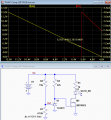
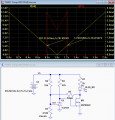
In my simulations a 1 megohm resistor from the MOSFET drain to the TLV431 Ref input, reduced the trip point by about 60mV going down.
In the simulation below the LED turns on at about 5.70V when the voltage is dropping and 5.76V when the voltage is rising for a 60mV hysteresis.
It's basically a voltage divider from the MOSFET drain voltage through the feedback resistor to the parallel resistance of R2 and R3, which increases the voltage slightly at the Ref junction when the MOSFET is off.
This is then reflected as a change in the trip voltage.
But as kubeek noted, 5.75V is way too low a voltage to discharge a 12V battery, if you want it to survive very long.
The current into the reference input is about 0.1 to 0.5 uA. This current flowing through the resistor voltage divider will be an error in the trip point. Depends on how much error is allowed. It will work but with some error.
There may be some "free" hysteresis. Turning on the LED increases the load on the battery and may drop the voltage down. No telling without more info on the battery.
BUT, be careful when turning off U1. For a short time, before the LED turns on, the load decreases and the battery voltage could go back up causing U1 to chatter on and off. I would definitely add hysteresis to prevent funny business.
Adding a series resistance to the DC source in the simulation could be instructive. This will simulate the internal resistance of the dying battery.
One more caution. With the 47K shown, U1 is operating very close to the minimum cathode operating current.
If you use those values, the 0.5μA maximum reference input current would cause the effective reference voltage to change by 1.6mV or 0.13%, thus negligible for this application.
No.
Where did you come up with that resistor?
The hysteresis resistor goes from MOSFET drain to the TLV431 ref input.
And a smaller resistor value increases the hysteresis.
A lower value for the resistor will increase the hysteresis and make any funny business less likely. IMHO, there is not enough information to determine the best value for the resistor (amount of hysteresis). The simulation above is a good illustration of the concept.
My comment is a caution that the battery characteristics should be taken into account with this circuit and the low operating current of the TLV431 is close to the minimum where unexpected things can happen.
If you use those values, the 0.5μA maximum reference input current would cause the effective reference voltage to change by 1.6mV or 0.13%, thus negligible for this application.
A small quibble. 0.5uA through 150K in parallel with 41K is about 16 mV. I agree, however, it is small and negligible. But, he asked about the effect of the reference input current.
It seems a very low power comparator such as an LTC6703-3 or LTC1998with a built-in reference and hysteresis would consume a lot less power than this circuit. One concern, for example, is the TLV431T cathode voltage of 1.2 volts may not completely turn off the MOSFET and there could be considerable leakage through the LED. Hundreds of uA or more. The comparator just seems like a lot less power and tighter specs. If power consumption is not important, "Never mind". The LED can also be driven directly by the comparator. No MOSFET needed.
A small quibble. 0.5uA through 150K in parallel with 41K is about 16 mV. I agree, however, it is small and negligible. But, he asked about the effect of the reference input current.
True, but that calculation is not pertinent to the question at hand.
I calculated the voltage change at the Ref input for the 0.5μA reference current.
This voltage change is the 0.5μA through the parallel resistance or the 150kΩ and the 41.2k, which gives 1.6mV.
And that is indeed the effect of the reference input current.
Why do you think it's not?
True, but that calculation is not pertinent to the question at hand.
I calculated the voltage change at the Ref input for the 0.5μA reference current.
This voltage change is the 0.5μA through the parallel resistance or the 150kΩ and the 41.2k, which gives 1.6mV.
And that is indeed the effect of the reference input current.
Why do you think it's not?
Is there another vendor which has a part the same features of a LTC6703-3 or would the TLV431T work better with a BJT instead? Since 800uA leakage is enough to consider a red led as lit even a bit less would be similar.
The TLV431 should work fine, but if there's a problem with the MOSFET leakage, you can add a forward biased diode or two in series with the MOSFET gate with a resistor from the gate to ground.
A BJT has an even lower turn-on voltage so that wouldn't help.
How do you figure?
The TL431 circuit only requires a few tenths of a mA.
The cathode voltage is less then that when the TLV431 Ref voltage is about 1.25V and it is fully on.
This is not explicitly shown in the data sheet.
It can, but that will give an inverted operation with the LED on when the voltage is above the trigger level.
RE: cathode voltage less than 1.2 volts. From the TI data sheet:
"8.4.1 Open Loop (Comparator)
When the cathode/output voltage or current of TLV431 is not being fed back to the reference/input pin in any form, this device is operating in open loop. With proper cathode current (Ika) applied to this device, TLV431 will have the characteristics shown in Figure 6."
Figure 6 shows 1.2 volts.
I could be interpreting the data sheet incorrectly. What does your simulation show?
RE: lower power
The LTC6703 has a supply current of around 10 uA. More than 10x less than the TLV431.
RE: Inverted operation
The LTC6703 has two versions with opposite polarities. Chose the one needed. Drive the LED directly. Max output current is 60 mA.

 Facebook
 Google
 GitHub
 Linkedin